


The Cover Uncovered: Yoko Ono’s elegy to John Lennon on ‘Season of Glass’

Yoko Ono’s cultural impact stretches way beyond the shadow cast by her connection to The Beatles. She’s an artist in every sense, and her avant-garde ways helped revolutionise her late husband’s output. When it comes to her expressive musical exploits, some might find Ono’s tendency to caterwaul quite polarising. To others, that’s the cathartic point of edgy music in the first place.
One of her most revered albums is her fifth, 1981’s Season of Glass. The project arrived as a body of work that is profoundly touching at points. The poignant album is coloured by the murder of her husband, John Lennon, in December of the previous year, only six months before its release.
Boasting moments such as ‘No, No, No’, ‘Goodbye Sadness’, and ‘I Don’t Know Why’, it’s easy to understand why the opus is thought of as one of her best. The album became her highest-charting record to date. Toeing the line between irony and sincerity, Ono delivered a masterclass. She lets listeners in but doesn’t reveal all, forcing them to read between the lines.
Notably, Ono directly approaches her husband’s tragic death in some of the pieces, with the likes of ‘Goodbye Sadness’ and ‘I Don’t Know Why’, two prominent examples. In the latter, she sings: “Out across the endless sea / I would die in ecstasy / But I’ll be a bag of bones / Driving down the road alone”. In what is perhaps the most touching moment on the album, Ono and Lennon’s young song, Sean, appears on ‘Even When You’re Far Away’, recounting a story his father would tell him.
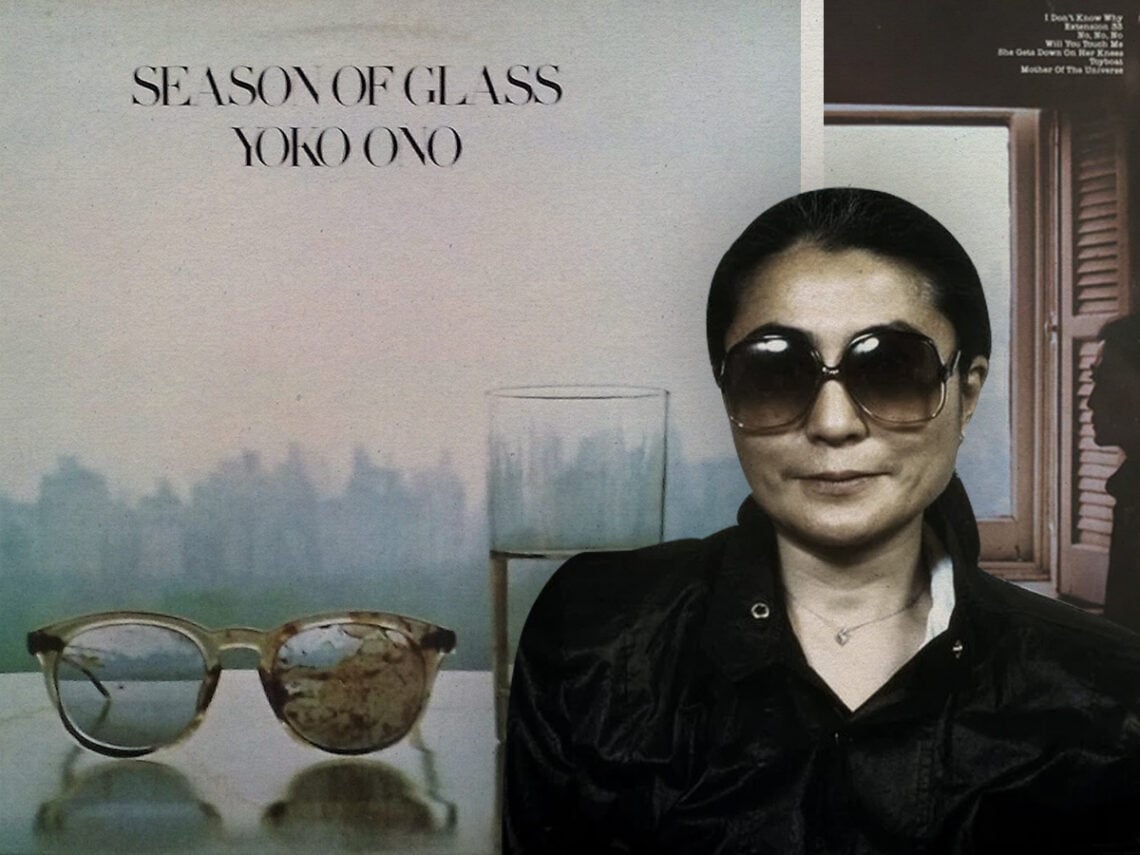
The great emotion contained in Season of the Glass is augmented by the stark implications of the cover art. Somewhat controversially, it features the blood-stained glasses that John Lennon wore on the day he was killed. They are sat next to a half-empty glass of water, with New York’s Central Park in the background.
Despite the record company having reservations about the cover image, Yoko held firm, as she felt that the glasses were the only thing of John that remained, in a literal and figurative sense. His bloody spectacles were the physical remainder of him, while the half-empty glass of water was his spirit, with his fairly cynical ethos remaining at the forefront of her mind.
Ono explained: “I used a photo I took of John’s blood-stained glasses on the record cover. The record company called me and said the record shops would not stock the record unless I changed the cover. I didn’t understand it. Why? They said it was in bad taste.”
Ono concluded: “I felt like a person soaked in blood coming into a living room full of people and reporting that my husband was dead, his body was taken away, and the pair of glasses were the only thing I had managed to salvage – and people looking at me saying it was in bad taste to show the glasses to them. ‘I’m not changing the cover. This is what John is now,’ I said.”

