


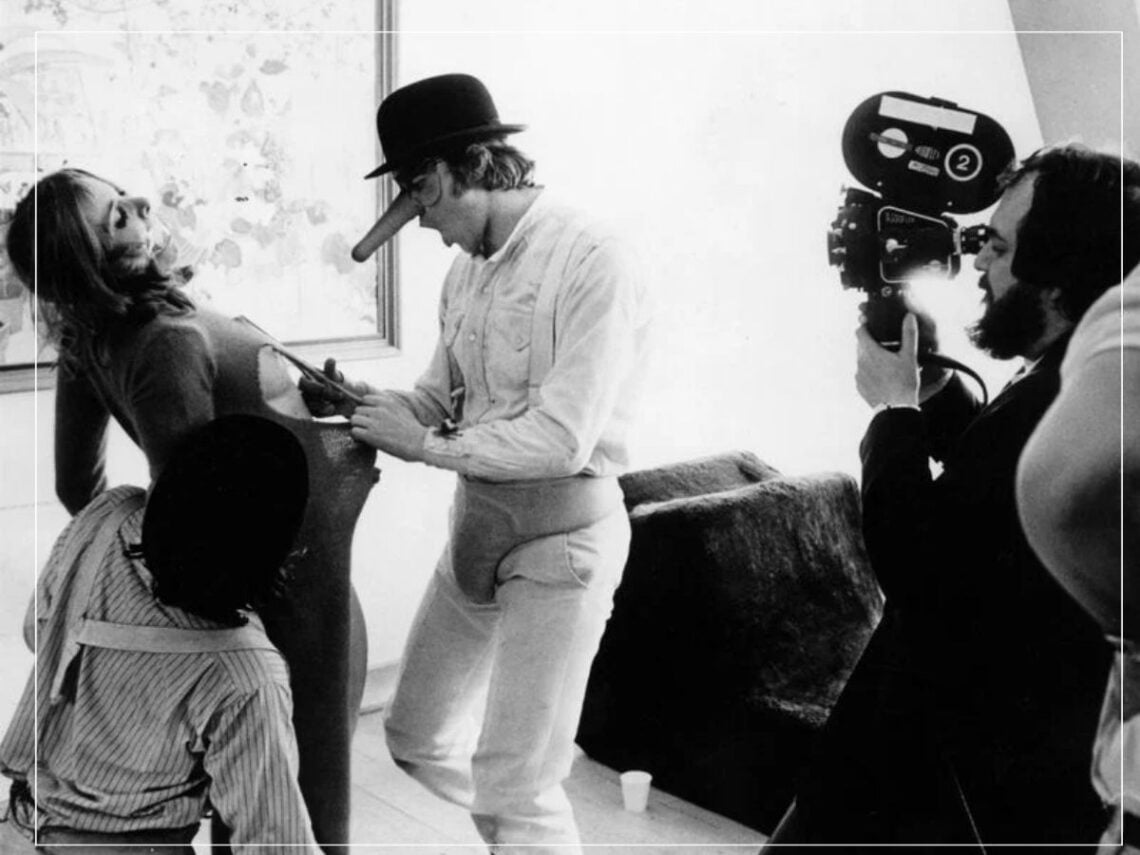
What is a “droog” in ‘A Clockwork Orange’?

“Does God want goodness or the choice of goodness? Is a man who chooses to be bad perhaps in some way better than a man who has the good imposed upon him?” Anthony Burgess asks in his seminal novel, A Clockwork Orange.
The movie and book alike present a terrifying version of humanity’s future (or perhaps an alternative version of our present) like few other movies could. The first-person narrative perspective of the film, retained by writer-director Stanley Kubrick from Anthony Burgess’ original novel, is key to the chilling effect it has on the viewer.
The central character, Alex DeLarge, is a reprehensible young criminal prone to acts of extreme thuggery and sexual violence. At the same time, we bear witness to Alex’s suffering as he’s forced to shed his violent tendencies through a form of psychological torture known in the story as the Ludovico method.
Throughout Burgess’ original novel and the movie, Alex narrates and converses with his friends and others in a form of cant known as Nadsat. Burgess invented this way of speaking to help flesh out the world in which the young protagonist and his gang of thugs exist.
Perhaps the Nadsat word used most often throughout the film version of A Clockwork Orange is “droog”, a term Alex reserves for his fellow gang members, Dim, Georgie and Pete, as well as himself. For example, in a scene where he’s visited by the others, he tells them, “As your droog and leader, I’m entitled to know what goes on, eh?” Later in the same scene, he uses a diminutive version of the word, calling them “my little droogies”.
But what is a bloody “droog”, then?
The word “droog” simply means “friend” in Nadsat and is something akin to a comrade-in-arms in Alex’s subculture of juvenile delinquency. Only members of Alex’s gang call one another “droog”, but this convention continues even after Dim and Georgie join the police. Even as a police officer, Dim continues to call Alex “droog”, perhaps in a mocking sense.
The word originates from the Russian noun “drug” (which has the same meaning and pronunciation) and is one of many words in Burgess’ novel based on the Russian language. As well as its Russian origin, however, “droog” also has its roots in the Welsh word “drwg”, which translates as “evil”. As such, the two meanings combine to perfectly encapsulate what these petty young thugs mean to each other.
They’re well aware of the criminality in their behaviour, and the etymological significance of the affectionate term they use for one another only accentuates the sense that they really mean harm. The guttural “oo” and “g” sounds of “droog” even remind us of the words “thug” and “hoodlum” in English when we hear it.
But as with everything in the book and film, a ‘droog’ is also merely a melodic and lyrical quip, used for how it sounds as much as anything else. That element is clearly defined in this quote, for instance: “I said, smiling very wide and droogie: ‘Well, if it isn’t fat stinking billygoat Billyboy in poison. How art thou, thou globby bottle of cheap stinking chip-oil? Come and get one in the yarbles, if you have any yarbles, you eunuch jelly, thou.’ And then we started.”
In many ways, that verges on nonsensical. But all the same, you’re left with an impression of what a droog is and how something can be droogie. Tying in with the themes of A Clockwork Orange, maybe impressions are more important than anything concrete and tangibly defined? Droogs are an ideal.
It’s very clear the point Burgess and Kubrick are trying to make with their frequent deployment of this word. Alex and his gang of youths are violent criminals, and proud of it.
