


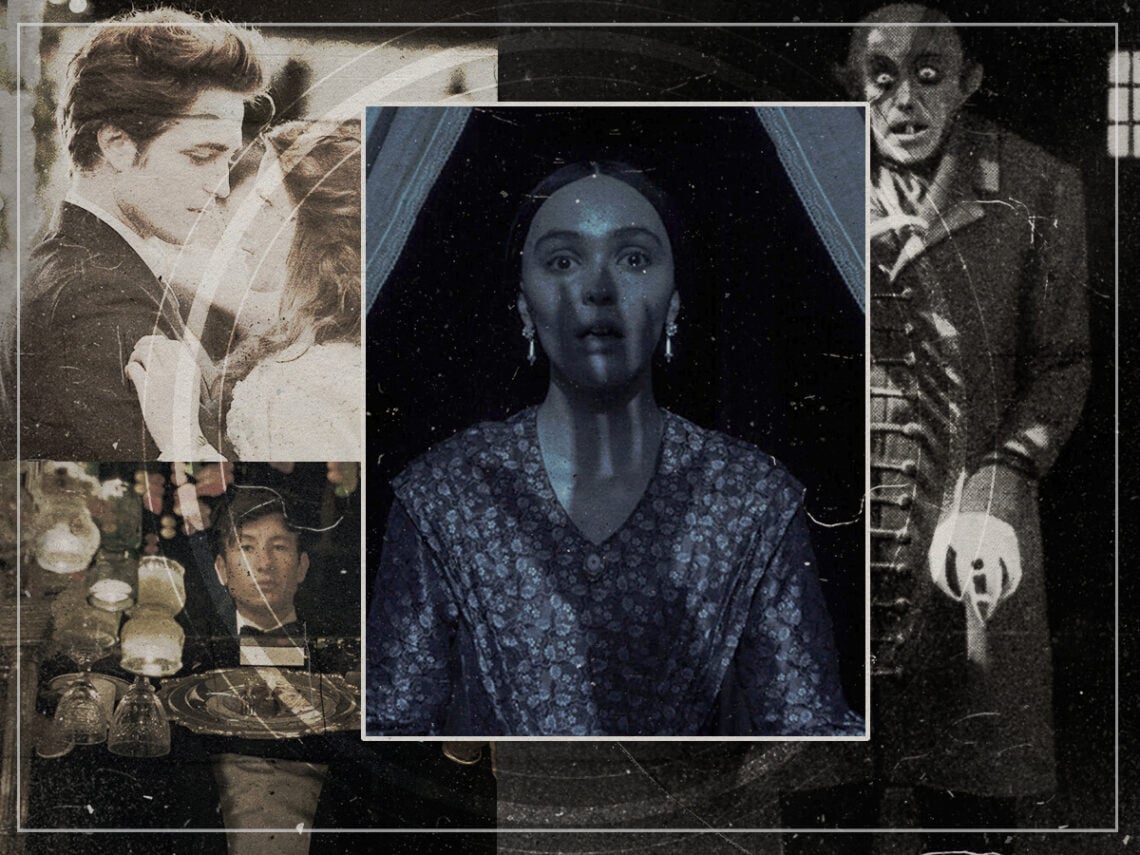
From ‘Twilight’ to ‘Nosferatu’: what does our ongoing fascination with vampires mean?

From the earliest days of cinema, vampires have held a prominent place among the pantheon of movie monsters. While the term itself has roots dating back to 1734, the essence of vampirism has been woven through folklore across diverse cultures for centuries. However, Bram Stoker’s monumental 1897 novel, Dracula, truly solidified the vampire’s position in popular culture, forever shaping our perception of these immortal creatures.
Drawing inspiration from earlier literary works like Camilla and The Vampyre, Stoker’s tale introduced a captivating and enduring portrayal of the bloodthirsty predator, fundamentally altering the trajectory of vampire mythology in a way that continues to influence and captivate audiences to this day. Although contemporary versions of the iconic vampire are often drenched in camp or comedic tropes, the original was depicted as a suave yet menacing aristocrat from Transylvania.
Physically, Stoker’s Dracula exuded an aura of eerie magnetism, possessing an ageless quality and an uncanny ability to exert influence over those around him. Possessing great strength and charisma, able to shape-shift into various forms, control animals, and manipulate the minds of his victims, Stoker’s characterisation was a complex, sinister figure, embodying both charm and terror, setting the template for the modern vampire archetype.
On paper, this may seem like a description that fits many modern representations of the vampire, but the overall transformation of vampires in cinema throughout the century is a stark departure from the trajectory of any other movie creature. However, this observation poses more questions than it answers: with political shifts and evolving audience preferences, why are we still endeared to the vampire trope?
“I’m the world’s most dangerous predator,” Edward Cullen tells Bella Swan in Twilight. “Everything about me invites you in: my voice, my face, even my smell. I’m designed to kill.” Instead of running for the hills, Bella insists that she doesn’t care, even after he tells her that he’s killed people before. It’s hilarious, but equally, there’s an intriguing appeal to someone so dangerous yet troubled at the same time.
Vampires, no matter how hard we try, or unless you’re Anne Rice, will always be rooted in camp stylism. By nature, audiences will always come back to them because they appeal to so many different aspects of internal and external tastes — they’re complex enough to provide comfort during times of cultural and societal turmoil yet simple enough to entertain and adhere to the escapist tendencies that we all crave.
Regardless of genre, these figures also often represent fears of the unknown, societal change, desire for power or control, and the struggle between good and evil. During times of societal upheaval, the vampire’s ability to reflect these uncertainties and offer an escape or exploration of these anxieties becomes particularly appealing.
In 1922, F. W. Murnau dropped the movie that would forevermore change the game. Nosferatu, based on Stoker’s novel, was a silent German Expressionist horror film which tells the story of Count Orlok, a vampire who travels from his castle in Transylvania to the German city of Wisborg, preying upon its inhabitants. More than a mere horror film, Nosferatu delves into the depths of the human psyche, exploring existential fears, the fragility of life, and the duality of human nature.
In the case of Nosferatu, Count Orlok represents societal paranoia as the plague spreads and fear grips the town; the characters grapple with a sense of isolation and helplessness, emphasising the terror of being trapped in an increasingly hostile world. This is a concern that can be applied across various eras and historical time stamps. Interestingly, however, the nature of Nosferatu still lends itself to the aforementioned camp tropes simply by adhering to (or, in this case, revolutionising) the gothic aesthetic in film.
That’s not to say that vampires in film, TV, and even music always subscribe to the campy style. For instance, these creatures are multifaceted in Buffy the Vampire Slayer, each boasting unique personalities and traits. Within the series, these vampires embody our enduring fascination with them and serve as a study of the essence of vampirism itself. In this scenario, as well as in others, the portrayal of vampires can encompass both a campy presentation and a profound layer of meaning.
In Emerald Fennell’s recent release Saltburn – a film that has no hint of any traditional sense of vampire or vampirism whatsoever – the concept is still very much present in the way that Barry Keoghan’s Oliver latches onto his wealthy new friend, Jacob Elordi’s Felix, whom he meets at Oxford University. In this context, vampirism provides a tool for “the fetishisation of beauty“, a theme which has recurrently surfaced in various movies, often delving into the realms of obsession.
In essence, our enduring captivation with vampires remains an enigma, yet numerous aspects and realities suggest its knack for becoming an ideal source of voyeuristic pleasure. Whether embracing the traditional image of fangs and capes or the less conspicuous human-like version, it’s difficult to envision a time when vampires won’t be either lurking in the shadows or strolling among us in the vast expanse of cinema.
