


What does ‘No Face’ represent in ‘Spirited Away’?

One of the greatest animated movies ever made, the recipient of the second-ever Academy Award for ‘Best Animated Feature’, and the only winner in the category’s history that wasn’t backed by a major Hollywood studio until he repeated the trick himself with The Boy and the Heron, Hayao Miyazaki’s Spirited Away endures as a two-dimensional masterpiece.
The animated fantasy follows ten-year-old Chihiro and her parents, who find themselves stumbling upon an empty amusement park that isn’t quite as abandoned as it first seems. When her parents are mysteriously transformed into giant pigs, Chihiro makes the acquaintance of Haku and discovers the park is a place where supernatural entities retreat when they need a break from the earthly realm.
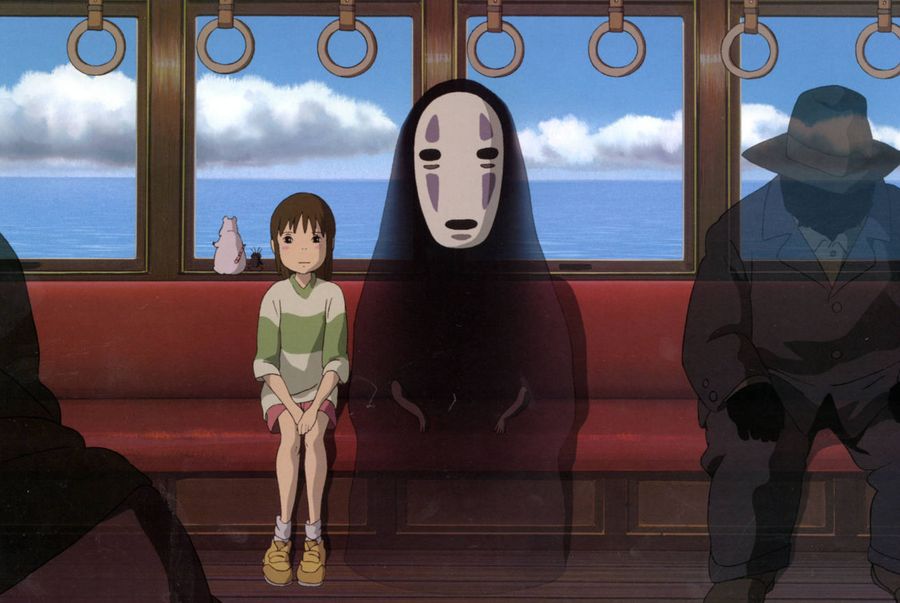
As a result, Chihiro is obligated to become part of the staff and work until she’s deemed worthy of being freed and reunited with her parents. Along the way, she encounters the spectral No-Face – also known as Kaonashi – who would swiftly go on to become one of the most popular and iconic characters in 21st-century animation.
Kaonashi literally translates as ‘Faceless’, which is about an apt summation as anybody could hope to find. Not only does the creature wear a mask to display that it doesn’t have a face of its own, but it develops new aspects of its personality and formulates fresh opinions based on the people it both encounters and consumes. This being Miyazaki, though, the meaning goes much deeper than that.
No Face represents the people who have no identity of their own or a true sense of self, and instead allow themselves to be shaped and dictated by their surroundings. The creature is semi-transparent, wears an undistinguishing mask, and uses its preferred method of hitting its calorie count to try and forge something resembling a personality of its own to hammer those notions home.
That sentiment applies to Chihiro, too, who finds herself completely lost and utterly alone as a young child forcibly separated from her parents and forced to survive in a world she not only doesn’t understand but can’t comprehend at first. No Face is illustrative of how the loneliness and abandonment the protagonist feels being left to fend for herself, with the creature being an outcast for so long that it’s hesitant at even being invited into the teahouse at Chihiro’s request.
After displaying some monstrous tendencies, No Face soon reverts back to its standard form, struck by the realisation that it doesn’t have to pretend to be anything else when it’s with Chihiro. Whereas she rises to the challenge of being alone, No Face is the embodiment of what happens when somebody struggles with the perils of isolation and the ability to stand out or make a mark among a crowd, whether it’s short or long-term.
Miyazaki confirmed as much, explaining how “there are many people like No Face in our midst.” Pointing towards the way it strives for companionship but doesn’t know who or what it wants to be, the filmmaker described the ghostly fan favourite as “the type of person who wants to latch on to others but doesn’t have a sense of themselves. They are everywhere.”
