


What is the concept contained in Siouxsie and the Banshees’ album ‘Juju’?

It was the arrival of the 1980s that truly made clear to the alternative music world and beyond that Siouxsie and the Banshees were no punk flash in the pan.
They’d come a long way in a few short years. Hastily cobbled together for an impromptu set at the famed 100 Club Punk Special weekender in 1976, two albums would follow, brewing a sharper and more Teutonic slice of post-punk conjurings than was heard across much of the British new wave at the decade’s end.
It was the recruitment of Magazine guitarist John McGeoch and Slits drummer Budgie that pushed the Banshees toward a headier, more exotic pop terrain, however. Potent alchemy was wielded on 1980’s Kaleidoscope, a febrile mosaic of restless creative zigzagging around eerie minimal synth, psychedelic dark wave, and desert rock mirages which served as a minor renewal for the band.
For the following year’s Juju, the Banshees were unstoppable. Conjuring a rawer but no less seductive album, the quartet hurtled steadfast toward an earthier charge of mysticism than heard on Kaleidoscope’s electronic edge. Steven Severin’s bass rattles with tribal groove, McGeough’s guitar attack remained direct but experimental, Budgie’s percussive skulk clamours with hypnotic trance, and fronting the dusky whirlwind is Sioux’s commanding vocals, soaring between planes of shrieking disquiet and cooing sexuality with ease.
“Juju was the first time we’d made a ‘concept’ album that drew on darker elements,” Severin revealed on the Banshees’ 2003 biography. “It wasn’t pre-planned, but, as we were writing, we saw a definite thread running through the songs; almost a narrative to the album as a whole.”
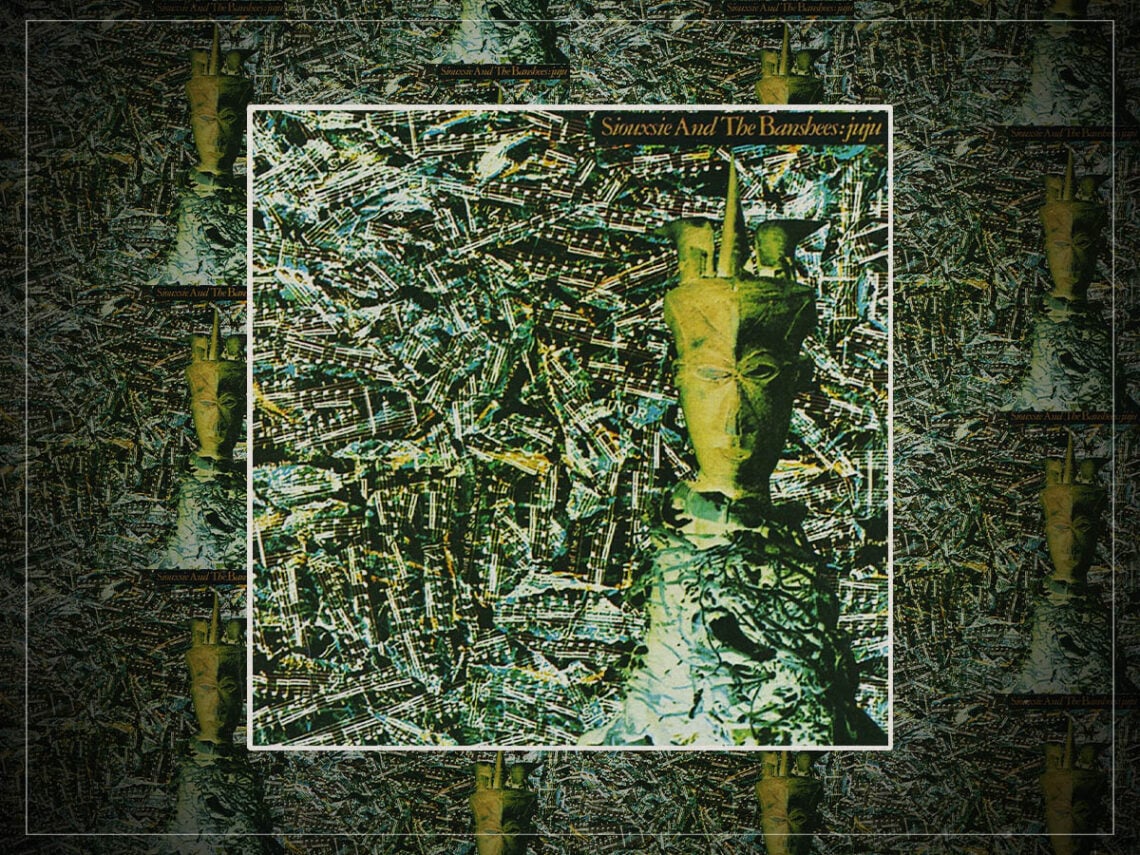
The “thread” owed much to a chance encounter with a relic of African indigenous art. Perusing the collection of masks exhibited at south London’s Horniman Museum, the discovery of the Juju mask captured the band’s imaginations. A major feature in West African cultural custom, Juju masks and effigies supposedly were able to be wielded by ‘Juju men’ for mystical purposes, be it good or bad. Ever since, “Juju” has entered the global lexicon of anything pertaining to something’s aura or prophetic omen.
It was the perfect guiding title for the alluring yet dark cloud that hung in the Surrey Sound studio. Eager for a fitting image to their fourth LP’s harbinger of weird energy, the Polydor label roped in Stylorouge designer Rob O’Connor for its arresting sleeve art, snapping a photo of the mask in its original ebony presentation, but inverting the colours to create its goldish brown hue.
For extra intrigue, O’Connor cut up a massive pile of snipped and excised pages of sheet music to add an extra twist of absurdist surrealism; the Banshees reportedly delighted with the final product.
Strange talismans and dramatic atmospheres clashed with a belligerent yet glorious charge on 1981’s Juju, an essential Banshees record amid their LP purple patch across the rest of the decade. While many fans will argue over the perfect entry point to their inventive oeuvre, the beckoning pull of the enigmatical Juju mask is as good an introduction to the post-punk pioneers as any.
