


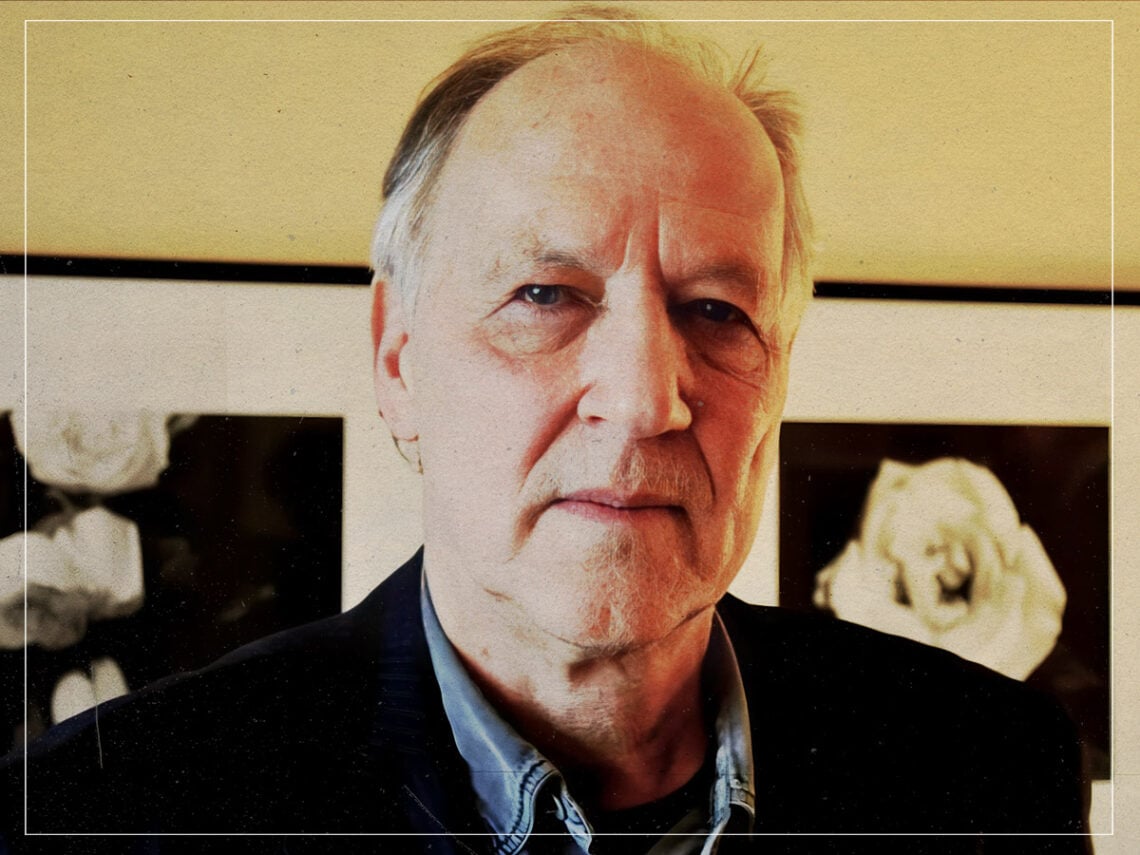
Why Werner Herzog prefers meaning to the “bullshit” concept of happiness

Werner Herzog has an inexplicable essence that makes him a darling of smokey rooms and seemingly endless conversations about the icons of arthouse cinema.
A big reason for that is that the actor, writer, filmmaker, and opera director has refused to be anybody but himself over a tempestuous career spanning over 60 years. In the public eye, Herzog comes across as aloof and cynical. Those who know him have also described him as “caring, thoughtful, playful and essentially gentle.” He is certainly unwavering, though, in his ability to be himself.
At two weeks old, Herzog’s family moved to the Alps during the waning days of World War Two. He grew up with his two brothers and single mother under impoverished conditions there, returning to Germany proper in the 1950s. From a young age, he was unapologetically authentic. Not one for compromise, with little patience for his naysayers. In one story, Herzog refused to sing in front of his class – and after being punished and humiliated by a teacher, refused to listen to music again until he was 18 out of principle.
Herzog is, as you might be able to tell, deeply principled. A man of his word, he made a bet with Erroll Morris that he would eat his shoe if the film Gates of Heaven was completed. When it was, he did just that. Herzog is also also endearingly nonchalant. He was once shot with a BB gun during an interview with film critic Mark Kermode in LA. His reaction? A quick, calm “What was that?” Upon seeing that the shot had pierced his abdomen, he said that it was “not significant” and continued on with the interview.
Herzog is a particularly outspoken member of the film industry, with a decidedly un-American way of thinking. For example, he has strong opinions against psychology, psychotherapy and self-reflection, which he calls “one of the major catastrophes of the 20th century. A major, major mistake”.
In an interview with GQ, he controversially likens all three to the Spanish Inquisition: “The Spanish Inquisition had one goal, to eradicate all traces of Muslim faith on the soil of Spain, and hence you had to confess and proclaim the innermost deepest nature of your faith to the commission. And almost as a parallel event, explaining and scrutinizing the human soul, into all its niches and crooks and abysses and dark corners, is not doing good to humans.”
He added: “We have to have our dark corners and the unexplained. We will become uninhabitable in a way an apartment will become uninhabitable if you illuminate every single dark corner and under the table and wherever—you cannot live in a house like this anymore.”
For Herzog, it’s not just dealing with yourself that becomes difficult but dealing with your other relationships: “And you cannot live with a person anymore—let’s say in a marriage or a deep friendship—if everything is illuminated, explained, and put out on the table. There is something profoundly wrong. It’s a mistake. It’s a fundamentally wrong approach toward human beings.”
Following on from this, one thing that Herzog apparently does not value at all is the very idea of ‘happiness’ – if there is such a thing. “A very American concept,” he calls it. “The pursuit of happiness has always been something that strikes me as very odd. Happiness is a goal in life, and I don’t have goals in life. But I have goals in existence, and I make that distinction.”
“What are your goals? To be satisfied?” asks Sanjay Srivastava for, ironically enough, the psychology blog The Hardest Science. “No,” replies Herzog. “That plays into this happiness bullshit. No, instead of happiness, there should be meaning in one’s life. At least in mine – I don’t want to preach to others.”
This simple message main seem hard-nosed and possibly even purposefully deflating, but the filmmaker truly means it. His principles would never allow him to put happiness in the way of achieving something of worth, either morally or artistically; even when those moments are gained, he wouldn’t waste time celebrating them. Herzog’s life and career has always been about purpose, and while his life’s purpose is undoubtedly to make films of cultural or personal worth, whether you enjoy watching them or not is really none of his business. There’s a good argument for Herzog perhaps needing to see a therapist about that, but we won’t be the ones to tell him.
