


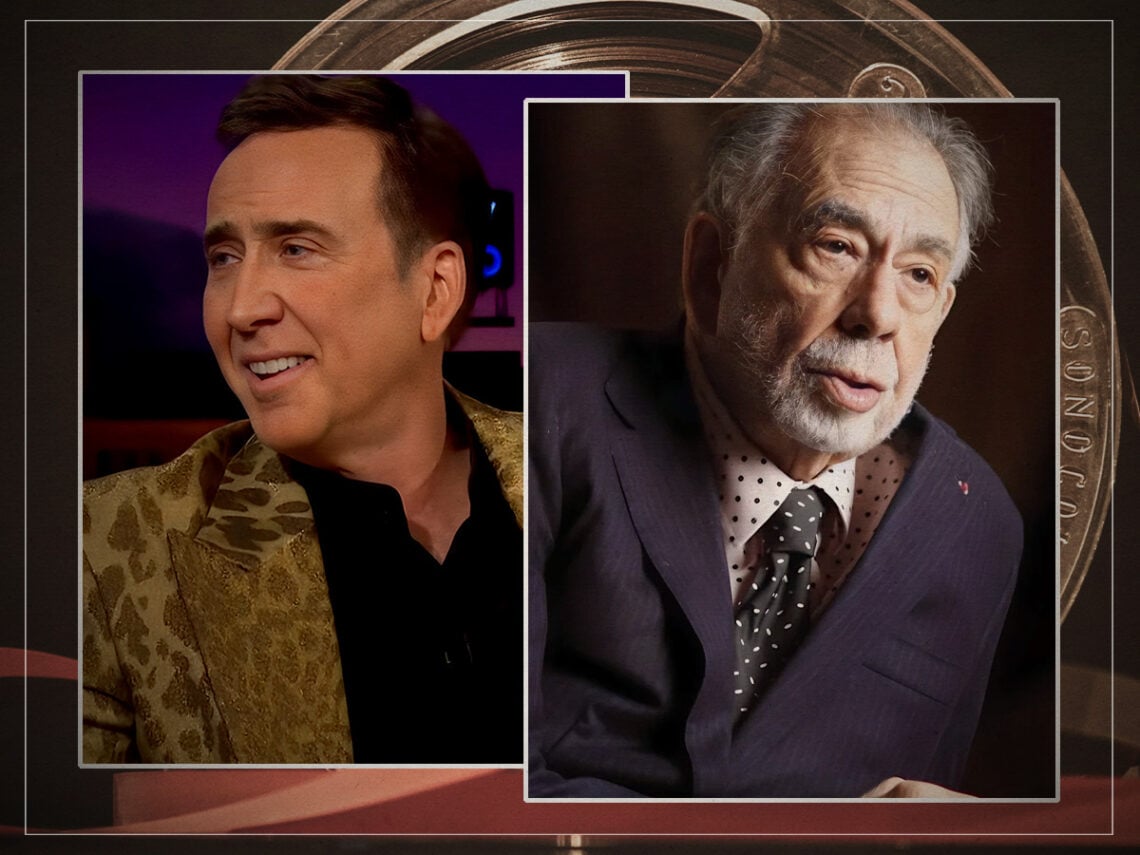
Were Nicolas Cage and his uncle, Francis Ford Coppola, too similar to ever truly co-exist?

In the 1990s and 2000s, Nicolas Cage became one of Hollywood’s biggest stars with a run of action hits like The Rock, Face/Off, Con Air, and Gone in 60 Seconds, alongside acclaimed dramas such as Leaving Las Vegas and Adaptation. He was cinema’s favourite maverick, a singular presence who took wild swings in both big-budget blockbusters and oddball indie films. For years, his eccentricity was seen as a strength, not a liability, and it wasn’t until the 2010s that his career began to falter.
At the height of his fame, Nicolas Cage became such a distinct brand that many people likely never realised he comes from one of Hollywood’s most celebrated families. Born Nicolas Kim Coppola, he’s the son of literature professor August Coppola, making him the nephew of The Godfather director Francis Ford Coppola and Rocky star Talia Shire, as well as cousin to Sofia Coppola and Jason Schwartzman.
When Cage was growing up, though, he felt part of the Coppola family, yet simultaneously cut off from it. August was an academic who had always been seen as the Coppola most likely to succeed, so when his younger brother Francis directed the greatest motion picture of all time and became filthy rich, it bred jealousy and resentment.
Cage was only eight years old when The Godfather changed movies forever, and he was confused as to why his father didn’t want to celebrate his uncle’s achievement. In fact, when Francis sent the family a stack of Godfather T-shirts, August forbade Cage from wearing one. Then, when The Godfather Part II was released two years later, August took Cage to the cinema, but pleaded with him, “Don’t tell your uncle we went to see the movie.”
To August’s chagrin, instead of him writing the great American novel and becoming the hero of the family, his brother became the person everyone’s lives revolved around. Shire, their sister, starred as Connie Corleone in the movies and received an Academy Award nomination for the second one, as did their father, Carmine, who composed original music for the film. By contrast, a frustrated August published an erotic novel in 1978 that sold fewer than 2,000 copies, and never took part in any of his brother’s films.

So, it was in this environment that Cage found himself drawn to the family business. On the rare occasions he visited Uncle Francis at his Victorian mansion or Napa Valley estate, he would daydream about achieving the kind of success his father never had. From his early teens, he began pushing for a chance to prove himself. Cage recalls sitting in a car with Francis and saying, “If you want to see acting, give me a screen test and I’ll show you acting.” His uncle didn’t say a word.
Ultimately, Francis would accede to Cage’s demands to let him audition in his late teens, and he cast the young star in three of his early films: Rumble Fish, The Cotton Club, and Peggy Sue Got Married. However, Cage was always terrified of being accused of nepotism, so he changed his stage name to “Cage” after his second credit. Francis was upset by this decision, and couldn’t understand why Cage wanted to abandon his family name, but he also couldn’t stop him from doing it.
In truth, even though Francis helped launch Cage’s acting career, the star always felt his uncle didn’t take him seriously. That doubt may have started with a failed audition for The Outsiders, which left Francis unimpressed. When Cage didn’t get the part, he felt blindsided. “I was ready to forget acting,” he said in a 1985 interview. “I went into the hospital with everything wrong with me. Heart, lungs, liver, tonsils—they all went bad. I was ready to go to sea and become a novelist.”
However, even when they did work together, their relationship was always contentious. They clashed on the set of The Cotton Club when Cage took his method acting tendencies to the extreme. Then, when they collaborated on Peggy Sue Got Married – a movie neither man truly wanted to make – Cage gave one of his most bizarre performances ever, basing his character’s voice on an obscure character from the animated series Gumby. Even though the film was a box office triumph and star Kathleen Turner received an Oscar nomination, Francis reportedly thought Cage was responsible for any bad reviews.
“Francis blamed me,” he once confessed. “He hasn’t asked me to work with him since.”
Over the years, many critics have wondered why Cage and Francis have always found it so hard to coexist. Both men have contributed classic movies to the pantheon, but have also gone out on a creative limb too many times to count and fallen flat on their faces.
If Cage had wanted to, he could have made action movies for his whole career, but instead he has always balanced those out with bizarre horror films, indie dramas, wacky comedies, and metafictional escapades. Similarly, if Francis had wanted to, he could have made a whole career out of gangster pictures and war movies. Instead, he followed his artistic muse to legendary flops like One From the Heart and Megalopolis, ploughing his own money into these endeavours, which baffled critics and stood little chance of lighting up the box office.
Hell, both men have also endured dark times in which they refused to declare bankruptcy, instead choosing to work their way out of deep financial holes. For Francis, this was in the 1980s after One From the Heart nearly sank Zoetrope Studios, and for Cage, it was the 2010s, when he made an obscene number of schlocky direct-to-video movies to fight his way back to financial stability.
Ultimately, though, these similarities in creative temperament and willingness to take chances have perhaps separated Cage and his uncle, instead of bringing them together. They’re probably too similar in their philosophies to get along for any length of time, and when you factor in the Coppola family’s history of “grudges and passion,” there’s maybe too much water under the bridge. As Cage once put it, there’s always been a “fundamental competitive edge amongst the men in my family,” and that may have been too deeply embedded to overcome.
