


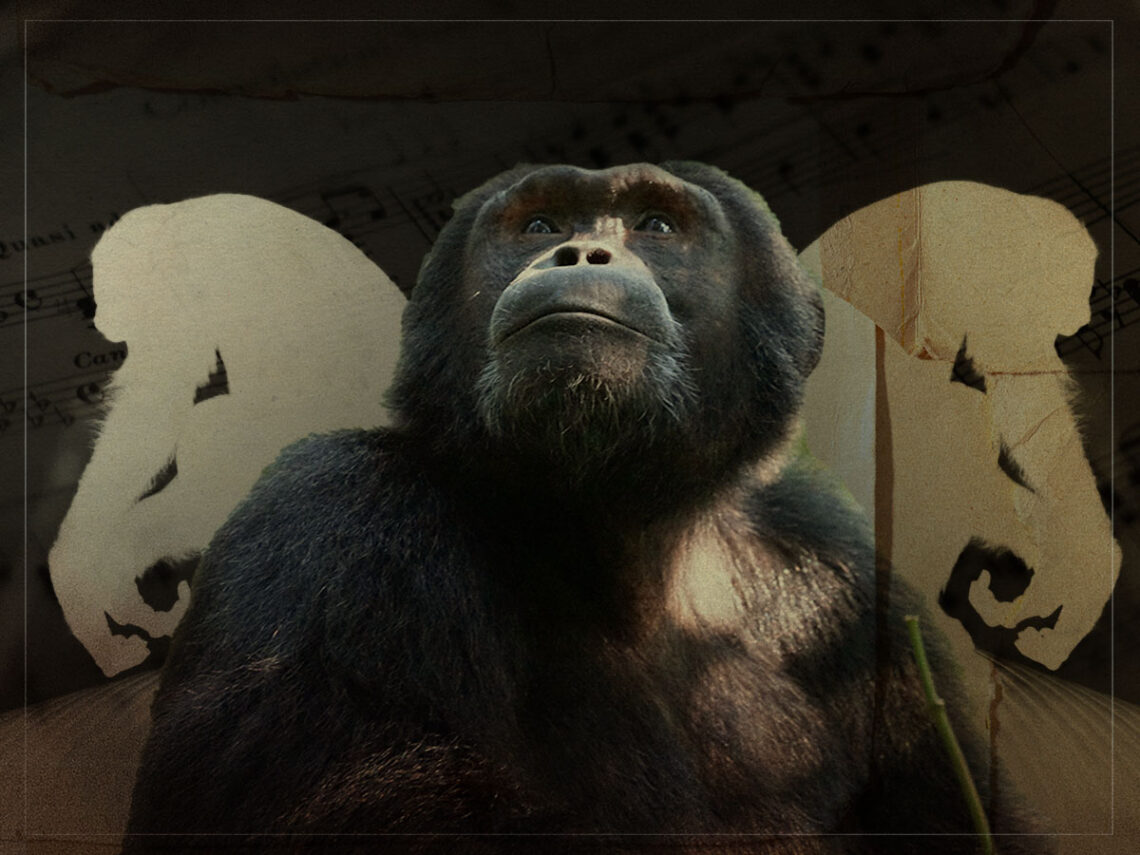
Were chimpanzees the world’s first musicians?

If humanity wishes to understand its evolutionary roots, a study of the chimpanzee possibly reveals plenty about our common ancestor.
Sharing over 98% DNA, the average troop of chimps in their natural environment shows an impressive breadth of familiar emotional range and sophisticated problem-solving. Social creatures, chimps can flash expressions of joy, grief, affection, and at times, murderous rage. Tests have revealed a natural grasp of cognitive thinking, too, a semblance of parental affection and ‘teaching’ base skills, plus deploying sticks and stones as a means to acquire nuts and insects to eat.
Our last hominid common ancestor is generally agreed to have walked the Earth approximately eight to six million years ago. Modern-day Homo sapiens, however, have only existed for around 300,000 years, creating with them the earliest roots of creative expression and ritual custom, including burial rites, ornamental decoration, and primitive signs of trade. Alongside such foundations to the universal human condition is the speculative origins of music, with theories ranging from sexual selection mating calls to a separate linguistic branch to communicate with ‘higher powers’.
With the earliest potential instruments being bone flutes in Slovenia provisionally dated as far back as 82,000 BCE, today’s chimps have a long way to go until they’re crafting anything that can be credibly identified as even remotely orbiting music. While the prehistoric trend would dictate that chimps have a good seven-odd million years before they’re whittling woodwind from a bear’s femur, recent scientific research points to the mysterious art form potentially arriving in the chimp kingdom sooner than we think.
So, were chimps the world’s first musicians?
According to a study published by the Current Biology journal, chimps have been observed to drum rhythmically with their hands or limbs, banging against tree branches for their loud, audio reverberations across the forest, characterised by individual tempos in a non-random manner. Building on previous research for ScienceDirect that suggested such percussion served as a means of communication, new findings further the theory that music forms a more primal universal, not unique to humanity.
“They’re actually drumming often with their feet, so they’re using their hands to hold onto those roots, and then they’re kind of dancing,” University of St Andrews primatologist and study co-author Catherine Hobaiter told NPR. “And sometimes they’re jumping between the roots and getting all of those different beat structures down, throwing a hand in if you want to get a little syncopated”.
Studying 11 different chimp communities across Côte d’Ivoire, Guinea, Senegal, Tanzania, and Uganda, the Current Biology analysis even suggests rhythmic differences between the subspecies inhabiting different ends of the continent: “…Western chimpanzees drum isochronously, while Eastern chimpanzees drum by alternating shorter and longer inter-hit intervals. Western chimpanzees also produce more drumming hits, drum at a faster tempo, and integrate drumming earlier in the pant-hoot vocalisation, typically during the rhythmic build-up phase”.
“Chimpanzee buttress drumming shows both species-level structural features of human musicality and stable subspecies regional differences across diverse ecologies”.
Zoo musicology has a long and recognised place in the animal world, from a bird’s morning tweeting to the deep, ocean sirens emitted from whales, but the recent developments witnessed in chimp troops frame music on a new level of primordial essentiality, suggesting that our collective affinity with melody, rhythm, and harmonies is as elemental to our being and evolution as speech and shelter.
