


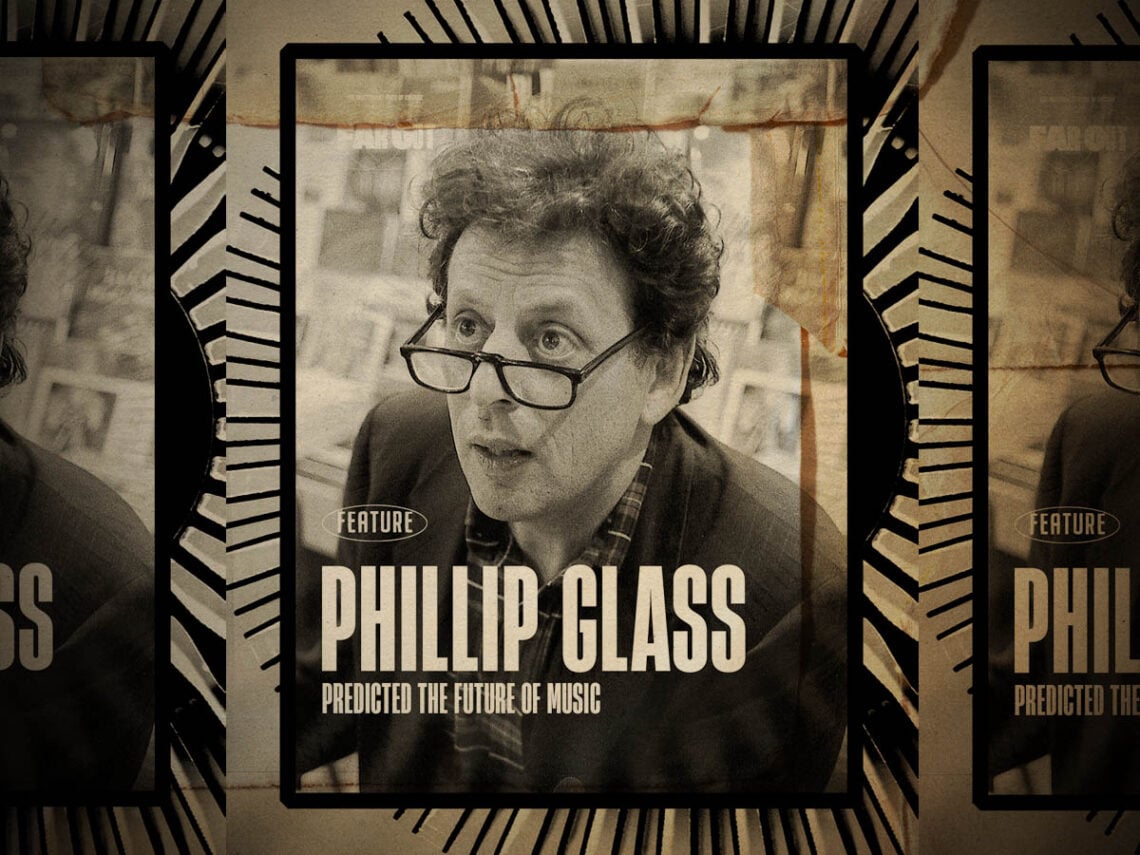
In 1987, Philip Glass predicted the future of music

Music’s trajectory since its early modern evolution has always been surrounded by the reverie question of what new chapter awaits its storied tapestry.
When music passed from preliterate spiritual practice to the established foundations of written works and orchestrated performances that scored antiquity, how did the early pioneers envisage it evolving? Could the Gregorian chants that upheld Catholic liturgical worship, the emerging Hindu raga scales, the printing revolution that spread Renaissance pieces to a wider audience, or the richly ornate Baroque compositions that dazzled the European upper classes ever have been even remotely predicted by the musical maestros of centuries passed?
It’s all too easy to consider music’s scope largely determined by the emergence of the Classical period, up to what lies ahead in five years’ time. Yet, music goes as far back as 40,000 years, with bone flutes discovered in Europe dating to the Upper Palaeolithic era. Unless humanity destroys itself, a prospect looking ever more likely in an age of end times corporatism and certain ecological collapse, music will evolve as a constant so long as mankind walks the planet, or elsewhere, should space travel and terraforming render planetary colonisation achievable.
Yet, it’s not hyperbole to consider how fortunate we all are to have witnessed the birth of popular music during its grand, epochal journey. With its rich sediments of country, jazz, blues, and gospel soul, the lightning bolt that struck America and the larger world with rock and roll’s first electric strum unleashed a 70-odd-year chapter of incredibly disparate and essential work that we contemporary humans should be immensely proud of. It’s a safe bet that the 20th/21st-century pop songbook will endure as much as anything by Mozart or Beethoven when our time on this planet is long gone and buried.
But the intersections of pop and contemporary classical have evolved at such a pace across the decades, it’s hard to pin down exactly where music’s heading in the immediate, even a few years ahead. It was a question posed to US composer and pianist Philip Glass. Often described as a titan of minimalism, a label he’s always denied, his avant-garde styles rattled the classical orthodoxy to such a degree that he formed his famed namesake Ensemble to provide a vehicle and venue for his progressive works. Speaking to journalist Bruce Duffie in 1987, Glass was presented with the question of music’s direction.
“…Well, if you’re asking me, I’ll say it’s going in the theatre,” Glass mused, “But I would say the style of the arts today has been informed more by theatrical collaboration than anything else. In the ‘60s and ’70s, we used to say that it was the art world that made the rules, in a way, with people like Andy Warhol and Jasper Johns. They set the tone for a lot of the other arts. Whether it be dance or music, it just spilled over into that…it’s shifted away from the visual arts and into the performing arts. Partly, the whole emergence of what we call the performance artist is a sign of that.”
Music’s endless forms and myriad shapes serve as the wider arts’ ultimate binding agent, able to amorphously form the essential DNA of anything from film, performing dance, exhibits, to the new dawn of digital media. By the end of the 1980s, Glass had scored acclaimed operas, Jerome Robbins’ New York City Ballet, 1982’s meditative Koyaanisqatsi documentary, and the Songs from Liquid Days collaborations with the likes of David Byrne and Laurie Anderson.
Well-versed in sculpting his pieces to adapt to a range of disciplines, the arenas for music to serve its stirring role away from the confines of the charts and traditional consumption of pop was perhaps half-wittingly anticipated by Glass, predicted that music be afforded a new vitality in the spaces of the arts world, or the increasingly mammoth arena tours that pull music ever closer to a realm where the stars of the day offer experiences over albums.
Was Glass a part of this shift? “I’m not separate from it, and I’m not exactly all,” he told Duffie, “It was my generation of people who made this happen. On the other hand, I was both acting and reacting at the same time. That’s what a community does.”
He explained how building a collective and responding to its making is an endeavour worth noting, adding, “The strength of an artistic community is that it incorporates all those things, that we don’t have one person, or not just simply one person, being the contributing element. It’s using a matrix and a network of things that are happening.”
