


Welcome to ‘Utopia’: Gwenno on non-places and finding her voice in her third language

When I sat down to chat to Gwenno Saunders, known mononymously as Gwenno, about her new album, Utopia, she was sitting in her car having just played at Homecoming Festival in St Austell, Cornwall.
For those not in the know, I’m told that it’s a festival that takes place over ten days, is run by the owners of the Eden Project, and is host to a large botanical garden, which sees people learn about sacred stones and ancient mysteries. As much as Utopia strives to cover stories set outside of Cornwall, where her two previous albums had taken place, it’s clear that she’s not letting go of this aspect of her identity too soon.
With seven out of its ten songs sung in English, a first for Saunders in her solo career, the artist pledged that she would be exploring the parts of her life that took place in the Anglophone world, as opposed to the Welsh and Cornish environments where the rest of her catalogue has been situated.
“I’ve had a lot of English language experiences creatively as well as personally, and so much has happened in English that I hadn’t got around to processing,” the songwriter tells me, adding that while she’d dedicated an entire decade to Welsh and Cornish, she always knew she’d return to English in the proper context.
“I think a big part of the reason why I went back to my Cornish and Welsh roots was a way of grounding myself in quite a chaotic time in history,” Saunders ponders, reflecting on her journey so far as a solo artist. “It’s been a very comforting, stabilising place”. However, when it comes to the intrinsic differences between the subjects that appear in her songs, depending on which language they’re in, there is a noticeable disparity.
“What’s fantastic for me about [singing in] Cornish is that I’m generally surrounded by a lot of ghosts of people or spirits of people that perhaps aren’t physically here,” she explains, “And what was very different about this album was that it is filled with people that are still alive.”

As much as Wales, where she was born and raised, and Cornwall, where her father hails from, are integral to her identity, these places only account for where Saunders has spent half of her life. “If I’d lived just in Wales and Cornwall, then I would just be making Welsh and Cornish records,” she argues, “But because I had this experience of going to North America, I’ve been in an indie band in Brighton and lived in London, I think that those are just parts of you that you need to pull in and acknowledge within your creative practice.”
Call Utopia the start of a new era for Gwenno all you want, but just because significantly less of the album is in her two primary languages, it doesn’t mean she’s abandoning her roots as an artist. “I went back to St Ives to write this album, but I knew I couldn’t write another record like Tresor because I would be repeating myself,” she says, distancing herself from previous approaches, before acknowledging the need to deliver an album where all three languages coexist.
With two songs sung in Welsh [‘London 1757’ and ‘Y Gath’], and one in Cornish [‘Hireth’], the multi-lingual element isn’t lost on Utopia. “I have to acknowledge all the Cornish language that isn’t here,” she notes of the difference between this and Tresor. “That triggered me to create a more realistic point of view of where these languages all sit together. It’s really important that I have established what those languages mean to me in my work, but it’s just acknowledging the English part of it that needs to fit in there somewhere, for my own peace of mind.”
Outside her creative practice, language still plays a crucial role in Saunders’ life. Recently, she’s been following in her father’s footsteps of teaching Cornish, largely to primary school children who haven’t been exposed to the language due to its declining status. “When I first started over 25 years ago, I did a lot of school tours around Wales and Cornwall playing electronic music at schools and youth clubs,” she elaborates. “It was nice to come back to that because it’s part of what I’ve always done”.
“My experiences of music have generally been from a sort of community perspective anyway, whether it be campaigning or teaching.”
Gwenno
The receptive imagination of nine-year-olds has meant that her classes have invariably gone down well, and not only have they learned parts of the Gwenno back-catalogue as a result, but are also more in touch with their own identity and local history. “We did a few different songs, particularly from my second album, Le Kov, because a lot of them are historical references,” she explains. “There’s one song called ‘Den Heb Taves’, which means ‘The Man Without His Tongue’. That’s an old Cornish phrase about losing your language and how that shapes your identity because you’re unaware of who you are and the history that’s around you linguistically.”
With songs that explore regional uprisings in the 17th century, such as the ‘Prayer Book Rebellion’, there’s a lot for her classes to take away from the experience, which she says can be quite “goth and intense”. However, she has plenty of “silly songs” such as ‘Eus Keus?’, a song about cheese, which lighten the mood. But all of it ultimately serves the same purpose. “I think it’s about presenting information to young people so they understand the context of their language,” she muses. “My point to them was that it’s not their fault they don’t speak this language; it’s actually systematic, and I think that gives you a lot more confidence about how you feel about your own culture or language.”
In her home life, Saunders speaks Cornish to her two children and her father, and speaks Welsh to her husband, leaving little opportunity other than in her professional life to use English. “I tend to talk in English through work, so interviews or with management or my label in London,” she explains, adding, “I don’t generally use English that much in my life at the moment.”
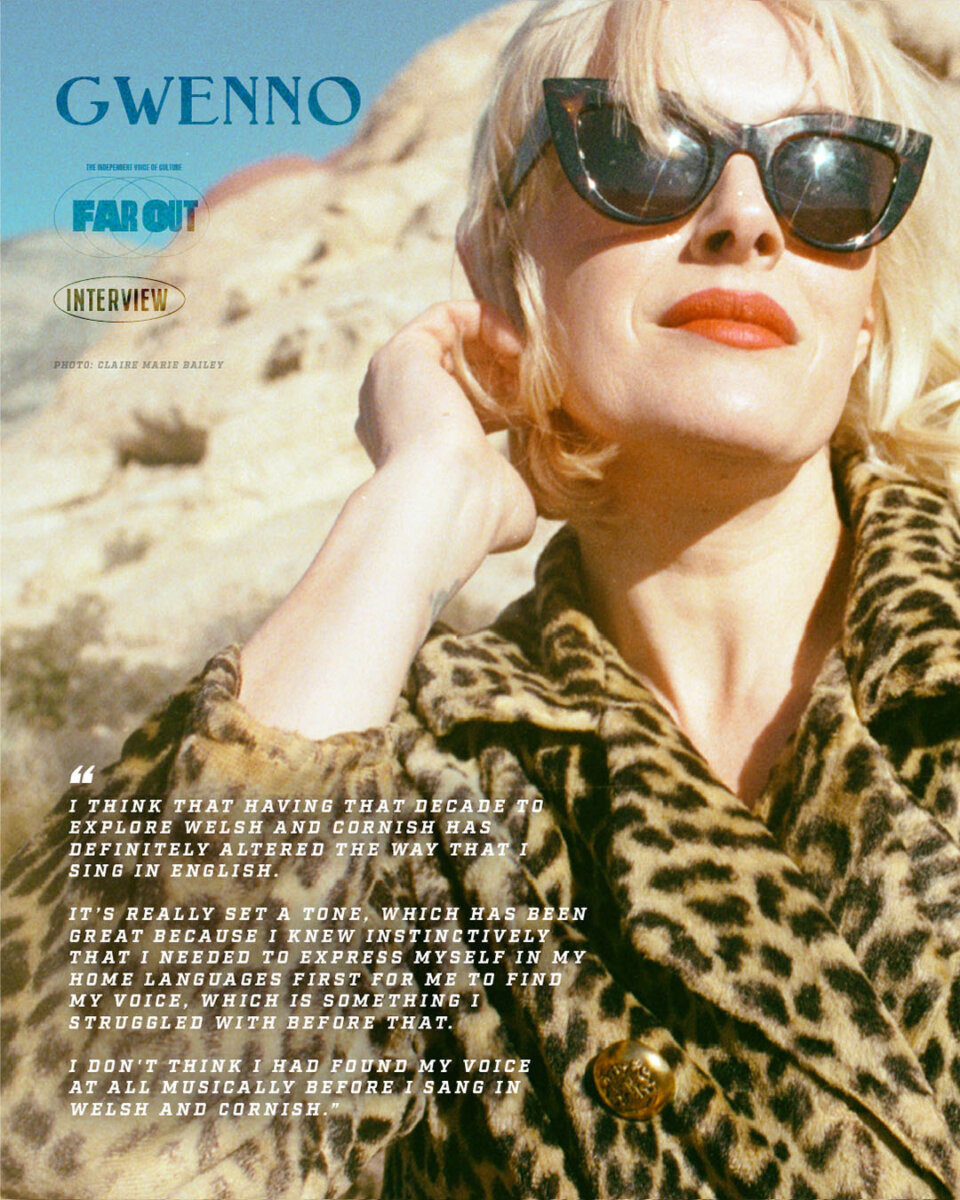
This ultimately affected the way she utilised the language on Utopia, and the approach to her songwriting process, which changed for the first time in over a decade. “I think that having that decade to explore Welsh and Cornish has definitely altered the way that I sing in English,” Saunders claims. “It’s really set a tone, which has been great because I knew instinctively that I needed to express myself in my home languages first, for me to find my voice, which is something I struggled with before that. I don’t think I had found my voice at all musically before I sang in Welsh and Cornish.”
“As silly as it sounds, it was an interesting challenge for me to try and find my voice in English,” she continues, “I could have just said I’ll ignore English for the rest of my life, but that would have been a cop out. Recording anything in English felt like the riskiest thing I could do within the context of my work. I think that’s where you find the truth and where you can challenge yourself by sticking my neck on the line a little bit.”
Singing in English for the first time meant directly tackling personal experiences that she’d not yet processed due to how they took place in English-speaking environments. Saunders claims that the periods of her life spent living and working in Las Vegas in her late teens, up until the period spent in Brighton-based indie band The Pipettes, were among the most chaotic of her life. Hence, she needed to afford herself the opportunity to address these chapters through her work in order to fully come to terms with some of it.
“It’s been really emotional to do, because I’d been able to shut out a lot of that chaos,” she reflects, “but as you get older, I think you’ve got to acknowledge chaos and mistakes. It’s about things not quite working out, and now I’m older, there’s a certain distance to them. It’s difficult to acknowledge failure in the moment because you’re trying to survive it, so this was a kind of love letter to my teenage and 20s self, and wanting to be kind to that person for having a go.”
Saunders firmly believes now, upon reflection, that everyone around her during this period was as lost as she was, and that despite there being a wave of glorification happening that paints the 2000s as being culturally important, she wants to take ownership of it for how she truly experienced that decade.
“Generally, my albums have been about comfort,” she acknowledges, “but there was no comfort in that period of my life”.
Given how much the album’s themes are rooted in chaos, and how they move from location to location, calling it Utopia may seem like something of an unusual, or indeed, ironic choice. However, after receiving a short lecture on how it had historically meant ‘non-place’ until Thomas More’s novel, Utopia, shifted its meaning towards being the ‘ideal place’, Saunders claimed that it felt fitting for everywhere she travelled on the record.
“There’s a value in the fragility of who you’re trying to be, but there’s also an energy to it.”
Gwenno
“Utopia felt like the perfect word to describe what it is to live in an urban landscape and clutch at those moments,” Saunders argues. “It was also the name of this nightclub that I used to go to when I was a 17-year-old in Las Vegas, listening to techno. All those fleeting moments mean everything, but because I’ve explored things that are rooted in history for thousands of years, I wanted to explore what human nature is and how we rearrange ourselves in a landscape.”
The way she describes all of the locations on the album is somewhat conflicted, with an element of discomfort when it comes to sharing how she truly feels about them. But when Wales and Cornwall are mentioned, there is a far greater warmth and homeiness. The final track, ‘Hireth’, which is a Cornish word roughly referring to a sense of longing and yearning for home, was included to illustrate a dichotomy between her connection to Cornwall and all of the other places she’s called home.
“It’s about contrast, and I included that song because it’s about the spiritual connection that you have to a place. It describes my relationship to Cornwall and the fact that it’s unexplainable. With every record, you want to create a whole picture in a way, so the record starts with all the people who have left Wales for London to try and make their mark, and I think that there was something about coming back to a more spiritual place that would ground me.”
How exactly does it differ from the other places she’s called home? When it comes to Las Vegas, Saunders insists that “there is no other city in the world that seems so at odds with its landscape”, and Brighton, which is the subject of ‘The Devil’, gets an even bigger condemnation. “It’s sort of a Neverland,” she chuckles, “It sounds really strange, but I’ve never been to a more godless place than Brighton”.
‘The Devil’, which she wrote with Rose Elinor Dougall, her former bandmate in The Pipettes and now one half of The Waeve alongside Graham Coxon, is perhaps the most negative indictment of a place on this record. Although she does insist that there are “beautiful people” in the city, despite it having “an underlying meanness that I haven’t experienced anywhere else to the same degree”.
This is a dramatic juxtaposition to ‘Y Gath’, a song that features guest appearances from fellow Welsh songwriters Cate Le Bon and H Hawkline, and is considerably more positive in its approach. The song, which Saunders explains is simply about cats and Welsh kids’ television, is rooted in childhood and home comforts, and although she says “it’s a bit surreal with a political edge buried deep down, as most Welsh language songs are”, she also acknowledges that because of their shared experience, it “felt like a natural thing for us to do together”.
Since Saunders herself says that the album is largely about processing chaos and trauma from the ‘English period’ of her life, it felt important to ask whether there were aspects of her ‘Welsh and Cornish periods’ that she now felt required dissecting on future releases.
“I don’t know how gruesome I want to get,” she says, hesitantly. “I kept it all quite above board for a reason, because when you bring up chaotic periods in your life, it can cause chaos as well. So, much of the reason why I have put such a positive spin on Welsh and Cornish is because I actually had a very chaotic upbringing. I suppose that was my way of finding the positives in that chaos.”
Despite this, she believes that her honesty as a songwriter and the fact that she’s allowed herself the space to dive into these areas in her own time have helped the record come out with a more balanced view of events. “I’m old enough and distant enough to be able to say these things abstractly and for them to be worth sharing, and not necessarily just for my own self-indulgence or creating a negative,” she argues. “Music is such a powerful tool that you’ve got to be really careful with. You can’t flippantly put negative energies into music. I don’t know how much good that does to the world.”
