


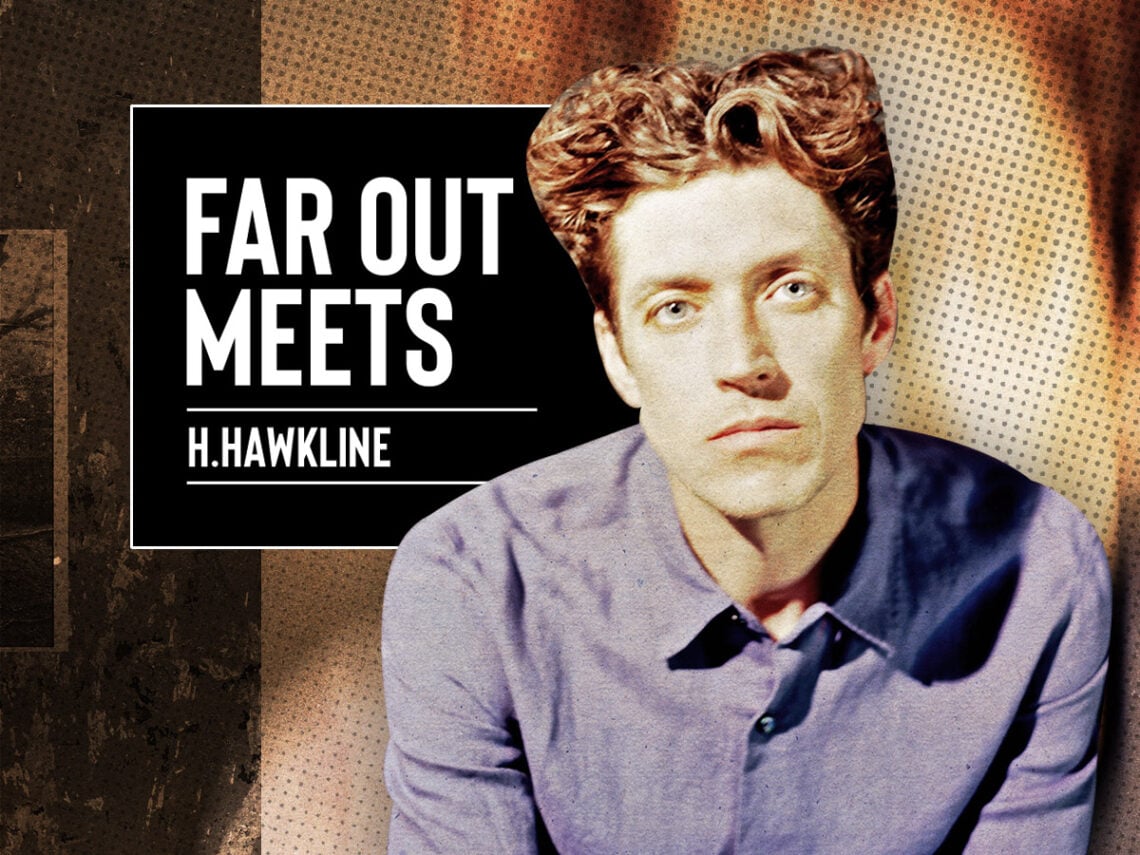
Far Out Meets: H. Hawkline on processing grief and getting by with a little help from his friends

I sat there for half almost half an hour. By the fifteenth minute, my battered Spurs mug was barren, devoid of the caffeinated beverage it once contained. The thumbs had started twiddling, with the palm’s sweat increasing with violence like one of those tanks gradually drowning the latest celebrity victim in the jungle. Still, there was no sign of the afternoon’s interviewee. Somewhat disappointed, I went back to the trundle of the rest of the day’s tasks. After all, it was mid-afternoon, and the work day was winding down. Would it be the overfamiliar dismay of bolognese or fajitas for dinner? It was that time of a winter’s day when the afternoon seamlessly gives way to the evening, and whole weeks can go by without a murmur. Then, an email notification entered my inbox: ‘Huw has joined your meeting’. We’re on. H. Hawkline – real name Huw Evans – does fancy a chat. Whatever day of the week, it was about to get much more exciting.
When I say I was somewhat disappointed by the original appointment not happening, I mean this in the sense that, as a consumer of music, the Cardiff native is someone you want to talk to. As well as being an accomplished solo artist, he’s a frequent collaborator of songwriting greats Cate Le Bon and Aldous Harding. On top of this, he’s also played guitar for Devendra Banhart. Elsewhere, he played bass on Kevin Morby’s albums Harlem River and Still Life, creating the sleeve for the former. Doubling up as a graphic designer, he can also claim artworks for records by Le Bon, Harding, and Teenage Fanclub. That’s quite a CV.
By briefly mentioning this myriad of exploits, it’s clear that Evans is the complete creative, a point quickly reaffirmed after speaking to him for only moments.
As I enter the Zoom chatroom, the camera at the other end is off, but despite this darkness, Huw greets me with a warm “hello!” before apologising for being “ridiculously late”. As the tables had now shifted, and he had been the one waiting for me, I found him paying an invoice, setting the relaxed tone of the conversation from hereon. Catching him in the middle of some life admin wasn’t necessarily what was expected, so to break the ice, I reached for the classic throwaway taxi chat, “busy day?” – it seemed a given at the time, forgive me.
“Fairly busy,” he explains. Indicating that sense of unfettered creativity, Huw was taking photos with his friend the following day, so he was attempting, albeit unhurriedly, to organise bits of their shoot. He says: “It’s one of those things where we probably should have a better idea of what we’re doing. Even though we’re doing something really specific, I strangely feel quite underprepared. But I’m just trying not to think about it. I’m just gonna turn up and assume that everything will be fine.”
Huw has made a living out of globe-trotting, so it was only right that to set the scene, we find out what corner of the world he was presently in. It was Cardiff. He hadn’t been there very long, though. It was the end of a very slow January, and Huw had just returned to the Welsh capital after an extended period on the road.
He’d recently returned from the “glorious gift” of playing the guitar on a “mad tour” of South America with Devendra Banhart at the end of 2022. Prior to that, he’d been working with “Hannah” – Aldous Harding – since early May, touring Australia and New Zealand. Huw explained that after the Harding job, he thought that was him done for the year, but then out of the blue, Banhart got in touch and offered him the gig in South America. His usual guitarist couldn’t make it. Fortuity incarnate.
As with any extraordinary experience – a term not used here lightly – a fallow period of getting reacquainted with ordinary life followed. He said: “So, it was a nice way to end the year, but the problem with doing something as amazing as that is, you then have to come back to real life. I can’t stand Christmas, so coming back from something like that and it being Christmas time was brutal – and you’re in Cardiff. It was like back to Earth with a bang.” After outlining the jarring experience of being in the “glorious” sun-drenched clime of Caracas, Venezuela, then his hometown the following day, I quickly understood the issue. “But you know, that’s what life’s all about”, he conceded.
Despite being relatively uninspired by his present surroundings, just over the horizon from our chat was H. Hawkline’s fifth album, Milk For Flowers, released on Friday, March 10th. It is his most robust offering to date, complete with more emotional depth and refined songwriting than ever before.
Underpinning it is one of the greatest tragedies a human can experience, the death of his mother. Huw’s natural surrealism is utilised on the opus to the full extent, analysing the complicated mesh of feelings inherent to the grieving process without ever divulging too much. This is an artistic triumph in itself. Already being discussed as one of the albums of 2023, as winter starts to give way to spring, it’s a fitting means of ushering in the next chapter of the year, containing sunny dots of the city he used to call home, Los Angeles. The Californian metropolis can be attributed to the headier moments on Milk For Flowers, with ‘Suppression Street’ perhaps the best example.
Displaying his innately enigmatic mode, and the almost abstract essence this gives his work, Huw explained the album’s title: “Flowers aren’t going to grow if you give them milk”, it seems a given, but it’s not something that most people, or any, bar he, would have ever considered.
“It’s funny,” he continues. “It’s one of those phrases… I think it’s something that, to me, on the surface, sounds kind of normal. Or, it sounds like something you could do. You should be able to give flowers milk. Milk should be good for flowers, you know? But it’s not going to do anything; they’re not going to grow if you pour milk all over them.”
Displaying both the technicolour surrealism and reluctance to concede too much that powers Milk for Flowers, Evans concluded the title’s meaning: “So, maybe it says something about… Sometimes you think you’re doing the thing that you feel compelled to do in a certain situation, with the best intentions. But, an outside person would be like, ‘What are you doing pouring milk all over the flowers? It’s not going to work?'” It’s an interesting analogy that leaves more questions than answers, but such is the nature of Huw Evans.
Considering the self-explanatory subject matter, extracting from Huw what the album is about was something I wanted to avoid pressing too hard with. However, he did go into some detail – whilst constantly pulling himself back in, it seemed – about the overarching “grief” that motivated it. Ironically, in trying to keep his cards close to his chest, he also let me into some of that natural sincerity that colours the record. “It’s an album about grief. I think what’s difficult for me about writing about grief or writing about a specific, tragic type of event or experience is that what you’re writing can feel exploitative, even though I’m not sure you can exploit yourself when you’re making art. But you know, there were other people involved with these things that happened.”
Huw maintained that he’d been lucky in that he’d got to his mid-30s and enjoyed a “really lovely life”, without anything “big” happening to him. Getting to that age and not experiencing anything too earth-shattering causes is inherently lucky, and that provides a sobering counterbalance to trauma, he suggests. Understandably though, it was a momentous juncture that changed his being moving forward. He observes: “So I think that was the first point for me in life where I was like, ‘Oh wow. Stuff can get really dark, really quickly.'”
Not one to be backed into a corner, Huw used Milk For Flowers as a conduit for processing the tragedy. In a strange, roundabout way, this has also produced a masterwork. There’s a lot to be said for sincerity in an age drowned in irony.
Opening up, he continued: “The album’s – kind of – about how you respond to grief and the alienation you can feel afterwards, as well as the fracturing of your personality that happens. There’s a sort of before and after. There’s this kind of before-and-after person that exists when something like that happens. I think that’s true of anybody’s experience of anything emotional that happens. You’re forever changed by these big things.”
Lucidly concluding his account of the recent past and its connection to Milk For Flowers, Huw expressed: “But for me, the change after this event was really palpable, to the extent that the person I was before feels like a stranger to me at times. I can’t even imagine being that way anymore. There’s ways, things; quite big beliefs I had about life and the way things are that I can’t even imagine thinking now.”
After getting the core subject out of the way, we moved on to influences, as there’s a lot going on in Milk For Flowers. “Musically, it would be, for me, what I would consider the usual suspects”, he says without giving more detail, in a perfect demonstration of his aversion to stitching his heart to his sleeve. It’s refreshing. “I think it’s a combination of all the sort of big musicians that we all love and listen to. So there’s no point me listing them,” he says later on.
Lyrically, he mentioned Yoko Ono as a standout influence on Milk For Flowers. In one of the more lighthearted parts of the conversation, Evans said two of Ono’s records impacted it. One was 1973’s Feeling the Space, and the other? “Approximately… Hang on”, he trails off before double-checking the title. “Approximately Infinite Universe.” That was it. Another 1973 album.
“There’ll be one lyric that is really poetic. She has a really beautiful way of expressing something where, on the surface, it might seem unrelated, but you know exactly what she means. But then, the next line will just be quite a frank confession about something. I do like that combination. You could have a really poetic way of saying something followed by a really direct statement.”
The line from his record’s title track, “I feel like a nun picking roses, and he never comes when he promises”, seems a fitting example of this. “Yeah, that’s it in a nutshell”, he says before expanding, “Although it’s an interesting one with that one, because ‘he never comes when he promises’ in that context, also maybe depends on who you think that ‘he’ is.”
Revisiting the musical influences of the new album, Huw explains that the group of friends and musicians he recorded it with – John Parish, Tim Presley, Davey Newington, and Cate Le Bon (amongst others) – were those who made the most significant mark on it. “It seems like a weird thing to say, but I hear a lot of my friends – not musically – but just in the sort of personality of certain things in the record.” He then labels Parish, famed for his collaborations with PJ Harvey, Aldous Harding and Eels, “funny” before breaking into a chuckle that implied he knew something that I didn’t.
Cutting to the chase, Huw revealed that Parrish was included in the press release after he gave a PR person the complete list of everyone who played on the record. However, Parish’s prominence is much less than the PR, and most of the articles on Milk For Flowers would have us believe. John played “congas for, like, 30 seconds on the record”, he laughs before pondering, “maybe John’s personality is in there a little bit?”
He carried on: “I think, certainly, watching Hannah and John working together on those Aldous Harding records influenced the way of expressing emotion in a way I maybe hadn’t done in the past.” He noted that Parish and Hannah also influenced him by using singing at the “front and centre” of his new work, with it now a key “motivation” instead of the “kind of nonchalant, half singing” he feels he had done previously.
From then on, the conversation drifted like so many of those cold winter afternoons. The price of being a musician in the current economic climate, his longtime home Heavenly Recordings, and the importance of languages such as Welsh and Cornish remerging in music largely thanks to the strides of his labelmate, Gwenno Saunders. A wholly enlightening chat, there is no better place to finish than with Huw’s advice to aspiring musicians, which provides positivity in a time when the futures of many artists are so enveloped in mystery.
Being a musician and life is about creating your own opportunities, so Huw says: “I think sometimes people put things out and they think, ‘Okay, well that’s it, this is the best thing I could possibly do.’ And then, if something doesn’t happen, it’s easy to feel like you’ve failed somehow. But actually, I think you’ve just got to record something, you put it out and then you’ve just got to immediately move on to the next thing, record it, put it out, do that. It’s not about that one thing. It’s about all the things that you’ll make.”
Huw practices what he preaches. Whether it be with getting signed by Heavenly Recordings, charting his own creative course, or, more pertinently, processing the death of his mother, he’s played the long game, and on Milk For Flowers, it shows. All the different strands have now come together. I get the sense that he’s just entered the next chapter of his career, and it’s sure to be one filled with blossoms, from the personal to the musical.
Listen to Milk For Flowers below.
