


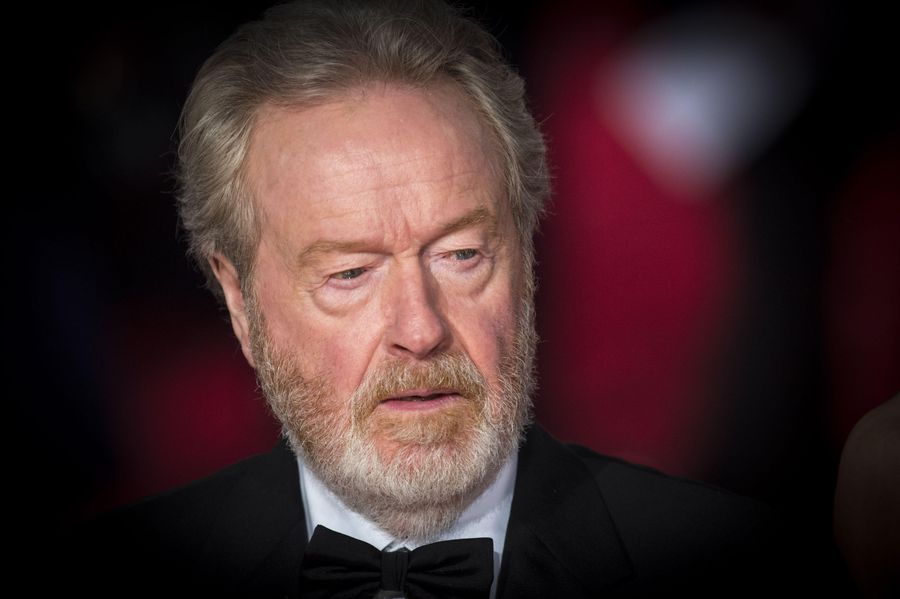
Watch the symbolic dystopian Apple commercial directed by Ridley Scott

Perfecting an atmospheric and concentrated visual overlay, British director Ridley Scott is more than comfortable telling stories in a science-fiction setting. Scott is responsible for some of the genre’s most influential contributions, Alien, released in 1979 and Blade Runner in 1982. The director has also imported his out-of-this-world vision into other media forms, such as commercials for the most prominent technology company Apple.
Directors venturing out into other forms of media makes for some brilliant crossovers to exert their skills and artistry. Commercials are a popular area, as they force quality imagery and execution in a brief runtime that has to be memorable. Some directors utilise the product and time they are given to exert their visual brand and favoured thematic concepts in the marketing tactic, something Scott has had years of experience in.
Speaking with Explore about his role in sci-fi movie making and how the genre came to him as a child, Scott mentioned other genre classics that have influenced it since. “You know, people think I’m a science-fiction fanatic, and I wasn’t as a teen. There was one or two that I thought were okay and I could describe as being interesting. But oddly enough, the very best early sci-fi for me, we’re talking way before Kubrick, right? Because Kubrick really hits the gong, and you go, ‘Holy shit. This is it. Now there is a real world here.'”
He added: “So when I saw 2001, it actually literally was seminal in many respects for science fiction, full stop. I think it totally influenced Star Wars, completely influenced George Lucas. Totally blew me away.”
“But the most important thing was the first real encounter with a brain and HAL. HAL was the star of the goddamn movie, and HAL was representing the corporation. Didn’t give a f— about the human beings on board, which in fact I think Dan O’Bannon and Ron Shusett copied, certainly were influenced by that for Alien,” Scott explained. “That wasn’t me. That was already in there with O’Bannon and Shusett. But little by little, I started to get fascinated by the logic of AI capability and AI certainty. It’s now well and truly here. In fact, probably has been here ten years.”
The filmmaker has since channelled these sci-fi classics’ influence on his artistic vision into his most well-known work. Titled ‘1983’, his futuristic commercial aimed to introduce the Apple Macintosh personal computer. Steve Hayden conceived the idea with Brent Thomas and Lee Clow. The commercial was also produced by New York production company Fairbanks Films, whom all worked under Scott’s brilliant direction.
The commercial takes place in a dystopian setting where every civilian looks identical to the last. The line marches through a futuristic hallway as an overarching voiceover announces there will be “a garden of pure ideology”.
Furthermore, English athlete Anya Major appears as the story’s ‘heroine’, running ahead of the prisoners and smashing a hammer onto a screen displaying David Graham, who plays Big Brother’s role, alluding to a break in the traditional system.
Scott’s commercial aired only twice on American television, first in 10 local outlets, including Twin Falls, Idaho, where Chiat\Day ran the ad on Saturday, December 31st, 1983, at the last possible break before midnight on KMVT, so that the advertisement qualified for 1983 advertising awards. Its second televised airing, and only national airing, was on Sunday, January 22nd, 1984, during a break in the third quarter of the broadcast Super Bowl XVIII by CBS.
The ad’s premiere garnered widespread media coverage and generated an estimated $5 million in “free” airtime. Due to its stylised approach and layered imagery, the commercial welcomed several interpretations concerning ideology and technology. One interpretation cited the unnamed heroine as a symbol of the Macintosh’s arrival into our culture, arguing that her white tank top with a stylised line drawing of Apple’s Macintosh computer represents saving humanity from “conformity”, as maintained by Big Brother.
These images aligned with George Orwell’s novel Nineteen Eighty-Four, which described a dystopian future ruled by a televised “Big Brother”. The estate of George Orwell and the television rightsholder to the novel Nineteen Eighty-Four considered the commercial a copyright infringement. They sent a cease-and-desist letter to Apple and Chiat\Day in April 1984.
Watch the commercial below.
