


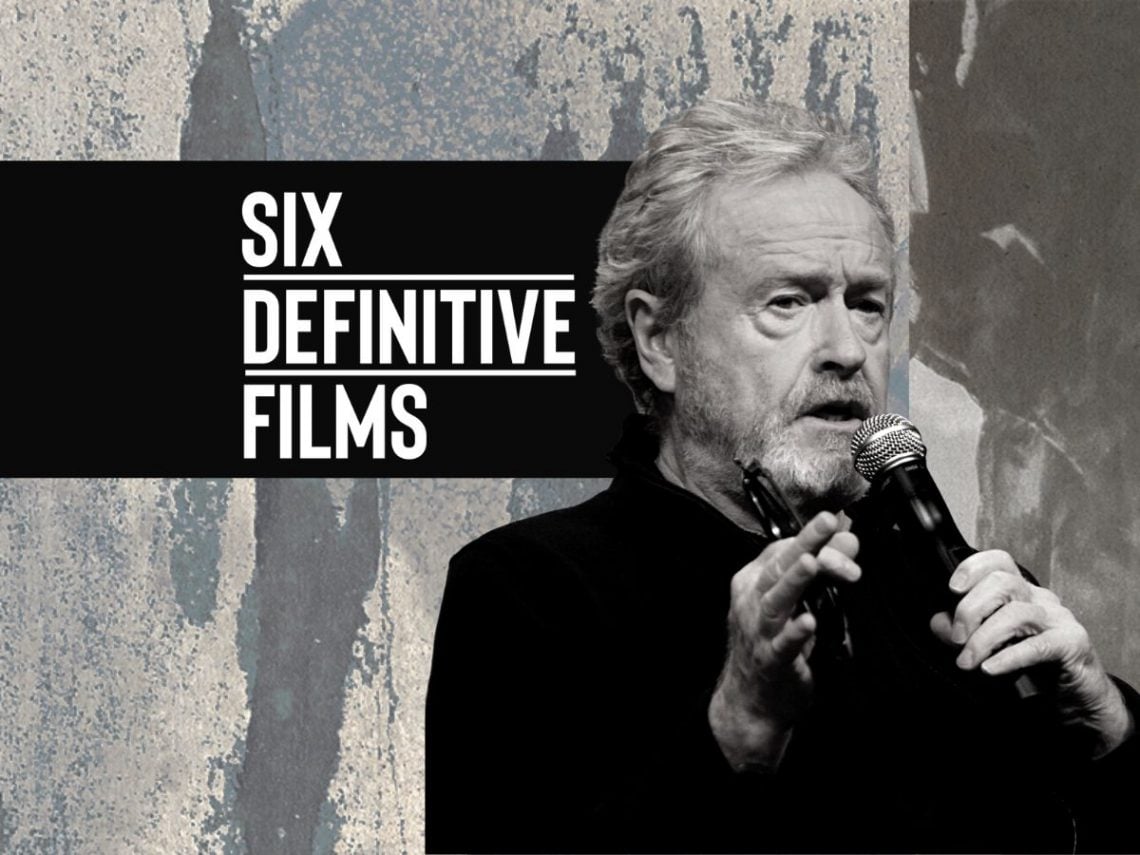
Six Definitive Films: The ultimate beginner’s guide to Ridley Scott

Few filmmakers had as big an impact on the shape of late 20th-century filmmaking as the British director Ridley Scott, joining an exclusive pantheon of artists such as Martin Scorsese, Francis Ford Coppola and Stanley Kubrick. Thanks to his grand scope and cinematic ambition, he has established his name in the pantheon of the best directors ever to grace the silver screen.
Taking to the industry in the late 1970s, the young director cut his teeth with commercials and short films whilst helming the odd episode of random series, including Adam Adamant Lives! in 1966 and The Informer one year later. Though, just like many of his peers, these projects were mere stepping stones since Scott’s real interest lay in science fiction, having been inspired by the writing of H. G. Wells as a child.
Whilst Wells would bring him to sci-fi, it was fellow filmmaker Stanley Kubrick who helped him recognise that his future belongs in cinema, specifically due to the impact of his 1968 movie 2001: A Space Odyssey. Speaking with The Telegraph in 2017, he recalled: “Once I saw that, I knew what I could do,” with the influential sci-fi masterpiece inspiring countless filmmakers and fans throughout several generations.
A sagacious figure in cinema, Scott has helped to manipulate the future of science fiction ever since the 1970s, continuing to innovate to this day.
Ridley Scott’s six definitive films:
Alien (1979)
Scott’s feature film career would begin in 1977 with the release of the historical drama The Duellists, predating the 21st-century swords and sandals action flicks that he would later become famous for. The movie’s moderate critical and commercial success would lead him to take on the 1979 sci-fi Alien from a screenplay by Dan O’Bannon, with the release helping him blossom as one of cinema’s most promising names.
“In space, no one can hear you scream”. Transcending genre and cinematic form, this iconic tagline for Ridley Scott’s Alien echoes around the cultural zeitgeist as an ominous reminder of the enigmatic nature of outer space. Emphasising horror over fantasy, Scott’s unique, industrial and sexual flick remains utterly unforgettable.
Blade Runner (1982)
After Alien caused a cultural firestorm, Scott ambitiously considered taking on Frank Herbert’s influential sci-fi novel Dune, though quickly turned down the concept for being a little too daunting. Instead, he took on another genre classic in the form of Philip K. Dick’s Do Androids Dream of Electric Sheep?, adapting the book in 1982 for his third feature film, Blade Runner starring Harrison Ford.
Set in 2019, Scott’s movie takes place in a futuristic version of Los Angeles that’s teeming with androids, aliens and a multitude of flying cars. The story follows police officer Rick Deckard (Ford), who is tasked with pursuing and terminating four replicants who have stolen a spaceship in the hopes of discovering their creator. A stunning sci-fi tale, Blade Runner, is a sci-fi classic and a futuristic existential masterpiece.
Thelma & Louise (1991)
With the weight of 20th-century science fiction on his shoulders after back-to-back successes, Scott took a step back from the genre in the mid-1980s, tackling the fantasy Legend in 1985 before the crime drama Someone to Watch Over Me in 1987 and the action movie Black Rain in 1989. He followed in a similar vein with his next film, following up a trio of mediocre releases with Thelma & Louise in 1991.
Where often a male lead would grab the steering wheel of a road movie, Thelma & Louise takes inspiration from Spielberg’s Sugarland Express and reimagines the typical male-buddy film with female protagonists, in addition to a freshness that would come to redefine the genre. A landmark of feminist cinema, the film, written by Callie Khouri, is an uncompromising look into the contemporary female experience, picking apart chauvinist male attitudes.
Gladiator (2000)
After deviating from science fiction in the late 1980s and early ‘90s, Scott returned to the historical drama genre that he dabbled in for The Duellists, helming 1492: Conquest of Paradise in 1992. The drama White Squall followed in 1996, alongside G.I. Jane with Demi Moore in 1997, before Scott took some time out and returned with the epic historical blockbuster Gladiator in 2000.
Reminiscent of the classic epics of old, Scott’s movie starred Russell Crowe as Maximus, a Roman general who is betrayed and relegated to fighting till death as a gladiator, where he builds a feud with Commodus (played by Joaquin Phoenix). Beloved by many, Gladiator won Best Picture at the Academy Awards in 2001, with Crowe also picking up the Oscar for Best Leading Actor.
American Gangster (2007)
As Scott entered the 21st century, his filmography took a strange turn, with the filmmaker seemingly taking on a random assortment of movies. Such films included the crime drama Hannibal with Anthony Hopkins in 2001, the modern war film Black Hawk Down in the same year and the comedy A Good Year in 2003, to name just a few. These movies vary in quality, with the release of American Gangster in 2007 bringing this trend of mediocrity to an end.
Starring Russell Crowe, who became something of a regular collaborator after working on Gladiator and A Good Year, alongside Denzel Washington, Chiwetel Ejiofor and Josh Brolin, the film follows an outcast New York City cop (Crowe) who is charged with ringing down Harlem drug lord Frank Lucas (Washington). Displaying Scott’s proficiency in directing a wide range of genres, American Gangster is an example of the filmmaker’s extraordinary versatility.
The Last Duel (2021)
Just like the first half of the decade, Scott struggled with consistency following the release of American Gangster, helming such middle-of-the-road movies as Body of Lies in 2008, Robin Hood in 2010, the Alien prequel Prometheus in 2012 and the seven-time Oscar-nominated movie The Martian in 2015. Whilst some of these films impressed, others lacked the innovation of his earlier efforts.
His most recent film 2021s, The Last Duel, is certainly the most creative and technically proficient of his latest releases, with the movie following Knight Jean de Carrouges, who is ordered to settle a dispute with his squire by challenging him to a duel. Starring the likes of Matt Damon, Adam Driver, Ben Affleck and Jodie Comer, The Last Duel takes audiences back to the majesty of such classics as The Duellists and Gladiator.
With the release of the critical success, Scott proved that he was still capable of cinematic prowess, with his future in the industry pointing to even more masterful innovation.
