

B.B. King on the difference between his and Stevie Ray Vaughan’s guitar playing
Read More


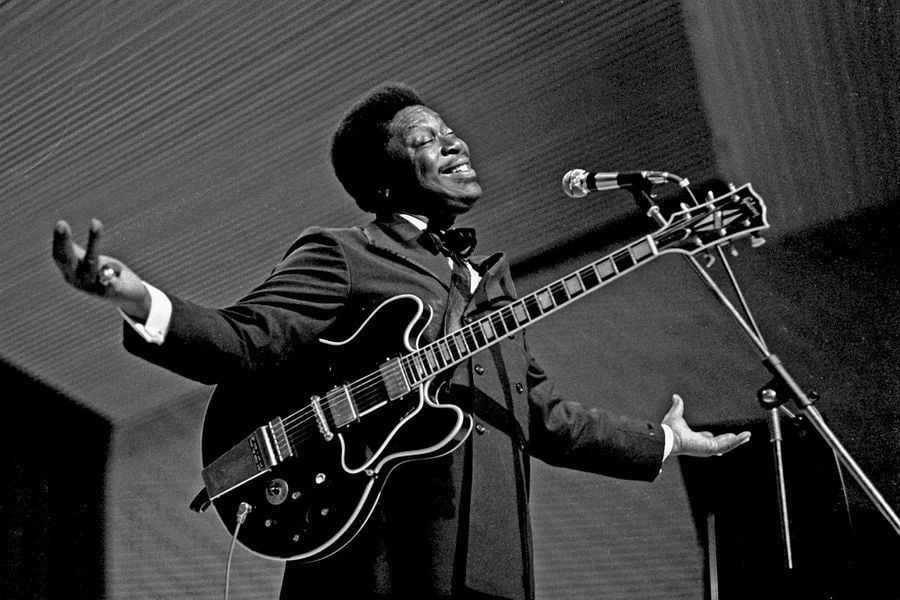
A king in every sense of the word, the late B.B. King is one of the most significant musicians to have graced the earth. The spirit of the blues personified, he and his renowned Gibson ES-335 ‘Lucille’, helped to change the course of guitar music, and the effects of his work can still be heard reverberating throughout music in its many different forms today.
Born in 1925, King was of the generation where the blues had a much more profound meaning than purely the musical. After all, he was born and raised on the remains of the Berclair cotton plantation in Mississippi and was brought up singing in local gospel choirs. To put it simply, his early life epitomized the African-Amerian upbringing in the era of Jim Crow, and a key part of this was the blues, which helped to alleviate the burden of such endemic physical and economic racism.
He quickly found a love for music, and he was also very skilled on the six-string, and by the 1950s, he had started to make his indelible imprint on the world. He became a key part of the historic Beale Street blues scene in Memphis, Tennessee, and here he rubbed shoulders with the likes of Bobby Bland, Ike Turner, and legendary producer Sam Phillips, a great indicator of the sort of status his musical aptitude brought.
He wasn’t called ‘The King of the Blues’ for nothing. King introduced the world to a sophisticated solo style based on fluid string bends, shimmering vibrato, and staccato picking. Duly, everyone from U2 to Jimi Hendrix have credited him with being a defining influence on their work.
He released numerous hit singles such as ‘You Know I Love You’, ‘Woke Up This Morning’, ‘Please Love Me’, and they helped his meteoric rise into the legendary class. He inspired some of the best rock acts of the 1960s, such as Cream and The Rolling Stones, who in turn popularised his music and the whole of the blues genre, meaning that King had far greater exposure than many of his most esteemed blues contemporaries.
Out of all the icons King rubbed shoulders with, one of the most eminent was also royalty, the ‘King of Rock and Roll’ himself, Elvis Presley. King happened to know Elvis before he was big and once described the great turnaround in his career that saw the ‘Kentucky Rain’ singer become one of the most successful musicians of all time.
Speaking in a Charlie Rose television interview, King explained: “Elvis was very shy when I first met him (at) Sun Studios in Memphis. Dewey Phillips was the disc jockey, and his brother Sam Phillips owned the station. So I used to go out to the studio, and my company that I worked for at the time would always contract Mr. Phillips to let us in anytime that we had something to record, and usually Elvis would be there practicing, a lot of times. At that time, he was a handsome guy, good-looking, but I didn’t think too much about his playing or singing, I mean he was okay, but I didn’t see at that time what I saw later on.”
Then pressed on whether Elvis was interested in King’s music, the guitarist responded: “He would watch, he wouldn’t ask questions a lot, but he would watch sometimes.”
Attention then turned to the fact that many people thought Elvis was Black when he first broke through. King recalled: “Well you see at first, he was playing more like rockabilly, he wasn’t really getting into the things that he started to do later. But when he started to do that, then he started to turn heads, including mine.”
He concluded: “He had everything, the looks, he had the talent, everything, he had everything, to me he had everything. You know you started looking at this guy, and say, ‘God almighty, he’s handsome, he’s tall, he looks good, he can sing, he can play.’ You know?”
