


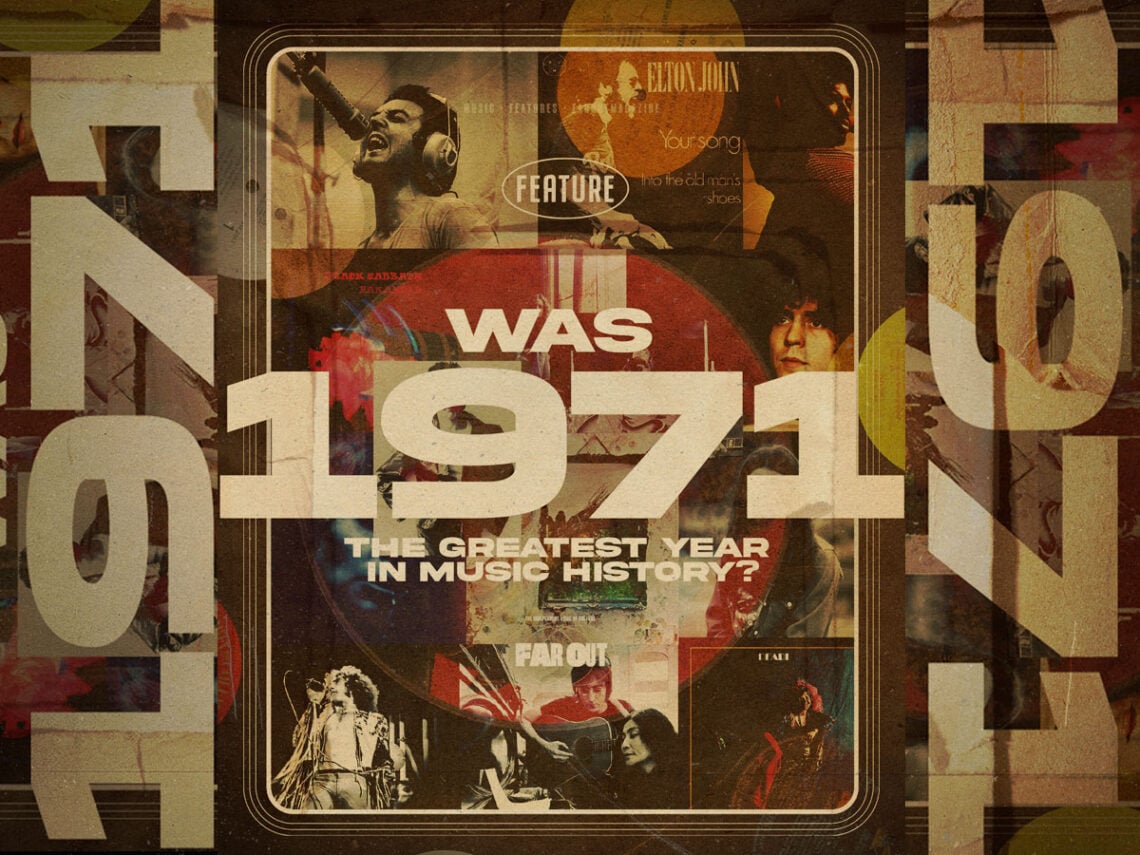
Was 1971 the greatest year in music history?

March felt like deep midwinter in Media, Pennsylvania, to a group of young students who scurried silently beneath a pitch-black sky. The strange darkness that night was perfect for the youngsters as their hearts pounded like angry prisoners against the bars of their ribcages. It all seemed eerily easy as they pried open the door to an FBI office that fateful night in 1971, and stuffed as many documents as they could into school satchels, bin bags, and duffel coat pockets.
They escaped into the twilight without a trace, leaving an unsolved crime for the authorities to fail to figure out. But that was the least of the FBI’s worries. The activists who had looted the offices that evening had one simple goal: “It seemed that no one else was going to stand up to [J Edgar] Hoover’s FBI at that time, and we knew what Hoover’s FBI was doing in Philadelphia in terms of illegal surveillance and intimidation,” Bonnie Raines who first came forward 42 years on from the crime decreed.
“We thought somebody needed to confront Hoover and document what many of us knew was happening,” she said. This dramatic confrontation almost serves as the perfect paradigm of what was happening. The centre of society was failing to hold. The documents proved massive amounts of illegal surveillance on the FBI’s part, designed not to protect the nation but to “discredit” and “neutralise” the left and its various movements, while intentionally attempting to “enhance paranoia”.
The world had certainly come a long way from The Beatles’ simple decree that all you needed was love. The Fab Four were no longer; the counterculture movement in its most peace and love guise had been slain along with the victims of the Manson Family, and the utopia promised by the boom of the 1950s had fallen on hard times. In New York City, 500,000 manufacturing jobs had been lost, and murders hit a startling high of nearly 33 every week.
Similar scenes were unfurling the world over, but it was in New York where Gil Scott-Heron was writing Pieces of a Man. His masterful album called for people to ignore distractions and realise what was really going on. In the process, he would pretty much invent rap music – ironically, with perhaps what remains the greatest album of that ilk of all time. A similar scene was unfurling in Michigan, where Marvin Gaye was upending the apolitical tenets of Motown and turning in What’s Going On.
Meanwhile, Joni Mitchell was reflecting on what was lost with the 1960s, and what she lost along with it, with the beautiful Blue. All of these albums, in their own way, seem proto-something. Amid the creeking division, culture was making a tectonic shift towards the new. In the 1960s, art had been somewhat self-stylised, a parody of its own hip self. Psychedelia and sticking it to the man had also become a toothless pseudo-commercial pursuit.
Granted, the ’60s certainly saw some of the greatest music of all time. But there was nothing phoney about Iggy Pop practically losing his mind on stage with the Stooges and inventing punk. There was no notion of cracking the charts when Funkadelic began an album with the words, “Mother Earth is pregnant for the third time, for y’all have knocked her up / I have tasted the maggots in the mind of the universe / I was not offended,” and a searing ten-minute solo.
The future had not yet been cancelled, everything was new and happening even as the world seemed to be faltering. With heavy metal emerging thanks to Led Zeppelin and Black Sabbath, sonic genre-blending blossoming with Sly Stone, and David Bowie rendering pop truly bizarre, there was no doubt that there’d be acts who could easily take up The Beatles’ mantle—imagine that? These days, such a bombastic thought could get you sectioned. Or at least struck out by whichever musical publication you claimed ‘x will be bigger than The Beatles’ in.
But in 1971, studio technology was polished and innovative enough for it to seem like the sky was the limit, and the neoliberal stranglehold was still slack enough for artists gnash their teeth in a manner that felt like genuine resistance, even if it was as subtle as Carole King’s soulful pop standing aside from the patriarchy. Perhaps above all, business logic hadn’t taken over.
That might have meant masterpieces like Loaded by The Velvet Underground, undoubtedly one of the greatest guitar albums of all time, reached a freakish flop of failing to chart entirely as it trudge over from 1970, but you’d rather have an independent world where Harry Nilsson wasn’t told you’d sell more records if you weren’t wearing a dressing gown, and Paul McCartney’s Ram wasn’t derided by a focus group, than the big label business of today.

What happened in music in 1971?
January, 1971

My song, not your song
Elton John and Bernie Taupin emerge from the shadows of ‘staff songwriting’ to prove that artistry often wins out over commercialism.
Despite the naysayers at the label they were working for ‘Your Song’ charts in the top ten in the UK and the US.
January, 1971

Paranoia in the States
Black Sabbath finally unviel Paranoia to the US market, giving heavy metal its global bidding. Its darkness causes quite a stir, proving music’s power to provoke in the 1970s.
February, 1971

Will the best drummer in history rise
After a comical bout of bickering, Ginger Baker and Elvin Jones finally sit down for a “drum battle” at The Lyceum.
Music is the winner.
February, 1971

A new Queen in town
Queen take to the stage for the first time, heralding a new blend of rock ‘n’ roll and operatics.
They might not take off for a few years, but they prove new forms are in the water.
February, 1971

A new King in town
Like Elton John before her, Carole King decides to ditch writing songs for others and boldly emerges with the masterpiece, Tapestry.
March, 1971

Wilson Pickett goes to Africa
As part of the Soul to Soul concert, Wilson Pickett heads to Africa to perform a huge show in Ghana.
It results in a vital exchange with Western music soon utilising Afrobeat sounds, and African music gearing towards a more global stage.
March, 1971

Me and Bobby McGee
Janis Joplin lands her first US number one six months after her death with ‘Me and Bobby McGee’.
Originally written by Kris Kristofferson, it showcases her spirit beautifully.
April, 1971

Is that rap in 1971?
Gil Scott-Heron releases ‘The Revolution Will Not Be Televised’, it is a masterpiece that rattles through a range of commercial distractions that preclude the public from revolting against their plight.
It may well invent hip hop, too.
April, 1971

Paul McCartney comes over all peculiar
Experimentalism is certainly in the air as Paul McCartney shuns the pressure of being in The Beatles with the very non-commercial record, Ram.
It is pretty much proto-indie and it may well remain his best solo album ever.
April, 1971

What’s Going On
Marvin Gaye releases What’s Going On. There is no question mark there—this is his statement. It is considered by many to be the greatest album of all time.
May, 1971

What happens when you put a duck in a microwave?
Bill Withers emerges with one of the greatest debut albums of all time, Just As I Am.
He was simply working on the tools a few months prior to Graham Nash hearing him through a studio window and insisting he gets a record made.
May, 1971

Sticky Fingers
The iconic Rolling Stones tongue logo emerges for the first time as the exiled gang promote their latest album, Sticky Fingers. It showcases the increasing multi-media side of music.
June, 1971

Behold ye hippies… Glastonbury
Glastonbury Festival is born.
Technically, there was a ‘Pop Festival’ at the site the year before, but this time, Michael Eavis attempts to make it at least vaguely successful under a newly rebranded name.
David Bowie, Fairport Convention and Hawkwind are among the performers.
June, 1971

Notes on a confessional form
Joni Mitchell further transforms songwriting with the deeply personal and yet subtly political masterpiece, Blue.
July, 1971

Grand funk attendance
Grand Funk Railroad smash the attendance record for a single show, selling out Shea Stadium and squeezing in a few more bodies than The Beatles before them.
Thanks to advancements in sound technology, they can actually be heard, too. This marks the start of large-scale shows as we know them.
July, 1971

Rock ‘n’ roll with lipstick
Marc Bolan transforms from a hippie folk enigma, to the first true glam rock star. His band become known as T Rex and they unviel a glossy new form with ‘Get It On’, topping the charts in the UK and cracking the US top ten.
John Lennon will later comment, “Yeah, it’s great, but it’s just rock ‘n’ roll with lipstick on.”
August, 1971

Concert for Bangladesh
George Harrison assembles the likes of Leon Russell, Bob Dylan, Eric Clapton and Ravi Shankar for a benefit concert that goes down in history.
August, 1971

Won’t be normal again
The Who release ‘Won’t Get Fooled Again’. It is notable for two reasons: the British Invasion rockers shows signs of the impact of prog with extended running times for their once-snapshot songs; and it asserts the footing of synthesisers in all genres.
September, 1971

John Prine in a dive bar
John Prine, a folk act discovered by the film critic Roger Ebert, reveals his debut solo album. It belnds folk and country with heartfelt lyrics of unblinking realism.
October, 1971

Meddle
Pink Floyd signal the transition away from psychedelia as they release the prog-adjacent album Meddle. The experimental album rises to third in the UK charts.
October, 1971

Rod’s solo success
Rod Stewart becomes the busiest man in rock as a member of The Faces, The Jeff Beck Group, and now as a solo artist with the mega-hit ‘Maggie May’.
November, 1971

Fourth time’s a charm
Led Zeppelin prove that heavy metal may well be here to stay. Their fourth and finest album, Led Zeppelin IV, becomes the best-selling record in their discography, and for a time, the fourth best-selling album ever. Now, it stands in 11th place.
November, 1971

Multi-track emergence
A string of new records, such as Hunky Dory and There’s a Riot Goin’ On, all use multi-track (16+) recording techniques to stunning effect, bringing a new sonic depth to popular music.
December, 1971

Smoke over Lake Geneva
A fan fires a flare gun at a Frank Zappa gig causing a major fire. Deep Purple witness the aftermath from a hotel nearby.
They are due to start recording the next day, so they immortalise the incident by writing ‘Smoke on the Water’. It becomes the riff millions use to learn guitar.
December, 1971

‘Happy Xmas (War Is Over)’
John Lennon signs off his year of Imagining peace and love, by releasing a classic Christmas single with Yoko Ono.
In the process, he ends all war ever / inspires Steely Dan to write ‘Only a Fool Would Say That’.
The best albums from 1971:
- Album II – Loudon Wainwright III
- Al Green Gets Next to You – Al Green
- Ash Ra Tempel – Ash Ra Tempel
- At Fillmore East – The Allman Brothers Band
- Aqualung – Jethro Tull
- Banana Moon – Daevid Allen
- Bless the Weather – John Martyn
- Blue – Joni Mitchell
- Brain Capers – Mott the Hoople
- Bryter Layter – Nick Drake
- Coming From Reality – Rodriguez
- Donny Hathaway – Donny Hathaway
- Electric Warrior – T. Rex
- Every Picture Tells a Story – Rod Stewart
- Faust – Faust
- Fragile – Yes
- Free Live! – Free
- Growers of Mushroom – Leaf Hound
- Histoire de Melody Nelson – Serge Gainsbourg
- Hunky Dory – David Bowie
- If I Could Only Remember My Name – David Crosby
- Imagine – John Lennon
- In My Own Time – Karen Dalton
- In the Land of Grey & Pink – Caravan
- Journey in Satchidananda – Alice Coltrane
- Judee Sill – Judee Sill
- Killer – Alice Cooper
- La Question – Françoise Hardy
- L.A. Woman – The Doors
- Led Zeppelin IV – Led Zeppelin
- Link Wray – Link Wray
- Loaded (UK) – The Velvet Underground
- Look at Yourself – Uriah Heep
- Madman Across the Water – Elton John
- Maggot Brain – Funkadelic
- Master of Reality – Black Sabbath
- Meddle – Pink Floyd
- Muswell Hillbillies – The Kinks
- Mythical Kings and Iguanas – Dory Previn
- Nilsson Schmilsson – Harry Nilsson
- Open & Close – Fela Kuti
- Pawn Hearts – Van der Graaf Generator
- Pearl – Janis Joplin
- Ram – Paul McCartney
- Santana III – Santana
- Sky’s the Limit – The Temptations
- Songs of Love and Hate – Leonard Cohen
- Sticky Fingers – The Rolling Stones
- Surf’s Up – The Beach Boys
- Tago Mago – Can
- Tapestry – Carole King
- Teaser and Firecat – Cat Stevens
- The Concert for Bangladesh – George Harrison
- The Low Spark of High Heeled Boys – Traffic
- Thembi – Pharoah Sanders
- There’s a Riot Goin’ On – Sly & The Family Stone
- What’s Going On – Marvin Gaye
- Where I’m Coming From – Stevie Wonder
- Who’s Next – The Who
- With Ginger Baker Live! – Fela Kuti & The Afrika 70
