


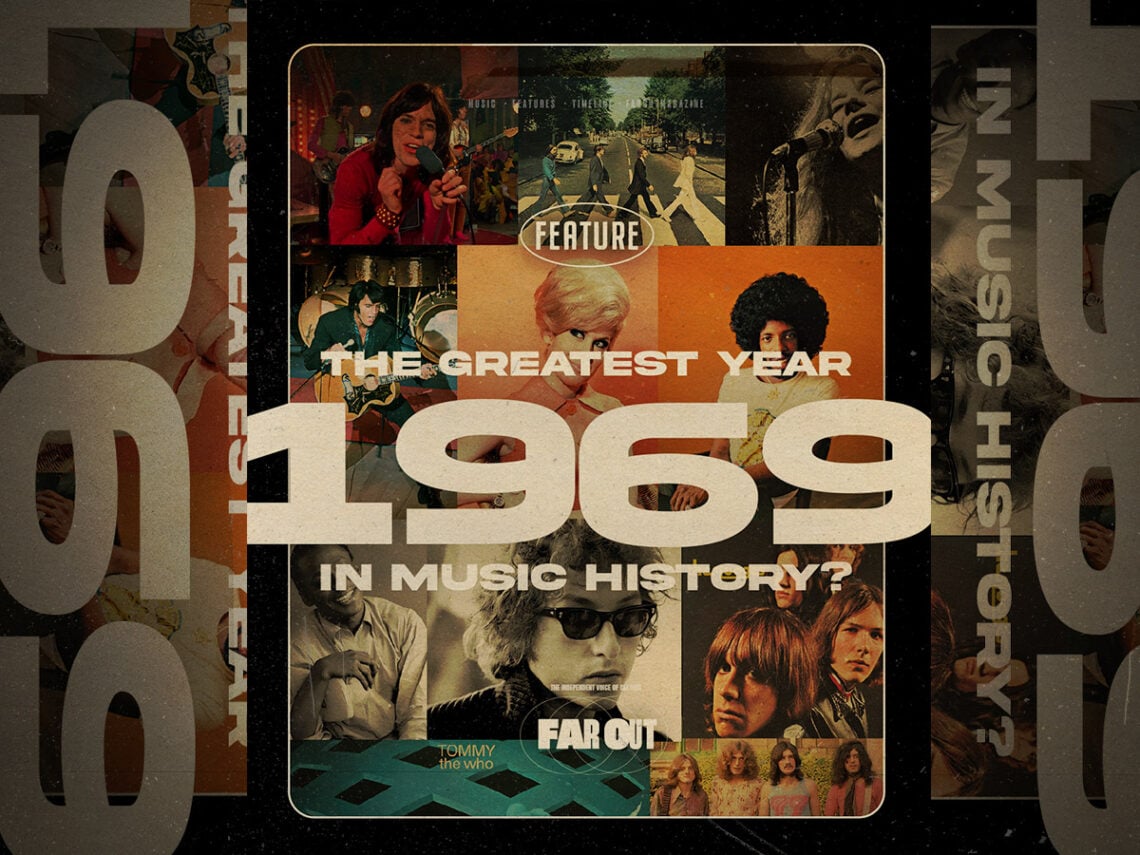
Was 1969 the greatest year in music history?

The blood orange Los Angeles skyline was flecked with the splatter of flickering police lights as the Summer of Love dwindled towards the Winter of Discontent. In the unseasonable heat of a musky autumn, the 1960s were roaring towards their unfortunate and inevitable conclusion. The decade’s proud cultural ideologies had been set ablaze by the hellfire of the Manson Family murders, and that smoke seemed to be smouldering over California. Peace and love had eventuated in untold unrest.
Meanwhile, Hunter S Thompson, a writer who had been at the heart of the counterculture’s heady haze in San Francisco, sat with a beer behind a typewriter, assured of the end of an era but uncertain of its legacy, and he supposed, “Maybe it meant something. Maybe not, in the long run, but no explanation, no mix of words or music or memories can touch that sense of knowing that you were there and alive in that corner of time and the world. Whatever it meant.”
In the end, it did mean something. It meant an awful lot. The extent of its impact can be measured through one simple thought experiment: imagine a band as big as The Beatles breaking onto the scene tomorrow. It’s an impossible task, beyond modern comprehension and even further beyond any expectation. The seismic influence of the alternative sphere in that golden age still reverberates. It’s only a sense that it didn’t achieve what it should have that posts a sorry asterisk on the intangible meaning that Thompson mused over.
However, perhaps we get a smattering sense of that meaning from a recent quote by Pulp frontman Jarvis Cocker, “It is incalculable how much influence The Beatles had in encouraging ordinary people to be creative. I had the good luck to be brought up under that benevolent feeling of people thinking: ‘We can do this’.”
In this respect, the meaning of the 1960s has been borne out in the art of every movement since. We can’t expect another Beatles, Stones, Bob Dylan or Nina Simone because we’ve already had them—everything else is just following in their unprecedented footsteps. In the 1960s, everything was brand-new, from the events that unfurled in a quick-fire splurge of chaos, catastrophe and conquest to the technology that broadcast these gaudy events around the globe, and the modern means of mass consumption, it was all unprecedented.

It can be said that this largely arrived between May 1963 and the following February. In a matter of months, Bob Dylan would deliver a masterpiece that changed music in the form of his Freewheelin’ LP, President John F Kennedy would be assassinated, and The Beatles would arrive in the US to a chorus of hysteia, in part, because they reminded the screaming masses of their brothers who were being shipped off in droves to the War in Vietnam.
Everything was unprecedented. However, not everything was polished. This pandemonium produced countless masterpieces from countless artists, all inspired by the adrenalised zeitgeist. But did the depth always match up? Was the technology capturing it at its most fine-tuned? Did everyone have their finger on the pulse, or were some going along for the ride and dishing out platitudes?
Until 1969, a lot of these rhetorical questions could be answered negatively. In the early days of the movement, there was an undeniable buzz, but it was also pitted with a fair bit of commercial posturing of peace and love, resulting in a lot of sugary pop singles devoid of any real sincerity. Many of the bands themselves had also only been kids when the counterculture movement came calling; thus, they struggled to truly grasp the matter at hand. Pet Sounds also had not quite laid out the rules of how to maximise the use of a studio to embellish music into a modernist masterpiece.
But as the decade progressed, a sense of competition, purpose, and untold riches beyond the next horizon drove artists forward into the unknown. The result was the dramatic conclusion of a decade of discovery—the darkest of days with the brightest of music.
What happened in music in 1969?
January, 1969

Heavy metal arrives
The year began, ironically, with the genre that was to take up the mantle of psychedelic rock as Led Zeppelin released their debut album. It hits the top ten in the UK and the US, and adds a muscular realism, more fitting of the fraught times, to wishy washy rock.
January, 1969

Pop gets Dusty
Even pop music moves in a darker direction as Dusty Springfield goes to Memphis and makes ‘Son of a Preacher Man’. It might be her last hit for over a decade, but its moody nature transforms pop.
January, 1969

The Beatles hit the roof
In a fitting final live performance, The Beatles dish out a whirlwind of hits, charting the prominent genres of the 1960s in a performance that will go down in history.
February, 1969

The first whiff of punk?
The MC5 bring a radical new edge to rock ‘n’ roll that closely resembles punk. They kick out the jams and use their music as a way to bolster the White Panther movement.
February, 1969

The King of Country, The King of Folk
Bob Dylan and Johnny Cash record together in Nashville, representing a collaboration of two American blue collar masters.
February, 1969

Everyday People have a party
Sly and the Family Stones release the masterful ‘Everyday People’. They blend a whirlwind of genres in a new funky mix, heralding the sound of the 1970s.
March, 1969

Avant-garde on the rise
John Lennon performs live for the first time outside of The Beatles. He plays an entirely improvised set with Yoko Ono in Cambridge. It brings mainstream attention to the weird ways of avant-garde experimentalism.
March, 1969

Swamp rock upsurge
Creedence Clearwater Revival romp up the charts with ‘Proud Mary’, and in a flurry of hits, they quickly become one of the best-selling acts on the circuit. They prove that there’s still plenty of life in the blues.
April, 1969

Reggae rises
Desmond Dekker announces the latest expansion of Western taste as reggae tops the charts in the UK and becomes the first-ever reggae track to chart in the US.
April, 1969

Tommy transforms the live experience
The Who deliver Tommy for the first time live, offering a full theatrical rock ‘n’ roll show. The concept album behind the performance does much the same for music, and its full of hits to boot.
May, 1969

High at the White House
The Turles perform at the White House and frontman, Mark Volman, is so high that he tumbles from the stage on five separate occasions. Comically, there can be no clearer sign of the massive impact of counterculture.
May, 1969

Still fire in folk
Crosby, Stills and Nash form a supergroup and release their debut album. Meanwhile, their future friend Neil Young also releases his first record with the Crazy Horses. And Simon and Garfunkel score a masterpiece with ‘The Boxer’.
June, 1969

Mick Taylor is on board
The Rolling Stones journey towards a new era as Mick Taylor joins in place of Brian Jones who would tragically pass away weeks later. The band, however, survive and go on to reflect the stormy times with the likes of ‘Gimme Shelter’.
June, 1969

Trout Mask madness
Captain Beefheart either delivers an untold masterpiece or an unlistenable mess depending on who you ask, with the album Trout Mask Replica. It certainly showcases experimentalism is alive.
July, 1969

David Bowie goes to space
After struggling to make himself heard, David Bowie utilised the moon landing to launch his career with the masterpiece ‘Space Oddity’. It is pop marketing at its finest.
July, 1969

Jazz meets rock
Miles Davis makes waves with the marriage of jazz and rock on the underrated In a Silent Way. It’s another example of genres blending as the late ’60s gets creative.
July, 1969

Following on from MC5
The Stooges deliver their debut album and further the sense that something distinctly punky was in the air. It might not have made any commercial impact, but a few years later the importance of its vitality will become perfectly clear.
August, 1969

There’s still life in Motown
The Supremes post record gross for their concerts in Texas proving that there’s still life in Motown. While the label might have been criticised for its apolitical stance, it still had hits in abundance from the likes of Marvin Gaye and Stevie Wonder.
August, 1969

Woodstock, 1969
500,000 very friendly people gather in a field—what’s left to say?
September, 1969

Janis goes solo and Dylan croons
In the haze of Woodstock and the murders in Los Angeles, Janis Joplin does her best to ease public unrest with her first solo album, while Bob Dylan turns into a crooner with the single ‘Lay Lady Lay’.
October, 1969

The birth of prog
King Crimson arrive with their debut album and herlad another new genre. Jimi Hendrix leaps around at one of their shows and calls them the greatest group in the world.
October, 1969

Pop goes erotic
Serge Gainsbourg and Jane Birkin team up for the sleakest and sexiest single since pop’s inception. It receives widespread bans, but proves a hit in spite of the stuffies.
November, 1969

Elvis returns
Seven years on from his last US number one, The King of Rock returns with ‘Suspicious Minds’ and tops the charts once more.

The Beatles depart
Abbey Road arrives from The Beatles as rumours of their end continue to swirl. The record culminates the sound of the band, journeying through the eras with unerring polish.
December, 1969

Altomont
Despire a debut from the Jackson 5, December was threatening to reach a quite conclusion, but tragedy struck at Altamont, tarring The Rolling Stones as a step too far.
The best albums from 1969:
- Abbey Road – The Beatles
- An Electric Storm – White Noise
- Arthur (Or the Decline and Fall of the British Empire) – The Kinks
- Bayou Country – Creedence Clearwater Revival
- Clouds – Joni Mitchell
- Crosby, Stills & Nash – Crosby, Stills & Nash
- Five Leaves Left – Nick Drake
- Green River – Creedence Clearwater Revival
- Hot Buttered Soul – Isaac Hayes
- In a Silent Way – Miles Davis
- In the Court of the Crimson King – King Crimson
- Kick Out the Jams – MC5
- Led Zeppelin – Led Zeppelin
- Led Zeppelin II – Led Zeppelin
- Let It Bleed – The Rolling Stones
- Liege & Lief – Fairport Convention
- Moby Grape ’69 – Moby Grape
- Monster Movie – Can
- Nashville Skyline – Bob Dylan
- On Time – Grand Funk Railroad
- Phallus Dei – Amon Düül II
- Santana – Santana
- Stand! – Sly and the Family Stone
- Sun Ra and His Intergalactic Research Arkestra – Sun Ra
- The Band – The Band
- The Gilded Palace of Sin – The Flying Burrito Brothers
- The Soft Parade – The Doors
- The Stooges – The Stooges
- Then Play On – Fleetwood Mac
- Tommy – The Who
- Trout Mask Replica – Captain Beefheart and His Magic Band
- Unhalfbricking – Fairport Convention
- Ummagumma – Pink Floyd
- The Velvet Underground – The Velvet Underground

Never Miss A Beat
The Far Out Beatles Newsletter
All the latest stories about The Beatles from the independent voice of culture.
Straight to your inbox.