


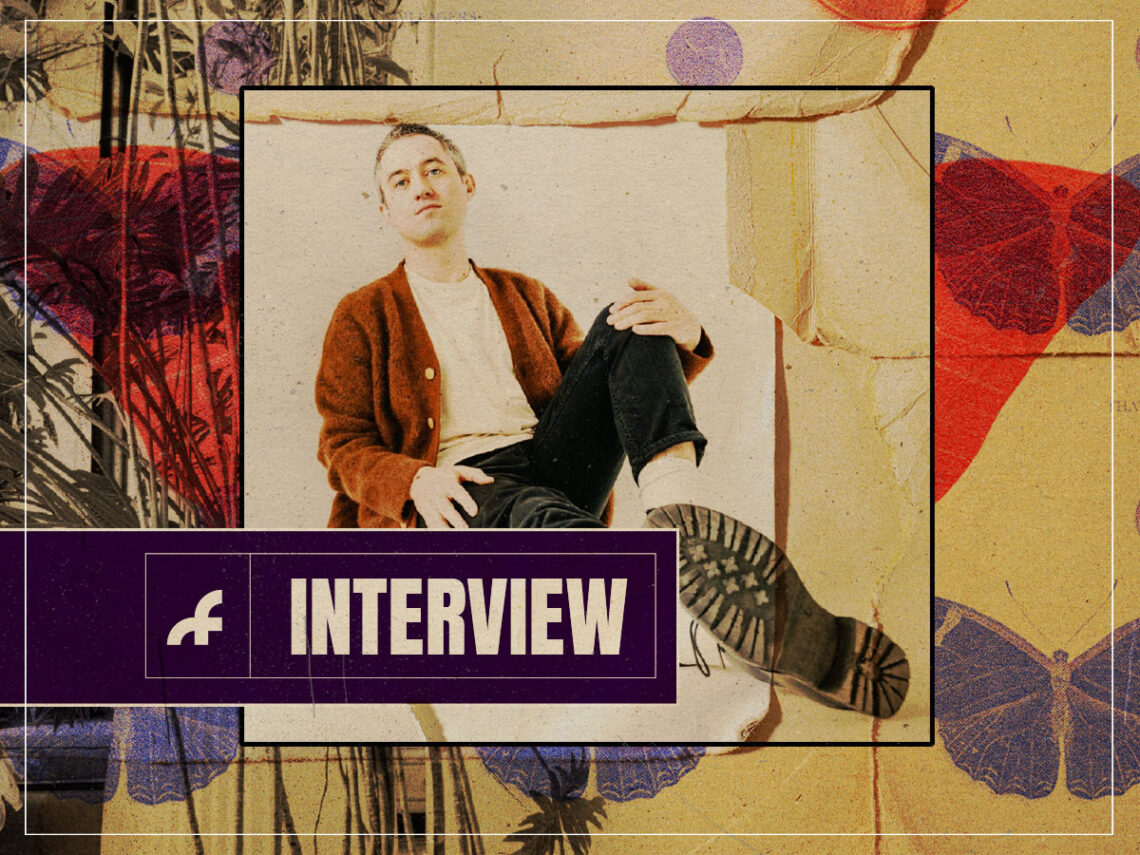
Villagers’ Conor O’Brien: “The internet is changing how we dream”

To demonstrate the theme of his new album, Villagers’ Conor O’Brien immediately draws attention to a famous Allen Ginsberg quote: “I saw the best minds of my generation destroyed by madness.” The singer’s latest album, That Golden Time, might promise all of the sentimentality that comes with whispering sweet nothings in your ear, but at the crux of it, it’s all about the Internet age.
That Golden Time manages to delve into the depths of your mind mostly on vocals alone, as O’Brien’s voice invites you into his vulnerable world, some of his more sinister lamentation arriving blanketed in a hopeful outer layer where quiet contemplation reigns supreme. Adorned with the type of album cover you would take to a tattoo shop for replication, the whole project offers a lot in terms of thought provocation.
“The process of making this album acted as a king of defence mechanism,” O’Brien explains. It’s easy to see why; musical creativity is an expressionist outlet for most artists, a passageway that enables a cathartic release, no matter what the subject. In the case of That Golden Time, however, the themes were mostly external. “The Internet age is not only changing how we interact with each other, it’s changing how we dream,” O’Brien explains, cutting right to the matter at hand.
After rather appropriately referencing the Ginsberg quote, the singer quickly moulds it to better reflect his own line of thinking. “I’m currently seeing the greatest minds of my generation destroyed by the internet, and it’s only the beginning.” It might seem a rather cryptic and dark outlook, but he follows this up with a considerably more positive suggestion. “I have hope,” he says, “and art and music is a good place to explore the murky grey area between the extremes.”
Currency, power, and technology are themes that run through That Golden Time and ones which largely influenced its direction. Alongside the album’s lyrical content and the atmosphere created by the musical arrangements, the album artwork provides a necessary gateway into this world, which depicts a dark moth next to an accompanying coin. Making the album as striking as it is was a deliberate choice after O’Brien set out to choose a visualiser that best represented his mindset.
“The most prominent theory as to why moths are attracted to flames and artificial lamps is that they confuse these sources of light with moonlight and subsequently lose their way towards an untimely demise,” O’Brien explains. “In the album artwork,” he continues, “the moon is actually an old Irish 20-pence coin.”
On the subject of more anthropomorphic connotation and its relation to the internet, he adds: “The nocturnal moth is seemingly using money as its central navigating beacon. The coin itself is not only representative of material wealth but also of value systems in general. One of the central attributes of the Internet age is its ability to present culturally determined beliefs and value systems as eternal, universal truths, which results in a censorious, tribalistic, fragmented environment.”

Describing the ways that this impacts our mental and existential selves, O’Brien delves into the more sinister aspects, saying, “You ‘gotta serve somebody’, as Bob Dylan so eloquently put it, and in this secular, technocratic society, it seems we’ve been duped into worshipping our isolated selves, consumerism, identity and, ultimately, material gain.”
This also runs through to the back of the cover, which includes the Lydian Lion from 600 BC in modern-day Turkey. “The same power relationships and bartering principles persevere throughout these cosmetic changes,” O’Brien concludes, and in some strange way, it all feels oddly comforting. There’s nothing good about the human’s fast descent into capitalist ways, but knowing that others are noticing the mess makes it all seem a little less difficult to contend with.
Perhaps this is the main reason why O’Brien is so good at detailing complex themes, even when one or two might seem to the everyday, colloquial conversation to be interchangeable terms. Romanticism and realism, for instance, could be seen as two concepts that often crossover and bleed into one another, but we draw inspiration from them all the time, no matter the implications.
“The friction between aspirational, idealistic, romantic ideals and the harsh reality of the world we live in daily is a constant source inspiration to me, good and bad,” O’Brien explains, explaining the ways his creative approach often occurs when “I’m encountering tension.” Although he is quick to reassure that music is “a joyful pursuit”, it is also a “sacred” infusion of “the deepest, darkest corners of the human experience,” but only “when it is treated with the respect it deserves.”
One example of this is the Villagers track ‘Truly Alone’. As the title suggests, O’Brien tackles themes of solitude but through a rather perplexing lens that marries both feelings of isolation and seeking out spirituality as a sole individual. Whether it’s intended or not, ‘Truly Alone’ feels like an ode to feeling fullness within yourself, but O’Brien explains its more complicated foundation.
“There’s that cliché going around that the more connected we get in this internet age, the more isolated we are becoming as human beings and souls,” the musician says. He adds, “I see a lot of truth in this, but it’s a double-edged sword; navigating the world as a lone agent can also yield spiritually nourishing results away from the market-driven noise and groupthink. It’s complicated.”
Being challenged in this way often results in great art, as proven by That Golden Time. Although this may be difficult emotionally and psychologically, it’s a necessity, both for creativity and personal processing. “My writing process is completely dominated by failure,” O’Brien says, his candid words somehow making complete sense. “I’m constantly losing track of ideas and abandoning songs.”
“It’s weird and uncomfortable and mostly frustrating,” he continues. Discussing the common experience of writer’s block, he adds, “I overcome it by maintaining a certain level of discipline and consistency. It can be difficult to sit a table with a blank sheet of paper for hours on end but it’s very rewarding when the floodgates finally open.”
It makes sense, then, as to why the singer reveals the song he’s the most proud of to be ‘Brother Hen’, which has more layers than you might have first thought. For instance, lyrics like “selling lies like pizza pies” provide a notable example of O’Brien’s ability to infuse serious views with something more trivial as a means of demonstrating his point. ‘Brother Hen’ may delight with its laid-back appeal, but there is more to discover beneath the surface.
“I get a lot out of the chord changes in this song,” O’Brien shares. “It’s ultimately about the connection between the mind, body, soul and the natural world.” And that’s broadly an overarching thread that runs throughout That Golden Time. There’s a delicacy there, too, one crafted by the soft piano chords and O’Brien’s sultry vocals. But there’s also a stark eradication of any pre-existing pretence.
As the project’s musical mastermind, O’Brien offers solemnity where it counts, with an underlying cynicism that might just change the way we view modern green. The Internet age undoubtedly has its benefits, but ultimately, what’s left when we sit alone with ourselves? What condition is our mind really in when we’re alone?
Perhaps the answer is hidden in the album’s titular track, as O’Brien sings: “Before the keepers of the gate / Revoked your ticket to the land / Where eloquence was still in date / And everything was cash-in-hand.”
