


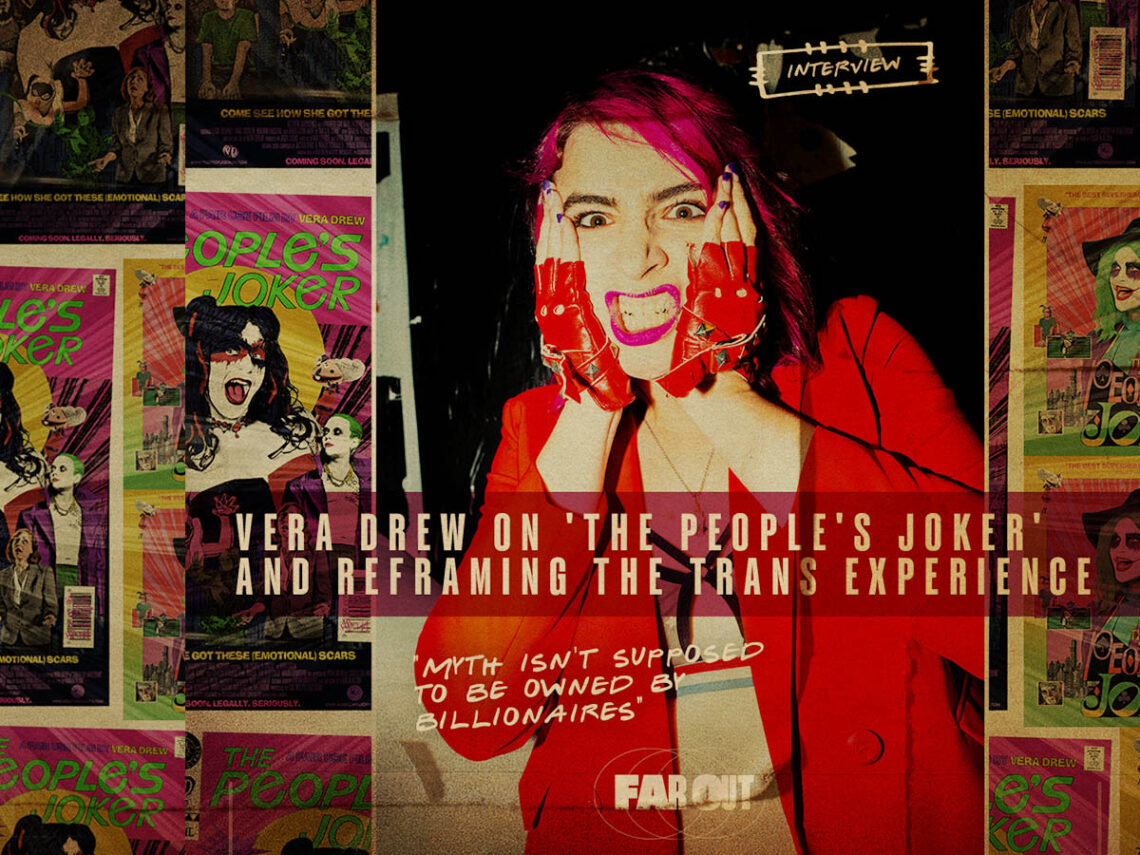
“Myth isn’t supposed to be owned by billionaires”: Vera Drew on ‘The People’s Joker’ and reframing the trans experience

In 2019, director Todd Phillips announced that he had stopped making comedy movies because ‘woke culture’ had made it impossible to be funny anymore. So he made Joker, a relentlessly cynical take on the comic book villain that was a box office smash. That’s when comedian Vera Drew stepped in. The long-time editor of contemporary comic legends like Nathan Fielder, Sacha Baron-Cohen, and Tim and Eric has a knack for turning footage into comedy gold, but when she started reworking Phillips’s film after a friend jokingly suggested it, she realised that she had a deeper connection to the source material than she’d remembered.
“I had this very specific memory actually resurface of going and seeing Batman Forever when I was six with my dad,” she tells me in a Zoom interview. “And there was something about watching that movie as a kid that… I didn’t have the language for it, but I just kind of knew I was queer. I think just because it is this sort of very expensive gay art film in a lot of ways.”
Phillips’s version of the story held its own revelation for Drew, who realised that she identified with the film on an even more personal level. “It’s this movie kind of about, you know, somebody who doesn’t have access to healthcare and is kind of pushed to the edge of society and stuff,” she said. “And that just felt very much like what the queer experience is.” So, with an army of artists and a minuscule budget, Drew reimagined the Joker origin story as a gloriously anarchic, punk-inflected trans coming-of-age comedy.
If you’ve heard of The People’s Joker, chances are it was back in 2022 when it premiered to rave reviews at the Toronto International Film Festival and was then quickly pulled from future screenings over threats from Warner Bros about copyright infringement. Until 2024, it existed as a mythical, unreleased, iconoclastic gem of the festival circuit that only a handful of lucky audience members had seen. Now, it’s finally getting global distribution.
“It really was made from this place of just friends making something together and kind of making each other laugh,” Drew says when I ask why she thinks the film has struck such a chord with audiences. “I mean, cynically, I think there’s a little bit of a freak show aspect to it,” she adds, “And also, it’s probably a breath of fresh air to sort of see something that is this honest and kind of unafraid about telling a very personal story.”

The film isn’t an obvious crowd-pleaser. Batman is recast as a fascist villain who persecutes unsanctioned comedians, and the closeted trans woman, who is our heroine, falls in love with a charismatic trans man, Mr J (Kane Distler), who is a combination of the Joker and Robin. As she discovers and develops her own identity as Harlequin the Joker, the heroine becomes less dependent on Smylex, the drug that she was given as a child to induce maniacal grinning, instead of being offered care for depression and dysphoria.
A superhero parody crammed with comic book sight gags centred on a trans hero, and the problematic nature of the contemporary comedy scene is not the sort of concept that a major studio would throw money at, especially when you factor in Drew’s kinetic editing style and the kaleidoscope of art that forms the sets and backgrounds. However, critics and audiences have embraced The People’s Joker with the kind of feverish delight and awe that, decades into the constant prequelling, sequelling, and rebooting of the MCU and DCU, almost never happens with comic book movies anymore.
The irony of Warner Bros threatening to sue Drew and her distributors over copyright infringement is that the film makes the best case of any superhero spinoff for why the characters should be in the public domain. To Drew, who has adored Batman from the time she saw the Schumacher film as a six-year-old, the characters are simply a version of modern mythology. “Myth isn’t supposed to be owned by billionaires and big IP,” she said, adding, “Anybody should be able to play with these toys and sort of… use them to figure out who they are and what their relationship is to society.”
Demonstrating the universality of these comic book characters has only become more resonant since Drew created it. I spoke with her less than a week after the second inauguration of Donald Trump in the US this January, during which he declared that it was official government policy that there were only two genders. When Drew made The People’s Joker in the middle of the pandemic, the former president was on his way out of office, and though the trans community was being targeted by conservative politicians, they were not being subjected to the intense vitriol and bigotry that they are today.
“When I think about it rationally, and I feel grounded and stuff, I’m so thankful that I’m having this experience now,” Drew reflects. “Because I’m just like, ‘Well, the movie’s out there in the States, you can watch it on MUBI right now. It exists. They’re not going to erase that… If they literally start rounding us up – which I don’t literally think they’re going to do, even though they are taking our healthcare away, which is gonna end a lot of trans lives – They literally can’t… they can’t erase me. And I don’t think they can erase us. Trans people have existed forever.”

She highlighted a quote from Larry Mitchell’s 1977 manifesto, The Faggots & Their Friends Between Revolutions: “The strong women told the faggots that there are two important things to remember about the coming revolution. The first is that we will get our asses kicked. The second is that we will win.”
“In so many ways, I felt like my entire life is just getting my ass kicked,” Drew said. “I’m ready to keep getting my ass kicked and make art… I feel like I have no option other than to just be honest with the kind of stories and stuff I want to tell right now. And I think that kind of is a byproduct of just where the rhetoric is at. It just feels like no choice.”
Despite the hate-fuelled scapegoating of the trans community in the news, the whole experience of making the film, even before it was received with such ecstatic praise, was deeply affirming for Drew as a filmmaker. One of the key things that she discovered on the project was that we’ve all been lied to about art. Speaking of her experience of working with Kane Distler, who plays her love interest-turned-manipulative abuser Mr J in the film, Drew lit up with appreciation. He is styled to look like Jared Leto’s version of Joker with tattoos, gold chains, and slicked-back green hair, but the actors couldn’t be more different. Where Leto is infamous for ‘going method’ by staying in character, often to the discomfort of his co-stars, Distler won Drew over from his audition because of how quickly he was able to jump in and out of character.
“It was almost scary watching him slide into the character and then just become this wonderful, sweet guy,” she said, adding, “I was so glad to have the experience of making something that proved to me two things. Whatever that version of [the] method is is so false. It is the most ego-driven way of performing. But also just auteur theory and the idea that a director has to be a control freak. I mean, this movie just proved to me that… being a director is actually about surrender and kind of going with the flow and really just trusting the crew of people that you put together.”
On the one hand, you might assume that Drew, as the writer, director, and star of the film and who was drawing so heavily on personal experience, would need to micromanage every aspect of the project to make sure it fit her vision. However, she discovered that the opposite was true. She found that, to get the best results, she just had to ask herself a few questions. “What are people good at? What aesthetic is this artist normally working in? …Where can they shine? And how could I fit that into this sort of collage that I’m building?”
That appreciation for collaboration is evident in every scene. The film is, as Drew notes, a collage of artistic styles. When she put out a call for artists to see who might be interested, she was inundated with responses. The project not only gave them all a reprieve from the loneliness and isolation of the darkest days of the pandemic, but it also became a sort of thesis about the value of human-created art.
“That was right around the time a lot of the conversations around AI and deepfakes were just sort of starting,” Drew remembers. “[I] saw the value of the human artist kind of becoming more of a thing… I don’t think AI or any of this stuff will ever replace cinema because the human variant of it all now has even more value than it ever did.”
Again, Drew is leaps and bounds ahead of Marvel and Warner Bros. on this one. Go watch the next big-budget superhero movie (the latest Captain America instalment comes out this week), and you might not be able to tell which aspects of it were made with AI and which were made by human artists. More importantly, it doesn’t really matter because it all feels so repetitive and soulless. The People’s Joker, on the other hand, is unabashedly its own – a film that draws on one of the most ubiquitous fictional characters of the past century and makes it something completely new.
