


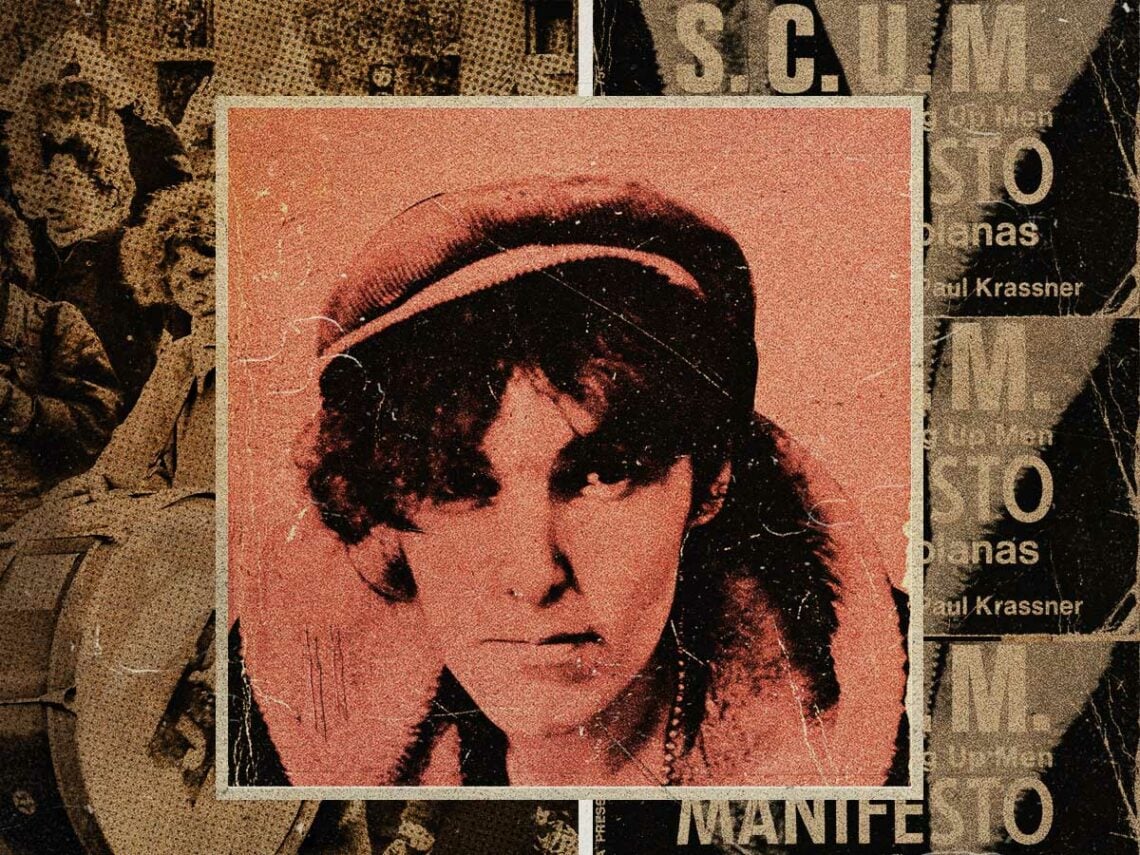
Valerie Solanas and the ‘SCUM Manifesto’: A feminist force that changed culture forever

It was a momentous point for culture when Andy Warhol was shot alongside Mario Amaya at his studio, The Factory, on June 3rd, 1968. Not only would it signal the end of the ‘Warhol 1960s’, as the increased security afterwards prompted a shift away from a cast of parading “superstars”, but it would also significantly affect his life and art moving forward. While these are both culturally consequential, this incident also announced Valerie Solanas to the world, and her influential work of feminist theory, 1967’s SCUM Manifesto.
Despite the meaning of her manifesto long being the source of debate, with questions of whether it is serious or satire abounding, it has been widely impactful to the art world and beyond.
At the time of the double shooting, Solanas was not some random Mark David Chapman-esque character, unknown to her victim. She had been a fringe member of The Factory scene and even appeared in Warhol’s 1968 film, I, a Man. Earlier on the day of the attack, Solanas was infuriated after being turned away from The Factory after asking for the return of a script she had given Warhol. Allegedly, it had been misplaced. Solanas returned and opened fire at the acclaimed artist. While Amaya suffered only minor injuries, Warhol was severely wounded by Solanas’ attack. After this, he was forced to wear his storied surgical corset.
The day after the shooting, Solanas was arrested after turning herself into the police. She claimed that Warhol “had too much control over my life”. Subsequently, she was diagnosed with paranoid schizophrenia and sentenced to three years under the control of the Department of Corrections. After the shooting, her SCUM Manifesto became both notorious and fascinating, as she told a reporter: “Read my manifesto, and it will tell you what I am.” She also said, “He wanted SCUM, well, he got it”.
So what is the SCUM Manifesto? A radical feminist work from Solanas, it was originally published in 1967. She self-published its first edition by making two thousand mimeographed copies and selling them on the streets of New York City’s Greenwich Village. Solanas then signed a publishing contract with Olympia boss Maurice Girodias in August 1967 for a novel but asked him to accept the SCUM Manifesto in its place later in the year. Olympia Press then published the first commercial edition of the Manifesto in New York in 1968.
Interestingly though, in a 1977 interview with The Village Voice, Solanas discussed the Olympia Press edition, grumbling that “none of the corrections … [she] wanted made were included and that many other changes in wording were made—all for the worse—and that there were many ‘typographical errors’: words and even extended parts of sentences left out, rendering the passages they should’ve been in incoherent.” However, later that year she published what she deemed a “correct” edition, which arrived with an introduction she had penned.
The SCUM Manifesto argues that men have ruined the world and that it is time for women to stand up to rectify it. To achieve this, it implores the formation of SCUM, an organisation dedicated to overthrowing the patriarchy and eventually eliminating the male sex. Although ‘SCUM’ is widely accepted as an acronym for ‘Society for Cutting Up Men’, Solanas objected to this, despite explicitly mentioning it in a Village Voice ad in 1967.
The Manifesto opens with this declaration: “‘Life’ in this ‘society’ being, at best, an utter bore and no aspect of ‘society’ being at all relevant to women, there remains to civic-minded, responsible, thrill-seeking females only to overthrow the government, eliminate the money system, institute complete automation and eliminate the male sex.”
Solanas then presents an account of the male being an “incomplete female” and genetically deficient due to the presence Y chromosome. Per the author, this genetic deficiency has caused the male to be emotionally limited, egocentric, and incapable of cognitive empathy or genuine interaction. She claims the male is unable to relate to anything bar his physical sensations.
The work then argues that the male spends his entire life attempting to become female and overcome his innate inferiority. Rejecting Sigmund Freud’s theory of penis envy, she claims men have “pussy envy” and seek to become women through “constantly seeking out, fraternising with and trying to live through and fuse with the female.” Solanas also accuses men of turning the world into what she describes as a “shitpile” before outlining a long list of issues. This made her happy with going to prison after shooting Warhol and Amaya.
Due to her list of grievances, Solanas concludes in the Manifesto that eradicating the male species is the moral imperative. She argues that women must replace the ubiquitous “money-work system” with complete automation, which will lead to the collapse of the government and the eventual loss of men’s hold over women. For this reason, Prof. Dana Heller has described Solanas as having an “anarchic social vision”.
Solanas proposes that a revolutionary vanguard of women is formed to achieve these ends, known as SCUM. She continues that SCUM should utilise direct action and sabotage to evoke change rather than civil disobedience, as civil disobedience only works to make minor societal changes. Instead, they want a complete overthrow of the system, meaning violent action is imperative. She writes: “If SCUM ever marches, it will be over the President’s stupid, sickening face; if SCUM ever strikes, it will be in the dark with a six-inch blade.”
The Manifesto concludes by outlining a utopian, female-dominated future where men are long gone. Inviting a host of positive and negative critiques, there would be no money, disease and allegedly, even death. She goes as far as to claim men are irrational in their want to defend the current system and should accept that their destruction is necessary for a better future.
Interestingly, when speaking to The Village Voice in 1977, Solanas claimed that SCUM was “just a literary device. There’s no organisation called SCUM—there never was, and there never will be.” She then argued that she “thought of it as a state of mind …. [in that] women who think a certain way are in SCUM …. [and] [m]en who think a certain way are in the men’s auxiliary of SCUM.” Contradictory comments such as this have ultimately prompted the vast array of readings of the true purpose of the Manifesto.
Regardless of personal readings of the SCUM Manifesto, it has profoundly affected culture. Janet Lyon argues that the work is both “notorious and influential” labelling it “one of the earliest … [and] one of the most radical” tracts created by “various strands of the American women’s liberation movement”. She also claims that “by 1969 it had become a kind of bible” for the group Cell 16, Roxanne Dunbar-Ortiz’s influential group of radical feminists. Arthur Goldwag asserted for the Southern Poverty Law Centre that: “Solanas continues to be much-read and quoted in some feminist circles.”
Given the radical essence of the SCUM Manifesto and its inextricable link to art because of Andy Warhol, there’s no real surprise that it’s permeated music. Nick Cave mentioned it when speaking to CBC in 2009. He said it “talks at length about what she considers maleness and the male psyche … basically men being halfway between humans and apes, these kind of lumbering lumps of meat, predatory lumps of meat”, and that “it’s quite wonderful to read …. [and] [t]here was an aspect of that I felt rang true.” He was discussing his novel The Death of Bunny Munro at the time, revealing that he had even “invented a character that was Valerie Solanas’s male incarnate.”
Another artist that Solanas has impacted is radical Welsh rockers Manic Street Preachers. Not only is she quoted in the liner notes of their 1992 debut, Generation Terrorists, but she also inspired the song ‘Of Walking Abortion’ from 1994’s The Holy Bible, with the title lifted from her work. In addition, consequential Liverpool punks Big in Japan wrote the song ‘Society for Cutting Up Men’, with the connection obvious. Unsurprisingly, Bill Drummond, later of the KLF, featured in this group.
