


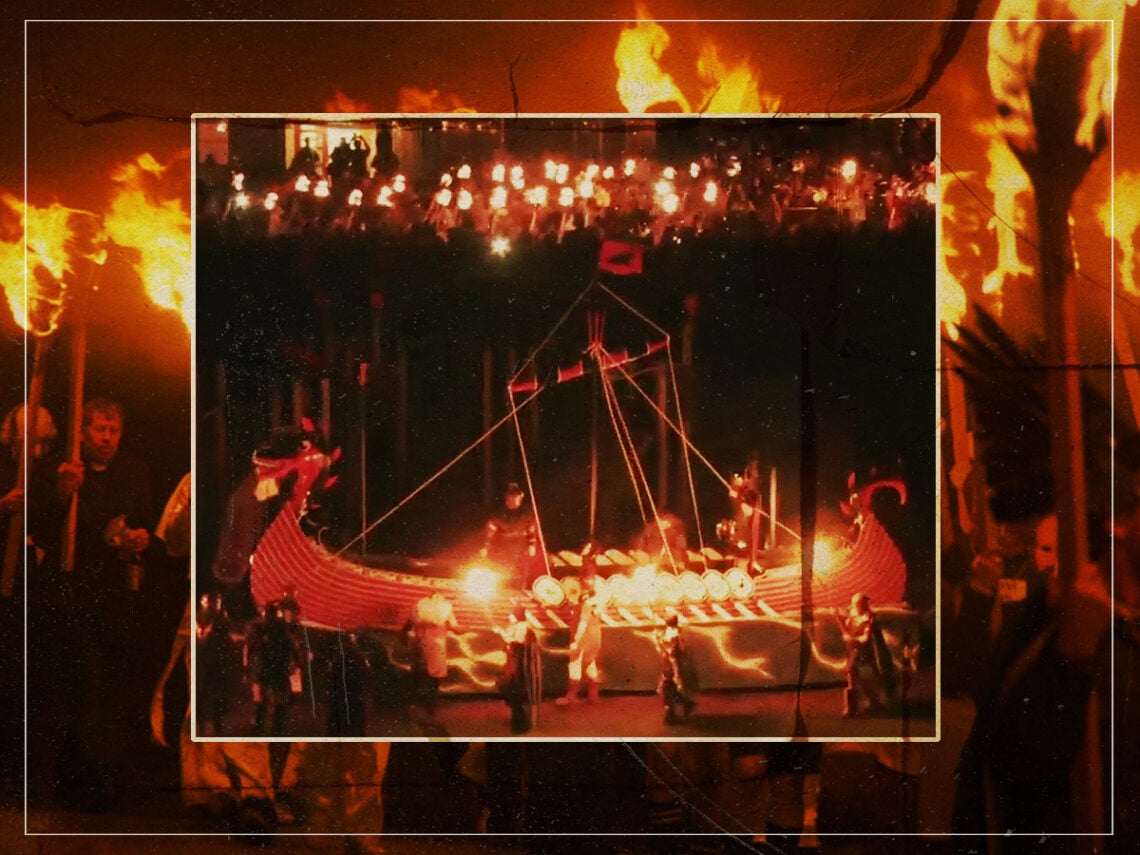
Up Helly Aa: maintaining Viking tradition in the modern age

The festival might be rooted in Viking tradition and iconography, but Shetland’s Up Helly Aa celebrations in their current form only date back to the 1870s.
In the modern age, it may have become more regimented and organised than ever, with each stage of the festival planned out meticulously, but it hasn’t become any less spectacular. Marches through the streets, torches, chants, and an awe-inspiring sense of scale are part of the pageantry, belying its evolution into one of, if not the most famous date on Shetland’s calendar.
There are festivals held across various communities on the islands, but the marquee has always been the one to unfold in the capital, Lerwick. Always held on the last Tuesday in January, up to a thousand people gather to march their way through the streets in front of a crowd of thousands more, culminating in a fiery swansong that’s about as close to witnessing the Viking experience as it’s possible to find in the modern age.
Tankards overflowing with mead may not apply, but it goes without saying there are usually plenty of pints involved when the celebrations reach their peak. The feasts, flames, and festivities date back over a thousand years, with the torchlight procession and the symbolic burning of a Norse longship inspired by the ancient rituals and religious ceremonies undertaken to mark the return of the sun following the winter solstice.
The head of the festival is anointed as the ‘Jarl’ and is defined by the resplendently ornate costume they sport, with the recipient representing the entire Shetland populace from Sumburgh and Lerwick to Unst and beyond. Becoming the Jarl can be a lifetime commitment on occasion, with anyone wanting to claim the position required to spend at least 15 years being part of a committee, which only welcomes one new member on an annual basis.
Only the Jarl gets to wear full Viking regalia, too, but their followers – also known as ‘Jarl Squads’ – are encouraged to wear a costume of their own. Ironically, for a festival where no small amount of alcohol is consumed, the Lerwick Up Helly Aa was initially formed by the Total Abstinence Society so that locals had something better to do with their time than to drink themselves into a stupor.
At 7.30pm on January’s final Tuesday, a signal explodes into the sky above Lerwick’s town hall, with the torches being lit and the accompanying band striking up as the march weaves through the streets for over half a mile, with the Jarl taking pride of place at the helm of the replica longship. Once the Jarl departs the ship, a horn sounds the call, after which the torch-bearers launch their implements into the boat, which is then pushed out to see to smoulder away in a blaze of glory as the crowd sings ‘The Norseman’s Home’.
The party continues long into the night, though, which isn’t ideal considering there are so many sore heads on a Wednesday morning and plenty of people need to go to work. Up Helly Aa might have been a proud tradition since the 19th century, its origins traced to hundreds of years before that, but it isn’t above embracing modernity.
2023 marked the first year women and girls were allowed to join the Jarl Squads, which, by extension, means there won’t be a female Jarl until at least 2038. Strangely, though, blackface wasn’t officially banned until 2020, but thankfully, it’s not exactly a major concern in this day and age that people will flagrantly disregard the rules.
One of Shetland’s proudest traditions and absolutely something that needs to be experienced first-hand if the opportunity presents itself, Up Helly Aa is a throwback to a completely different time when the present was jaw-droppingly disregarded in favour of Shetland embracing its long and rich Norse heritage.
