


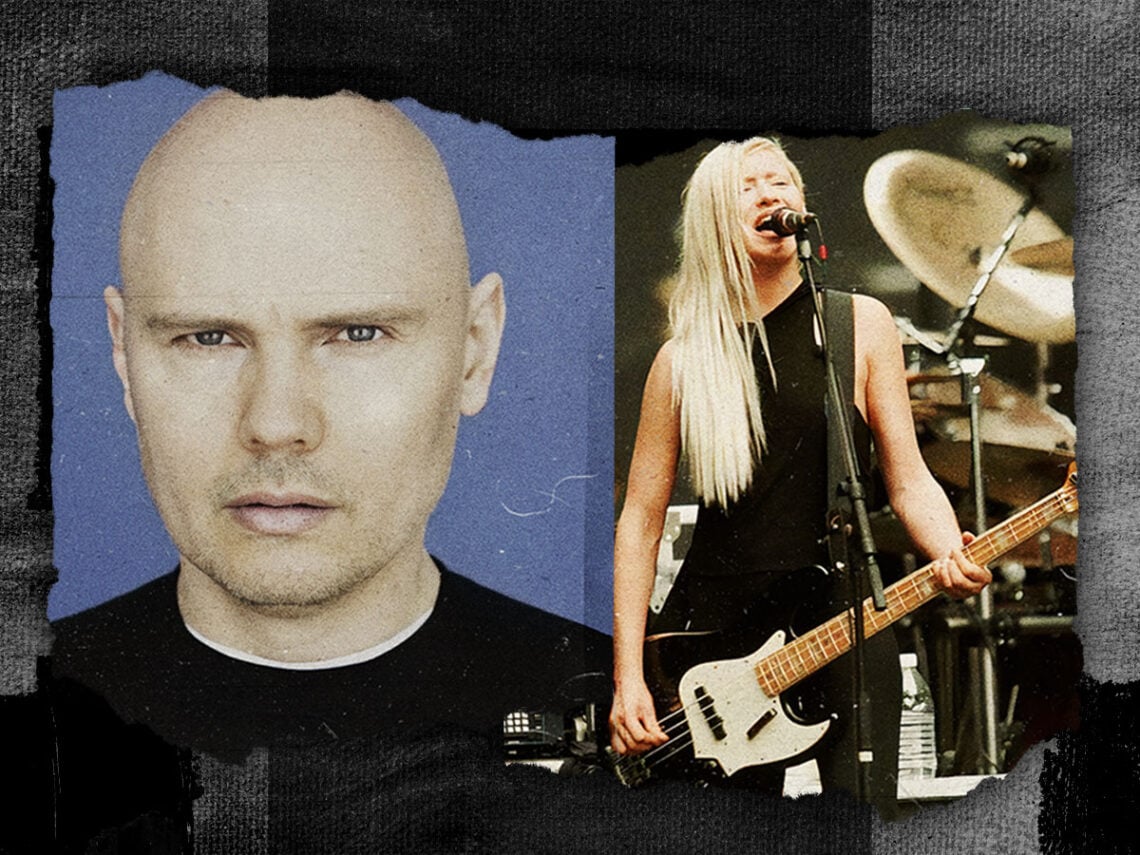
Understanding the feud between Smashing Pumpkins’ Billy Corgan and Darcy Wretsky

At the beginning of the alternative revolution, artists were shedding the skin of the rockstar ego. Since acts like Axl Rose and Bret Michaels were making the rockstar attitude seem stale, bands like Nirvana and Pearl Jam came along with almost no ego, looking to play their songs to fans and then get straight out of the venue. While The Smashing Pumpkins operated in a similar fashion, Billy Corgan was proud of his work, even if it meant stepping on the toes of his bandmates.
Having come from a troubled childhood, Corgan tried to have control over The Pumpkins in whichever way possible. Although he wrote all the songs, Darcy Wretsky was comfortable working in the back of the stage, holding down the low end on songs like ‘Siva’ and ‘Rhinoceros’ on their debut album Gish. After the huge success of that record, though, Corgan was determined to make a classic album and would push anyone out of the way of his vision.
Siamese Dream contained some of the most famous songs of The Pumpkins’ career, like ‘Today’ and ‘Disarm’. Produced by Nirvana’s producer Butch Vig, the whole album has a larger-than-life feeling, as if Corgan is trying to make his version of a stadium rock record in the age of irony. However, there was only one problem: Wretsky wasn’t allowed to play on it.
During the recording of the album, Corgan had to be sure that every single song was played correctly and ended up re-recording most of Wretsky’s bass parts to get what he wanted. As engineer Jeff Tomei remembers, Corgan’s reasoning behind re-recording the project was to capture what he heard in his head, recalling: “My opinion as to why is that Billy knew pretty much what he wanted. In all fairness to James and D’arcy, there is no way to get inside someone else’s head and play exactly what they envision. I also don’t think that they were as prepared for the record as Billy”.
Wretsky mentioned getting increasingly agitated that she couldn’t contribute, telling Alternative Nation: “We would be writing a song, and he would say, ‘That’s not the right bassline!’ ‘Oh, you’re telling me it’s written already?’ There’s so much ugliness. Billy loved to humiliate people and shame people in front of other people. It was incredibly abusive, and I was the only one who would fight back”.
As the band took to the road, Wretsky became more dependent on drugs to deal with the pressure she was facing. Once the band got around to making Mellon Collie and The Infinite Sadness, Corgan would refuse to hear anyone’s say in the matter, making what he envisioned as being his generation’s version of The Wall.
For all of the inspiration he was getting, Corgan was pushing away every member of the band, which culminated in Wretsky quitting the group. When asked about her decision to leave, Wretsky cited her problems with Corgan, saying: “It was mostly that Billy would have a scapegoat for three months, and then somebody else. He doesn’t understand that other people don’t think like him, he always thinks that everybody is in the same mood as him. He would get really angry if he was depressed and you were happy”.
When assembling a new version of the Pumpkins from scratch, Corgan seemed to dismiss what Wretsky added to the band, telling The Chicago Tribune: “I make sacrifices to do my work. That’s not victim talk, that’s nobody’s fault, that’s a choice I made for me. It’s my band. Show me any band that lasts for any tenure, they don’t have the original members. This world doesn’t care about that. They just want to hear the songs”.
The hate didn’t let up over time, either, with Corgan original members James Iha and Jimmy Chamberlain back in the band recently without Wretsky. The Pumpkins might have been a group effort for a while, but it’s been Corgan’s outfit as of late, and Wretsky has never forgotten that.
