


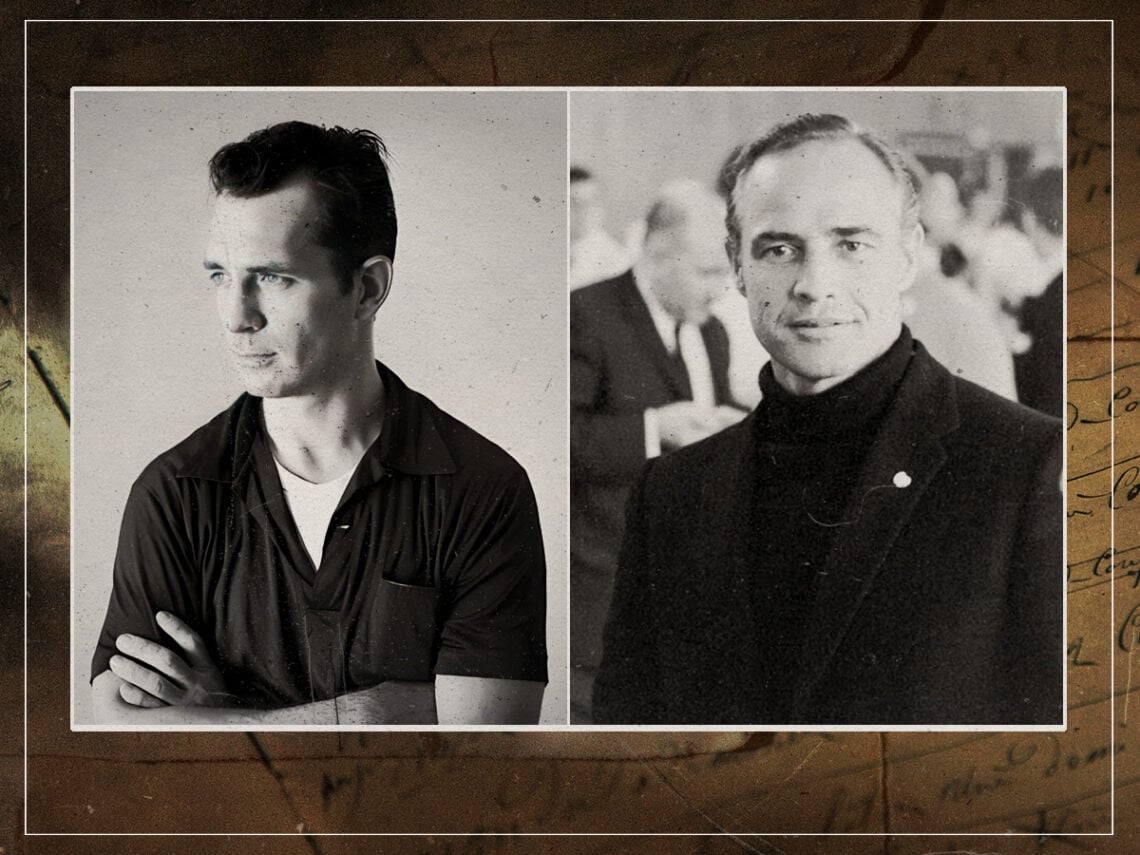
“Put up your dukes”: the unanswered letter Jack Kerouac wrote Marlon Brando

The cultural course of the 20th century in America would have looked starkly different were it not for the two legendary figures of Jack Kerouac and Marlon Brando. Writer and poet Kerouac, known as a pioneer of the Beat Generation alongside William S. Burroughs and Allen Ginsburg, was praised for his stream-of-consciousness style of writing. He left a deep impression on the likes of Bob Dylan and several other key figures in the counterculture and hippie movements of the 1960s.
Brando, meanwhile, remains under consideration as one of, if not the, best actors to ever grace the camera. Having given countless truly mesmerising performances in productions, including A Streetcar Named Desire, On the Waterfront, The Godfather and Apocalypse Now, Brando carved out a legacy for himself as a true icon of American cinema. His influence continues to rain down over the medium, even today.
Around 1957, these two monolithic figures of American culture came together for just a brief moment in the form of a letter that Kerouac sent to Brando. It transpires that Brando did not reply to the letter, with Kerouac later referring to him as “a shit” in another letter to Allen Ginsburg. Still, the original letter details the hopes the writer had of coming together with the master actor in what might have been the most iconic collaboration of all time.
The letter begins with Kerouac’s plea to Brando to purchase the rights to his novel On the Road and make a film adaptation. In fact, the writer said that he would even help Brando restructure the iconic novel into a movie format, “making it into one all-inclusive trip instead of the several voyages coast-to-coast in the book, one vast round trip from New York to Denver to Frisco” and so on.
Kerouac had “visualised” the kind of shots that could be made of key moments in his novel, like the “road unwinding into the windshield” through both day and night. Brando would, of course, have played the role of Dean Moriarty, seeing as the character is a “real intelligent Irishman”, while Kerouac would have played Sal Paradise.
It was primarily financial concerns that had made Kerouac interested in a film version of On the Road, though. He told Brando, “All I want out of this is to be able to establish myself and my mother a trust fund for life, so I can really go roaming around the world writing about Japan, India, France… I want to be free to write what comes out of my head & [sic] free to feed my buddies when they’re hungry & not worry about my mother.”
From there, Kerouac told Brando of his next novel, The Subterraneans, “about a love affair between a white guy and a coloured girl, a very hap story.” Kerouac thought that the adaptation potential for a play would certainly have been easier than On the Road and detailed his desire to give “the theatre and the cinema in America a spontaneous dash [and] let people rave on as they do in real life.”
The writer began to speak passionately about his writing and pointed out how he knew that Brando would agree with him. “Everything I write I do in the spirit where I imagine myself as an Angel returning to the earth seeing it with sad eyes as it is,” he wrote. Kerouac had also offered his admiration for “superior” French cinema of the 1930s to Brando, noting, “The French really let their actors come on [and they] talked soul from soul, and everybody understood at once.”
Kerouac signed off by urging Brando to seek him out in New York or Florida if he wanted to go ahead with a film version of On the Road. “What we should do is talk about this because I prophesy that it’s going to be the beginning of something real great. […] Come on now, Marlon, put up your dukes and write! Sincerely, later, Jack Kerouac.”
Now, Brando and Kerouac never got around to making an adaptation of On the Road, but what a prospect it was: two titans of 20th-century culture delivering one of the era’s most iconic novels for the screen. There’s a deep respect in Kerouac’s words, rhetoric desperation almost, for Brando, and the letter serves as a piece of American history. In this artefact, the worlds of two true icons of the United States gloriously clashed together for just a moment.

