


‘Un chant d’amour’: The controversial story of Jean Genet’s only directorial effort

Jean Genet’s influence looms large over popular culture. He’s referenced in David Bowie’s ‘The Jean Genie’, while his novel Our Lady of the Flowers inspired John Waters to tell his friend, Harris Glenn Milstead, to call himself Divine. And don’t forget Patti Smith’s obsession with him either, writing ardently about him across several of her memoirs.
With his array of novels, plays, and poems, Genet borrowed from his own experience as a petty criminal. Having been born to a sex worker mother who gave him up for adoption, by the time he had come of age, he too had wielded his body in exchange for money, while thieving further sustained him. He spent much of his time in prison, but Genet embraced all that he considered evil and transgressive. To him, this was the ultimate act of rebellion, and he lived on his own terms, drastically opposing ‘good’ and ‘moral’ society.
His sexuality was naturally a big part of this, and Genet was open about his homosexuality, which he saw as another rebellious act, in a way, so when he decided to pour explicit scenes of male queerness into his only directorial effort, Un chant d’amour, released in 1950, it was only a matter of time before it was subject to intense controversy, further cementing his disobedient nature.
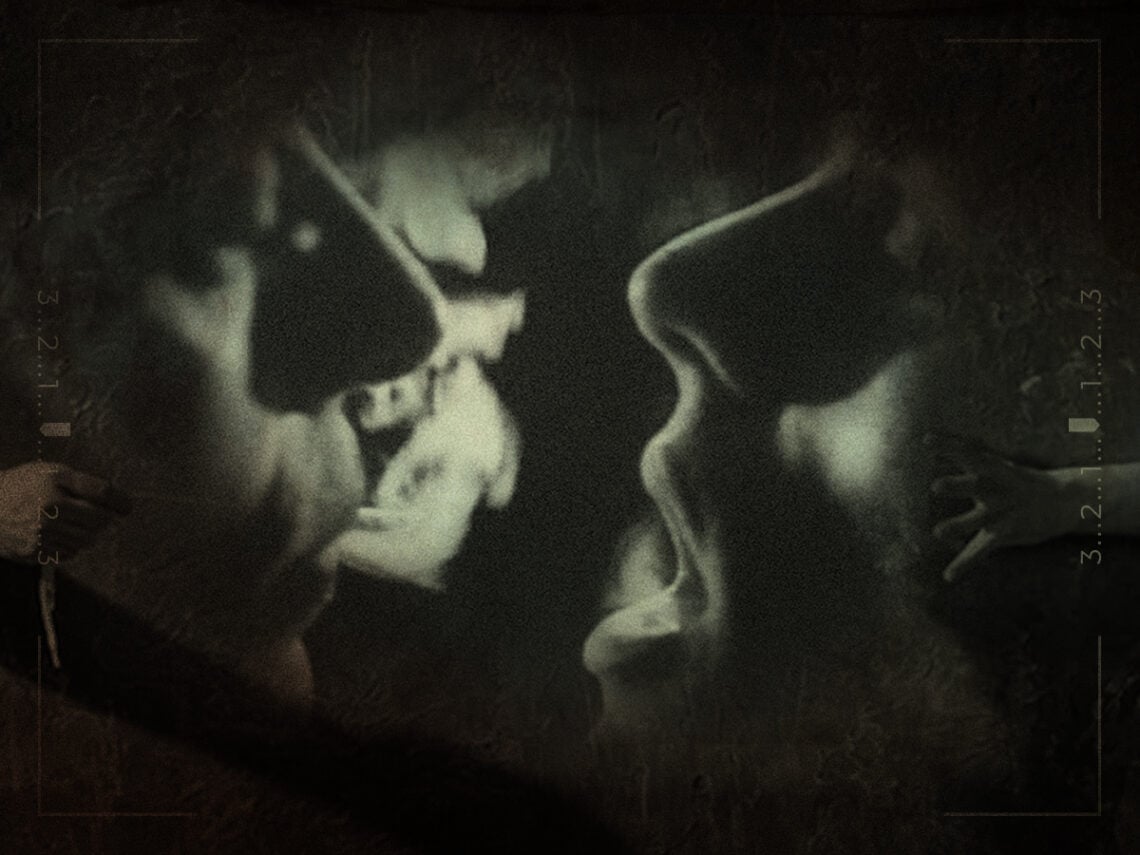
Clocking in at just 25 minutes, Un chant d’amour or The Song of Love, is a silent black-and-white piece of experimentalism honing in on voyeurism and the power of love and desire against a backdrop of repression, where we begin with a scene which shows two hands, one trying to give the other flowers from his prison cell window. Once we’re taken inside the cells, we see the men separated by their walls, but they find ways to communicate. In one gorgeous scene, a straw is placed through a hole in the wall and the pair share cigarette smoke; it’s one of the most quietly erotic things you’ll ever see.
There are various shots of fully naked men, and in some sequences they’re on top of each other, holding and caressing each other. In another scene, a man strokes his own penis as the guard spies on him, while a later sequence sees the guard thrust his gun into a prisoner’s mouth. For 1950, it was pretty groundbreaking. Films just didn’t show this kind of thing, and of course, in many places across the world, homosexuality was strictly outlawed.
The film was a bold and uncompromising act of cinematic and personal rebellion for Genet, using close-up shots of body parts and evocative, shadowy imagery to portray hidden and secretive eroticism, yet, due to its explicit approach to homosexuality, it struggled to be screened anywhere, and it took four years for the movie to be shown in public.
So, while it might have been shown in 1954, the film soon found itself the subject of much outrage when people attempted to screen it over subsequent years, such that a distributor named Sol Landau attempted to screen the film in California in 1966, but he was soon told he’d be arrested as a result. Taking the issue to court, he was denied permission by several local courts, as well as the US Supreme Court, which saw the film as nothing more than pornography. The fact that this film ‘promoted’ homosexuality was a major problem, and it was deemed perverse and disgusting, rather than a beautiful and erotic exploration of same-sex desire.


A few years before, the film had entered the controversy associated with the banning of Jack Smith’s Flaming Creatures, for the screening of which director Jonas Mekas was arrested due to its similarly controversial and queer content. To raise money for their legal defence, Mekas tried to screen Un chant d’amour, knowing what he was doing, of course, but that only led him to get arrested on obscenity charges.
Decades on, Genet’s popularity has prevailed, although Un chant d’amour remains a relatively unknown work from the iconic artist. That’s down to its long-term bans across France and the United States, but now, with just a few clicks, you can easily find it for free online.
