


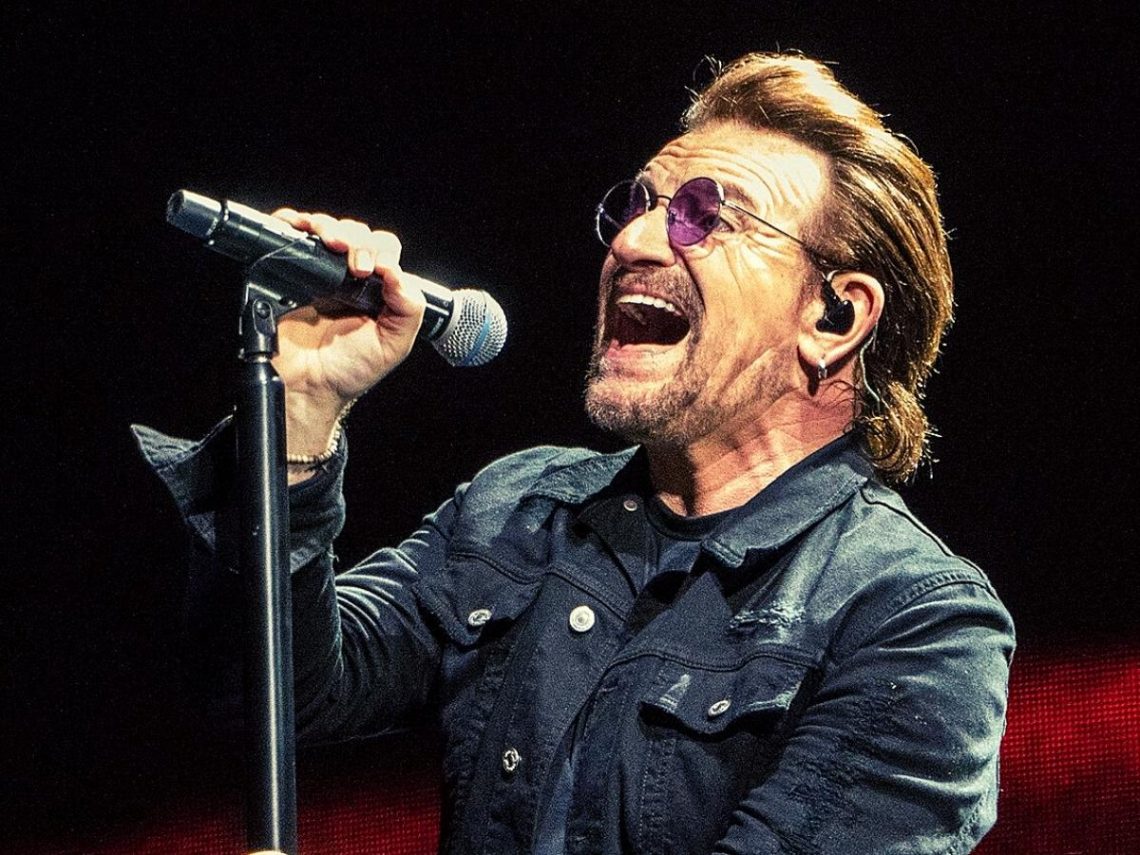
‘Love Rescue Me’: The U2 song co-written by Bob Dylan

Like most songwriters of the late 20th century, Bono has both admired and envied the songwriting prowess of Nobel Prize-winner Bob Dylan. Having gripped the zeitgeist of a countercultural generation in the 1960s using poignant, politically-driven folk material, the troubadour began to broaden his scope to give rock music a sharp poetic edge for the decades to come.
As frontman of the Irish rock group U2, Bono became one of the world’s most successful musicians over the 1980s with a unique approach to anthemic pop-rock music at a time when synth-pop groups were all the rage. Consolidating his legacy over the past four decades, Bono also devotes much of his time to philanthropy and political activism.
Like Dylan, Bono has used music for the power of political persuasion. While U2’s material is, for the most part, dissimilar from Dylan’s associated style, the influence of Dylan on Bono isn’t difficult to hear. Further to this, Bono has seldom let a year go by without professing his sincere admiration for the American legend.
In glowing tones, the Irish singer once proclaimed, “Music can change the world because music can change people.” Dylan certainly changed him. When he was young, his voice rang out like a beacon of truth and poignant purpose. As Bruce Springsteen put it, “He planted a flag, wrote the songs, sang the words that were essential to the times, to the emotional and spiritual survival of so many young Americans at that moment.” The same was true all over the world, leaving a young Bono longing to meet his hero.
The pair first interacted in 1984 when Bono was given a chance to interview Dylan for the Irish music publication Hot Press before he took the stage at Slane Castle. Later that evening, Dylan invited the U2 singer to join him on stage for a performance of the Blonde on Blonde cut ‘Leopard-Skin Pill-Box Hat’. Sadly, the moment was spoiled when Bono forgot his lines under the pressure of the moment.
In 2020, Bono shared an open letter addressed to Dylan, where he enigmatically professed his love for the songwriter and recalled their meeting in 1984. “It could be Blowin’ In The Wind… like I was in Slane Castle, making it up as I went along,” the Irish singer started. “You let me sing beside you. You reminisced about Liam Clancy and Tommy Makem in the West Village, encouraging me, ‘You’ve not just got to make your own song up, you got to make yourself up too’.”
The message continued: “In the scriptures, the apostle John has his view on Blowin’ In The Wind… John 3:8 ‘The wind blows wherever it pleases. You hear its sound, but you cannot tell where it comes from or where it is going. So it is with everyone born of the Spirit.’”
Although Bono may hold remnant embarrassment over his slip-up while singing ‘Leopard-Skin Pill-Box Hat’, it appears he looks back on the interaction with fondness. Dylan was ostensibly unperturbed by Bono’s performance, too: the pair became well-acquainted through the mid-1980s and even wrote a song together.
So, which U2 song did Bob Dylan help Bono write?
Undoubtedly, Bono felt like a kid in a candy shop when Dylan joined him for a songwriting session in Los Angeles in the winter of 1987. At the time, U2 were sculpting their hybrid live/studio album, Rattle and Hum, and touring in support of The Joshua Tree; Bono feared a new song he was developing, ‘Prisoner of Love’, was lyrically derivative of a Dylan track.
Since Dylan was living in Malibu at the time, Bono swung by to ask whether the drafted lyrics were, in fact, his. Dylan confirmed the lyrics weren’t plagiarised, and as one thing led to another, he agreed to help Bono finish the song. Once completed, the song title was changed to ‘Love Rescue Me’.
Initially, Dylan recorded lead vocals for the song, but he later asked Bono not to release this version due to agreements he had signed with his supergroup, The Traveling Wilburys at that time. The track became one of two songs on Rattle and Hum, for which Dylan was credited. The other was a cover of ‘All Along the Watchtower’.
In typical Dylan fashion, there is both an immediacy to the rolling song, and a mystic faraway obfuscation. It is as potent as a downpour, and as unknowable as tomorrow’s forecast. For U2, it is also an enormous point of pride and a glowing endorsement.

Never Miss A Tale
The Far Out Bob Dylan Newsletter
All the latest stories about Bob Dylan from the independent voice of culture.
Straight to your inbox.