


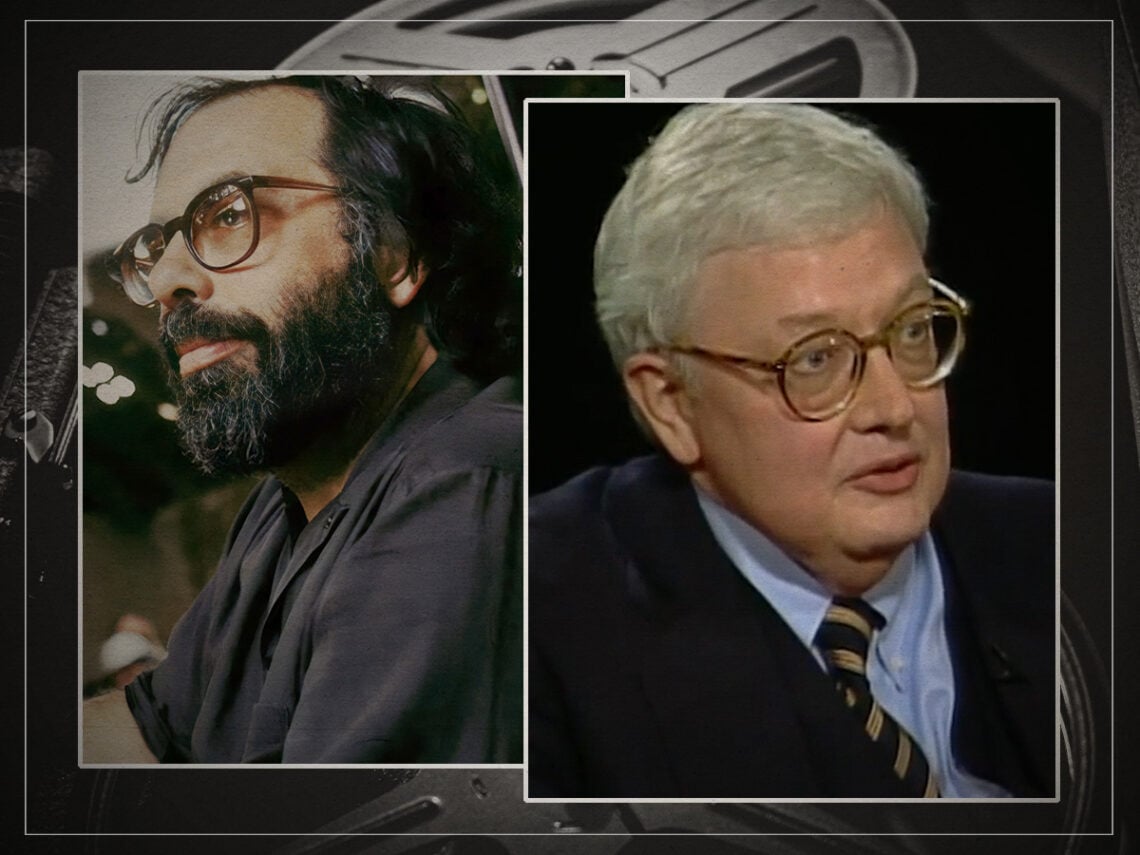
The two Francis Ford Coppola movies Roger Ebert hated: “A sharp disappointment”

Roger Ebert began his illustrious career in film criticism in 1967 when his first review for the Chicago Sun-Times was published. A mere two years later, Francis Ford Coppola’s directing career began when his debut movie, The Rain People, was released. On September 16th, 1969, Ebert awarded Coppola’s first film his full four stars, dubbing him a shining example of a new breed of experimental American filmmakers. Over the next 50 years, Ebert followed Coppola’s work closely, giving the director favourable reviews more often than not, aside from the two misguided efforts he absolutely hated.
It is genuinely fascinating to examine Ebert’s assessment of Coppola’s filmography because no other director has experienced dizzying highs and catastrophic lows quite like Coppola. However, along the way, Ebert was notably kinder to some of Coppola’s flights of fancy than other critics.
Naturally, Ebert awarded the full four stars to each of Coppola’s undisputed classics of the 1970s. This makes perfect sense because the idea of any critic not marvelling at the cinematic mastery on display in The Godfather, The Conversation, The Godfather Part II, and Apocalypse Now sounds vaguely insane to cinephiles. However, in the ’80s, Coppola struggled to maintain unimpeachable quality in his films, and Ebert’s reviews reflect this. He gave two stars to One From The Heart, and two and a half to The Outsiders, Gardens of Stone, and Tucker: The Man and His Dream.
Interestingly, in the mid-1980s, Ebert doled out his full four stars for Coppola’s two best films of the decade: The Cotton Club and Peggy Sue Got Married. These movies were generally well-received, but not quite to the rapturous level with which Ebert celebrated them. He then started the ’90s by awarding The Godfather Part III a staggering three and a half stars, which showed that he was more than willing to champion a Coppola movie that most critics begrudgingly accepted at best, and hated at worst.
All this is to say that Ebert was always an admirer of Coppola, even when the iconic director made films that prompted other critics to sharpen their knives. In fact, his propensity for going easier on Coppola than some of his peers made his cutting one-and-a-half-star reviews of 1996’s Jack and 2007’s Youth Without Youth stick out like a sore thumb.
Now, before getting into what Ebert thought of Jack, which starred Robin Williams as a ten-year-old with a condition that made him age incredibly quickly, it’s worth noting that it received vitriolic reviews across the board. This was a saccharine comedy-drama that was neither funny, nor dramatic, nor moving, and critics tore into it with gusto. Still, it was slightly unusual to see Ebert follow suit by declaring, “Jack doesn’t want to be a great movie. It only wants to pluck the usual heartstrings and provide the anticipated payoff.”
Having said that, Ebert’s review of Jack is still notable in that he is very reticent to criticise Coppola personally. Most of his ire is directed at Williams and the screenwriters, while Coppola gets off relatively lightly. Perhaps he wasn’t quite ready to fully take the director to task – but the same can’t be said for his Youth Without Youth review, which came after the helmer took a ten-year break from directing.
If they say absence makes the heart grow fonder, the opposite applies to Ebert when he sat down to watch Coppola’s supposedly triumphant return to the screen. Instead of being met with a return to form, though, Ebert saw Coppola flailing to make his fantasy-drama meditation on time and consciousness coalesce into a coherent film – and failing at every turn.
“Youth Without Youth proves that Francis Ford Coppola can still make a movie, but not that he still knows how to choose his projects,” a devastated Ebert wrote. “The film is a sharp disappointment to those who have been waiting for ten years since the master’s last film. The best that can be hoped is that, having made a film, Coppola has the taste again, and will go on to make many more, nothing like this.”
