


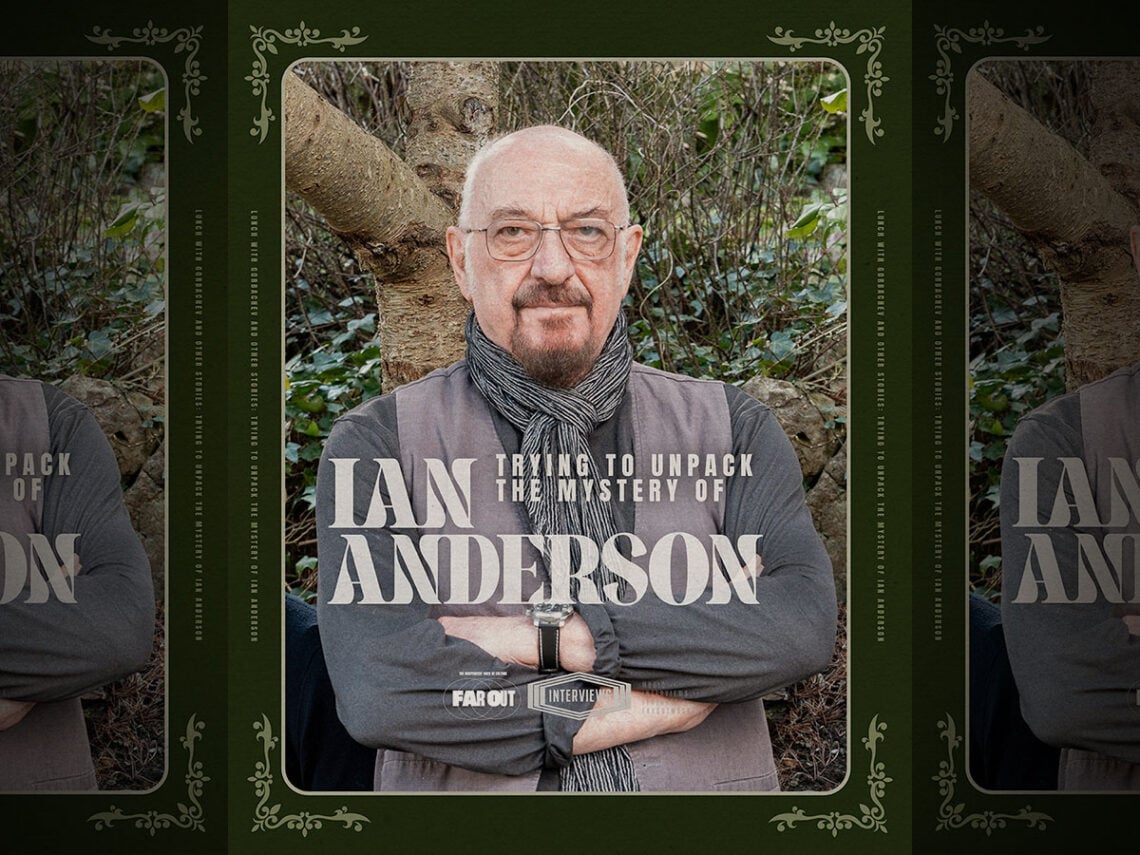
Lunch with Gorbachev and other stories: Trying to unpack the mystery of Ian Anderson in 30 minutes

Prog rock is inherently hard to define, and Ian Anderson, the flute-playing, lyric-writing rock star, remains a by-product of that mystique.
The man takes many forms. Dart back decades, and you’ll see him prancing around pre-Glastonbury wearing flamboyant tights and blowing raspberries into ol’ reliable. Catch him onstage now, and that music is still prevalent, but the theatre is somewhat subdued. As he faces me, a cold morning in December, the stage aesthetic is left behind, with Anderson talking through a Zoom screen, eyes forward, a humbly decorated room behind him.
Peruse the prog pioneer’s discography, and you’ll be perplexed by its haphazard nature. Given prog rock is loosely defined as rock music with other bits added, there really isn’t much of a limit on what kind of sound such artists can put out into the world. The result is a musical mind that seems entirely impenetrable, so that morning, as the bespectacled icon stared thoughtfully forward, it felt like a chance to unpack a musical mystery.
That’s all good in theory, but it becomes immediately evident that this won’t be easy, for a simple “How are you?” is answered with, “That’s how most people begin, and the answer I always give is ‘Well, about the same as yesterday’. And that’s called continuity, which at my point in life, continuity is something I’m very grateful for.”
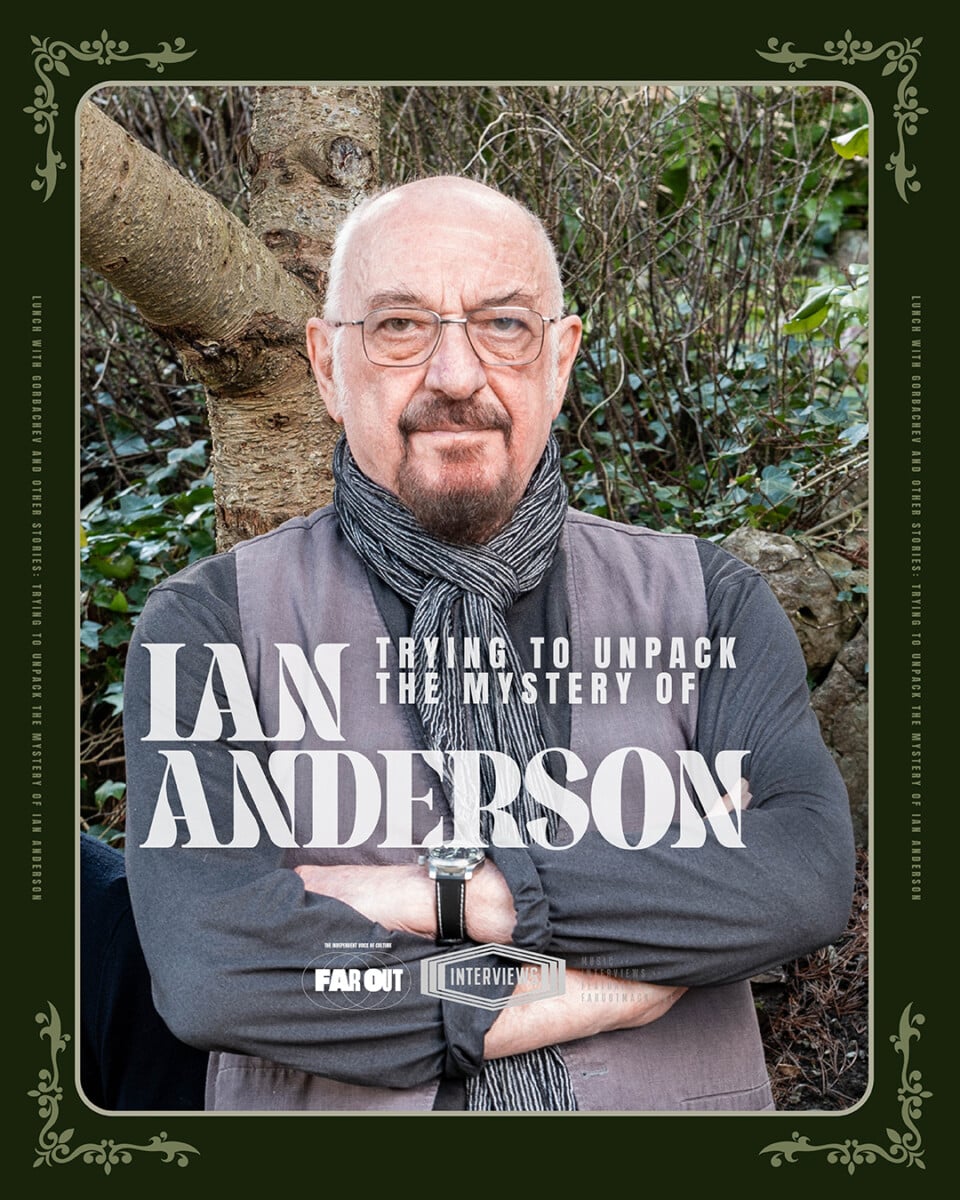
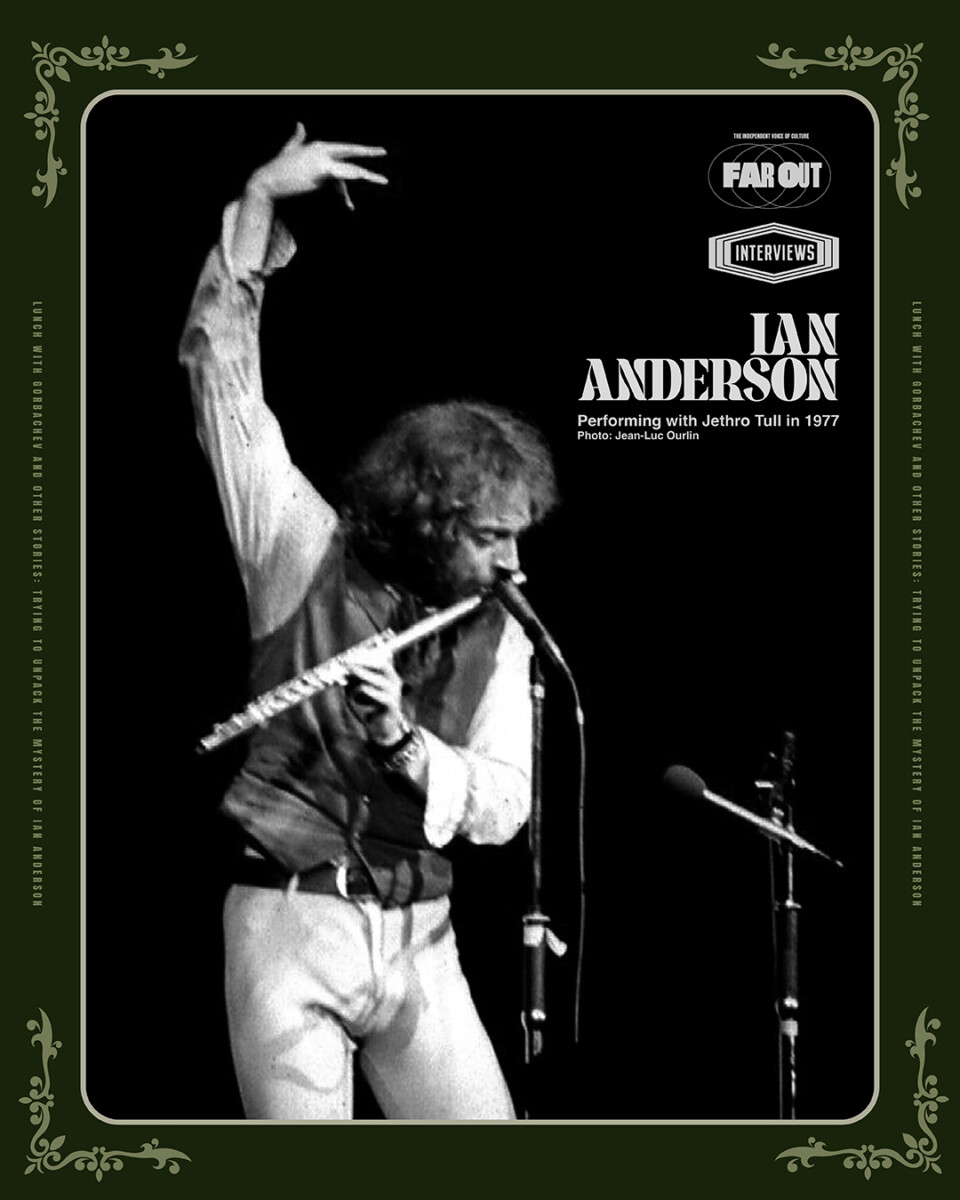
Is that reflected in his music? The fluent in flute affiliate has always been somewhat reluctant to hang up the woodwind; whether it’s in a band or on his own, Anderson seems to always be making music and always on the road. The decades roll on by, but even at 78, the Jethro Tull frontman shows no signs of slowing down.
“It was my aspiration, my chosen profession back in, I suppose, about 1967, when I decided I really wanted to give music a go. By 1971, ’72, I thought, well, things are going OK. You know, with a bit of luck I could continue to do this as a life’s work rather than just a few years of heady youth,” he said, “Luckily, in the world of art and entertainment, we frequently are able to die with our boots on in the sense that we are not going to have retirement forced upon us like a British Airways 777 pilot or an astronaut…or a racing driver. I mean, there comes a point when, you know, you’re going to be told ‘Hang up your hat, it’s over’, but luckily in terms of what I do, that doesn’t happen.”
Anderson continued, “There is a slight feeling of wondrous awe and anticipation about the final years and what they may hold in terms of job satisfaction, and perhaps, more importantly, the satisfaction that you try to give to the people who come to your concerts and buy your records.”
It begs the question, when will the end be? At what point will Ian Anderson decide that that’s enough excitement and entertainment for one lifetime? Sure, music might be a profession with more longevity than others, but there still has to be an end date.
“It would seem a bit churlish to pack it in now,” he told me, “But I still have to be realistic. The end, while it’s not in sight, it is a glimmer on the distant horizon that is going to come ever closer. And when it does get sufficiently close to me to have to make the announcement ‘This is Jethro Tull, the final tour’ then I won’t, because I don’t believe in announcing such things.”
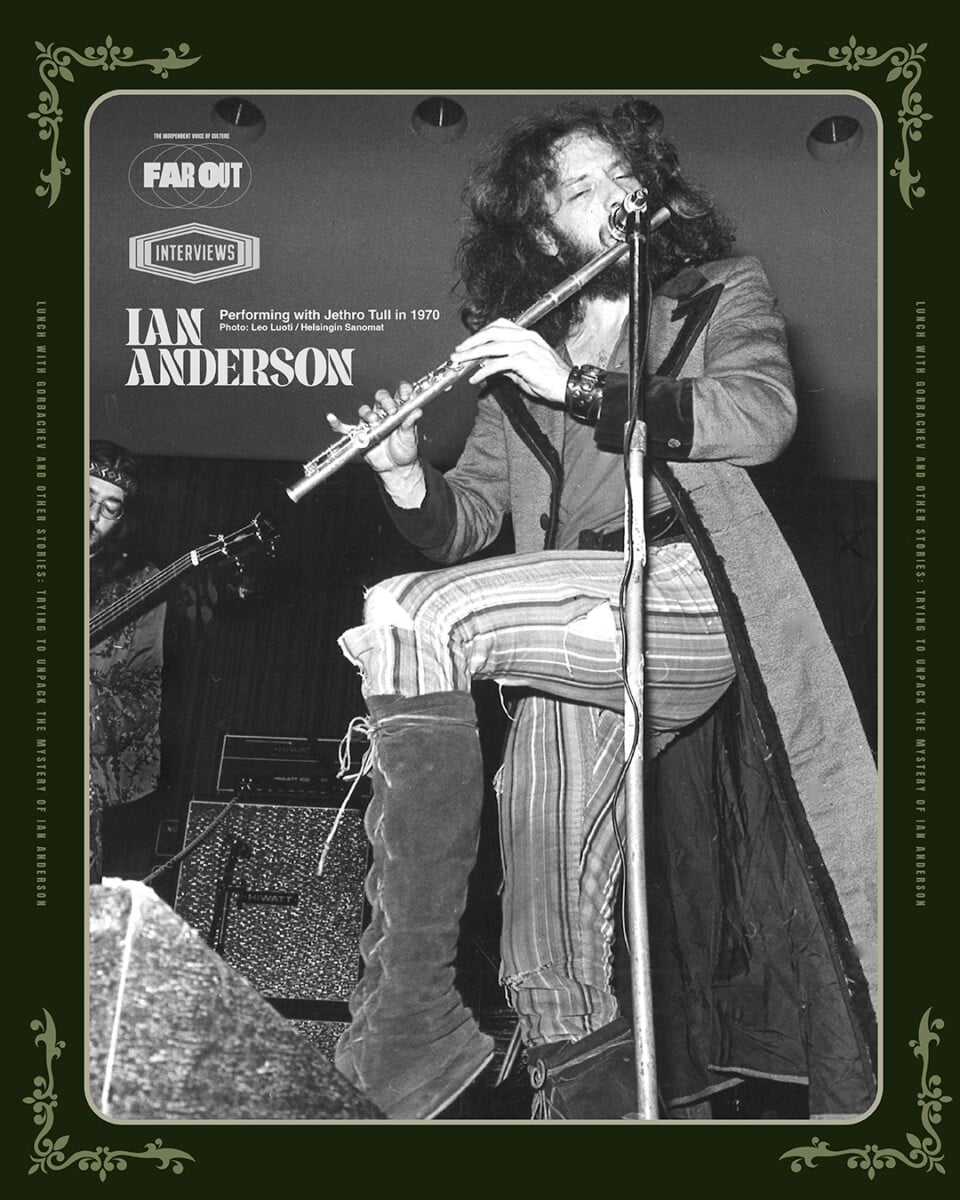
So, Ian Anderson is in the business of ripping out the last page of the book as the prog superstar clearly doesn’t believe in endings.
“I think there is a time when you simply just won’t be noticeable there anymore, when the tour dates page on the Jethro Tull website will just be blank,” he adds. “That’s going to happen. It won’t happen next year because I’m booked up through to December, but let’s say in 2027, maybe that could be the time that it’s all over. Maybe it would be 2030, 2035, it all depends on physical and mental health, and whether or not Mr Putin decides to go nuclear.”
A random political nod towards the end of his answer, sure, but that seems to be something which Anderson has an affinity for. A lot of what I believe to be relatively harmless questions are met with an endless barrage of rolling consciousness. The man has no filter, both in what he says and how much he says of it.
For example, we talk about his reluctance to stray too far from home for future shows and the unlikelihood that he will go further than Europe. Given he has some European shows coming up in 2026, it seems appropriate to ask where he’s looking forward to going back to. Maybe I shouldn’t be surprised that a mind capable of everything Anderson has done, from Aqualung to Christmas albums, can spin such a question so that it covers immigration, Mark Almond and the birth of Christ, but nevertheless, I was somewhat perplexed.
“Bradford. Odd choice. Bradford,” he declared. “I played in Bradford Cathedral at a fundraiser some years ago, and I was kind of struck with Bradford as one of those cities that I don’t think I’ve been to very often. It’s quite interesting walking through the centre of quite a busy, large town-small city, feeling a little bit like Mark Almond in Southport in 1969. The archetypal only gay in the village, as it were.”
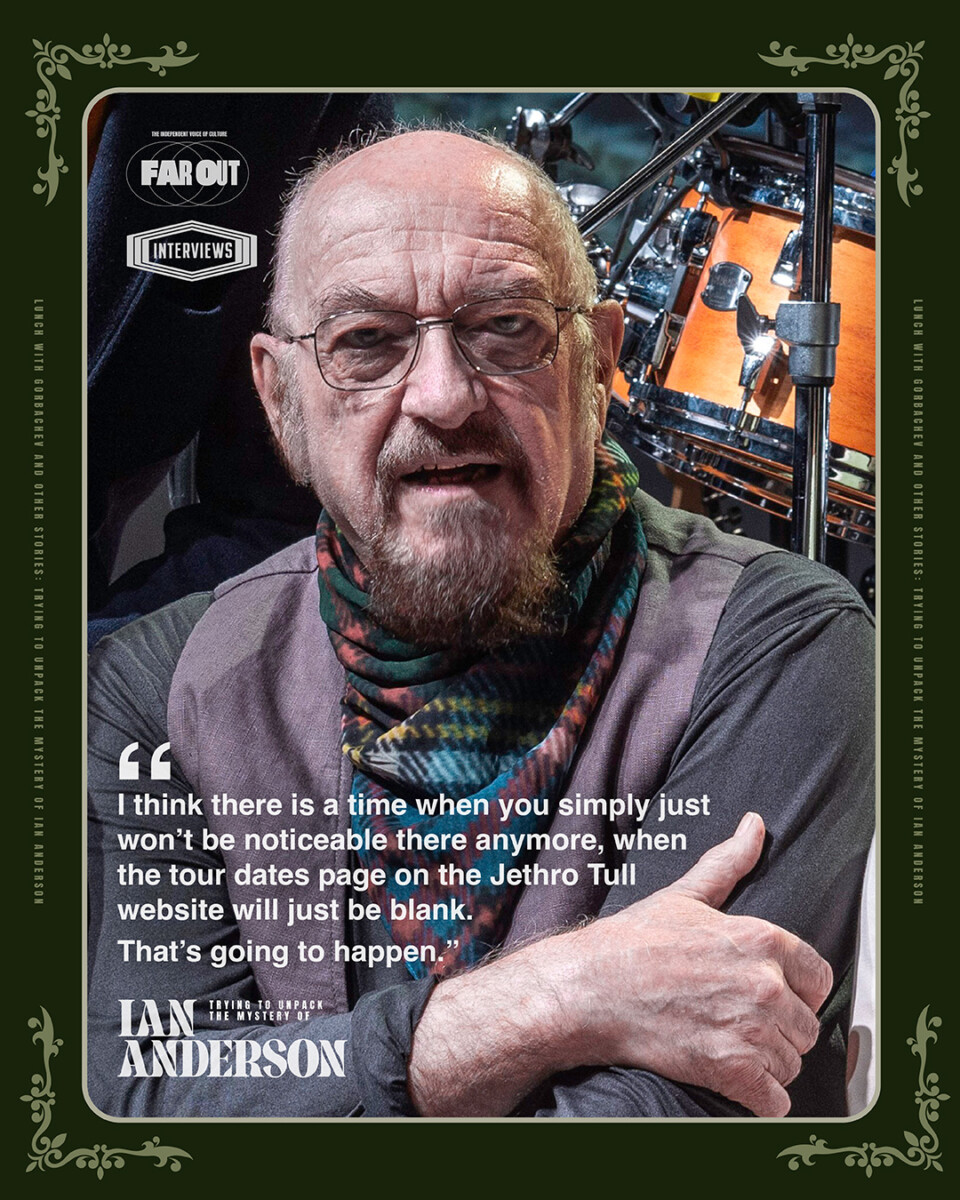
“I, walking through Bradford, felt the last time I was there, you know, I was the only white guy in the village, because everyone was Asian or Black,” he said. “And so, there’s something quite sobering about being in the midst of a society where you are forced to consider that we, willingly or unwillingly, are playing host to the enormous and often beneficial aspects of immigration, particularly following partition in India, 1947.
“A huge influx of Indian, Bangladeshi, Pakistani people who came to make their lives in the UK, working in the factories and running the corner shops, bless them, without which there would be no corner shops,” Anderson highlighted the importance of immigrants, especially with the hostile attitudes towards them in the UK and beyond.
“And so, those stereotypes, however some people might find them insulting, them, to me, are quite important about the world in which we live in,” he adds. “Like many aficionados of Asian cuisine, I eat Indian food. Well, chances are it’s 80% more likely we’re eating Bangladeshi food because the majority of Indian restaurants are actually run by Bangladeshi families, so they kind of, to a degree, do represent a very, very big emphasis in what have become the habits of British people. White, grey, black, brown and in between, you know, we all have to accept that we enjoy something,” he offered sagely, before moving on (unprompted) to talk about modern immigration, and the ongoing debate surrounding it in the UK. I should stress, I asked him where he was excited about going on tour.
“We didn’t resent them in the way that we tend to resent immigration today,” he adds. “Partly because of the scale of immigration today, and partly because of, I suppose, the reason people are doing it as a cold-hearted wish to benefit from, you know, the social welfare and the care attention that they get. But, you know, there comes a time when, rather like Mary and Joseph in no short terms, visiting Bethlehem and there being no room at the inn. You know, someone had put up a sign saying ‘No Vacancies’ and that’s kind of where we’re at today, I think, with immigration.”
Balance in a new world becomes the keyword as he goes on, “We are struggling and creaking under the weight of a population that is definitely not as hard-working as many of those early immigrants from Asia and the West Indies in the ‘50s and ‘60s. I think times have changed, and we have to accept that it is a different world, increasingly so, and there is an overwhelming swing of the pendulum taking place to be very anti-immigrant. The balance and the moral position must surely lie somewhere in between. It’s not the way necessarily to win elections, to adopt a middle ground, we know that.”
We spoke more about immigration, and Anderson seemed relatively balanced on the whole thing, mimicking the sentiment of a lot of the centrist UK. He doesn’t agree with the Reform Party, but he also wants control. I suppose I shouldn’t critique his mind for going towards the subject, given it’s now tied with the weather as the most commonly talked about thing in this country, but the Jethro Tull frontman didn’t stop there with his off-piece rambling.
For instance, shortly after our chat on what the UK’s immigration policy should be, he asked and answered his own question about other cities he wants to visit as a tourist. First, he says Lisbon, because it’s nice, and then other cities for other reasons…
“Those like Munich and Berlin are kind of easy ones, I’ve been there so many times over the years, they feel almost like a second home in some ways. I do thoroughly enjoy those cities,” he says. “And partly, I suppose, because being a creature of the immediate post-war and Cold War, I am drawn to cities that have their dark side of history embedded in them, which Munich and Berlin both do. And Prague, for instance, another city that has a strong, historical, and dark past in terms of initially the Nazis and then the Eastern European cities that were being controlled with the reigns of a USSR tough boy. Long before Putin, of course, we had the other guys.”
There’s more, “Gorbachev is probably the only one who, almost unwittingly, steered Russia away from its isolation and brought a temporary end, at least, to the cold war years and gave so many countries their dignity back as well as their territories. Gorbachev, I think, deserves a much better place in history than he has, particularly in Russia itself, where he is remained reviled in his removal from power. Yeah, Gorbachev is a pretty important guy. I had lunch with him once, and he struck me as a man with great principle. If there was something he was passionate about, he would thump the table and be really outspoken, whereas in his public appearances, he never really did that.”
I never knew he had dinner with Gorbachev.
“We had lunch, not dinner”.
Sorry, lunch.
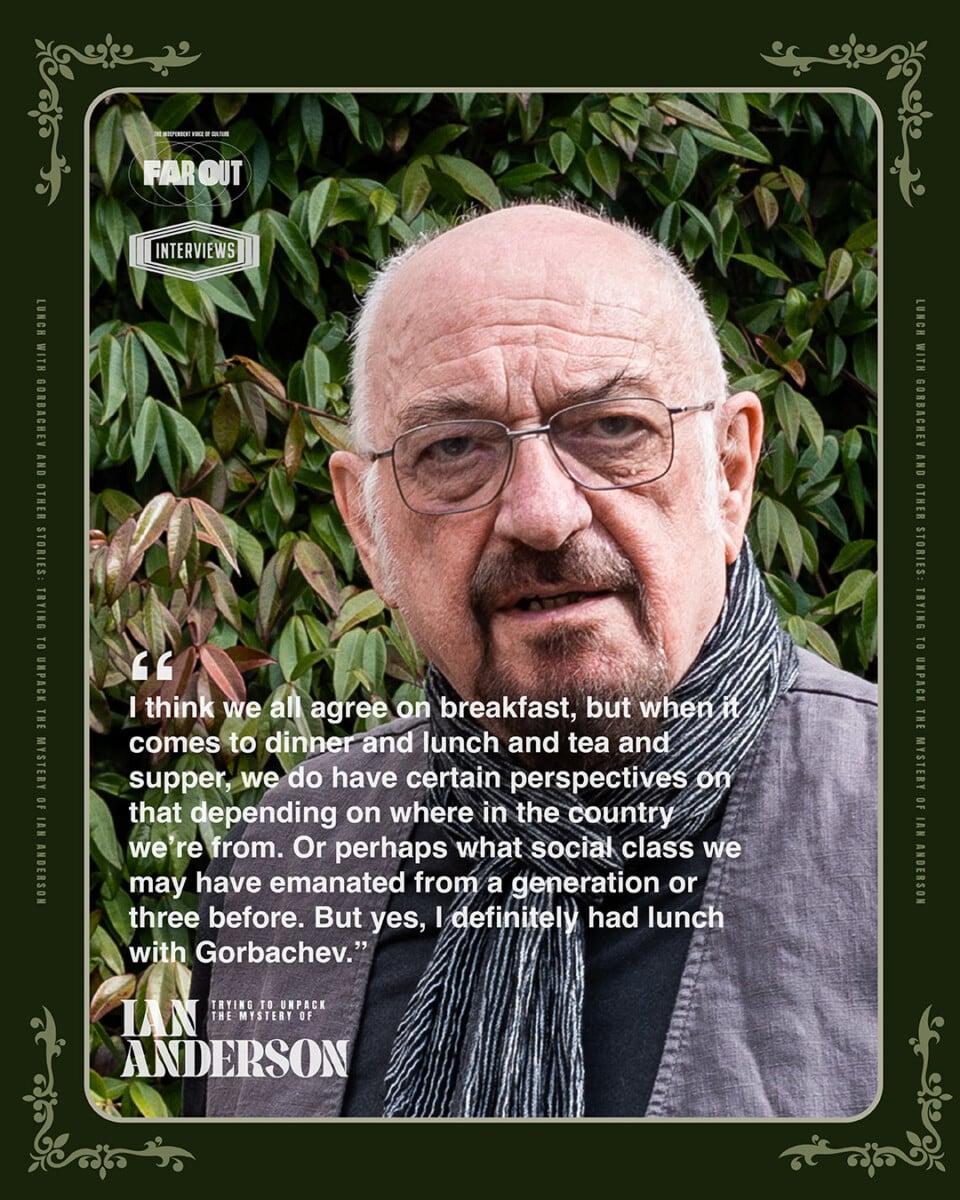
“The nuances,” off he goes again, “I think we all agree on breakfast, but when it comes to dinner and lunch and tea and supper, we do have certain perspectives on that depending on where in the country we’re from. Or perhaps what social class we may have emanated from a generation or three before. But yes, I definitely had lunch with Gorbachev.”
As our interview rattled to a close, it dawned on me that the two of us had hardly spoken about music. In a last-ditch effort to better understand the complex world of prog, I asked him for the albums which he would suggest for people who aren’t familiar with the genre. Given the two of us spoke for over 30 minutes, I had grown used to the sound of Anderson’s soft voice, as he weaved his way through his own thoughts, drifting from topic to topic, landing on islands, looking around and moving again.
It was hard to follow. God knows what it will be like to read, but in those final minutes, hearing him talk about music, it acted as a reminder of how much of an understanding he has of his own art. This was a failed attempt at unravelling the mystery of one of our greatest prog minds, as the closest I came is below, and we didn’t even make it out of the ‘60s.
“I suppose one of the precursors before it was really being called prog rock,” he said, “Probably at a time when maybe progressive rock had just being maybe mentioned for the first time in the British music press, it would be the band The Nice, which featured Keith Emerson, who went on to be in Emerson, Lake & Palmer, a true prog rock band years later. But yes, I would go with The Nice and their first major album, which…name escapes me. That was something that got me fired up.”
Anderson continued, “I could also include Piper at the Gates of Dawn and The Beatles’ Sgt Pepper’s in 1967, released only three months apart from each other. Those two were a signpost saying, ‘Progressive rock this way’. They were intriguing because they were a sign of things to come.”
