


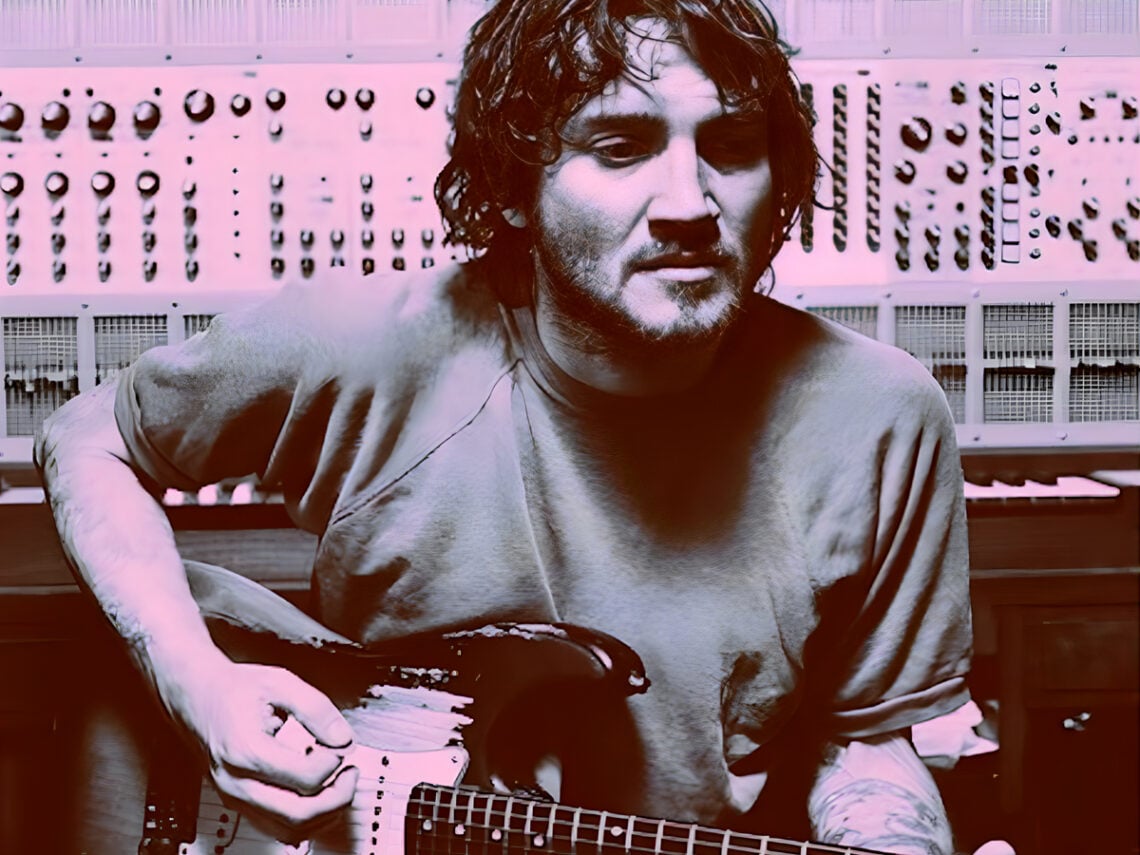
“True art”: The album that saved John Frusciante’s life

Music has always been life’s great equaliser. Whatever divisions society tries to put in place seems to vanish at the striking of the first note in any recording or live show. It’s how bonds are forged between people of different genders, classes or, in this case, nationalities. For it is the music that allows a West Coast dweller like John Frusciante to be spiritually connected to Macclesfield legend Ian Curtis.
As the 1980s bled into the 1990s, the plates of musical culture began to shift, with darkness injected into the otherwise enthusiastic disposition of indie music. On domestic shores, bands like The Stone Roses were gritting the shiny roads of house music in preparation for the Oasis steam-roller to come through. While in the US, the super-slick products of 1980s hyper-capitalism had disillusioned masses of music listening audiences, leaving a void for a heavier brand of rock to emerge.
While their styles were appropriately contrasting for the very different cultures harvested by each country, there was a shared attitude and sentiment toward how art was approached. There was something wider at play within the economic and societal landscape that burgeoning artists were pushing back against.
And while John Frusciante injected a virtuoso style of technical brilliance into the Red Hot Chili Peppers, clearly inspired by Jimi Hendrix, he was profoundly impacted by the work of Curtis and Joy Division.
Writing about a record that changed his life, Frusciante said, “Unknown Pleasures creates an enormous impact with the smallest means; the album benefits from its shortcomings. This is true art and a priceless perspective: that the result can be so much bigger than the stake. I kept that in mind when I later returned to the Chili Peppers and had to learn to play the guitar again. A few years later I was on a solo tour and covered ‘New Dawn Fades’, the heart of Unknown Pleasures. It was my way to say thank you”.
While Frusciante is well known for his face-melting riffs on tracks like ‘Hey’ and ‘Dani California,’ he was also able to evoke a more tender feeling. Heard best on ‘Under The Bridge’ or ‘This Velvet Glove’, his guitar playing allowed Kiedis’ lyricism to tap into something existential in the same way Curtis could.
In the same essay, Frusciante explained what it was specifically about Joy Division that he connected with, saying that after his struggles with heroin addiction, he had “reached a point where I gave up playing the guitar completely”.
He added: “Music was only of passive importance to me as a listener. Back then, I played the music of two bands again and again, and to this day, they are the only real constant in my musical life: Depeche Mode and Joy Division. Not so much because their dark music suited my sinister phase so well, but because of their sense for simplicity.”
Watch below for Frusciante’s solo performance of ‘New Dawn Fades’ and see his admiration for the band’s work in real-time.
