


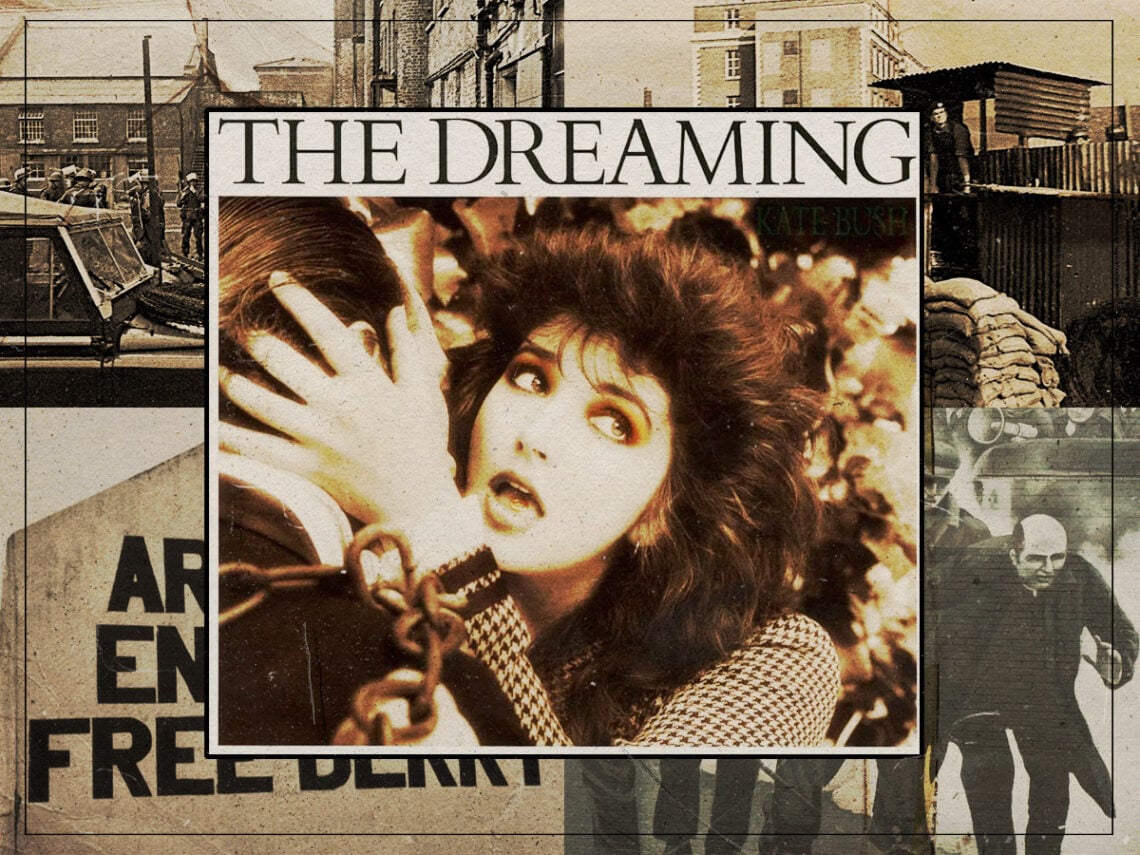
How the Troubles in Ireland impacted Kate Bush’s ‘The Dreaming’

Kate Bush is perhaps one of the most highly regarded British songwriters of the past 40 years. The massive success of her debut single ‘Wuthering Heights’ pushed her into the public eye, becoming the first woman to ever score a number one song in the UK with a self-penned track, and she has remained a beloved writer and musician ever since.
Despite bursting onto the scene in 1978, a time of great political awareness in pop music with the overt political messages of punk rock still fresh in the minds of many and the blossoming 2 Tone movement providing opposition to a rise in right-wing attitudes among Britain’s youth, Bush’s political views have always remained ambiguous, at best.
In recent years, the musician called former Prime Minister Theresa May – responsible for the overtly racist Windrush Scandal, which saw many UK citizens wrongfully deported to the Caribbean – “the best thing that’s happened to us in a long time”. Not a great look for Bush, who later clarified in her book How to Invisible that the comment “was not meant to be political”. Bush has also repeatedly downplayed attempts to view her work as being of a feminist nature, repeatedly telling interviewers that she does not intend for her songwriting to have any feminist meaning, but she does not mind if other people view it as such.
One aspect of her personality that the singer has been open about, however, is her Irish heritage. Bush’s mother, Hannah Daly, was Irish, and throughout Bush’s career, she was never afraid to embrace this heritage. Her fourth studio album, The Dreaming, is perhaps the most obvious example of Bush celebrating her Irish roots. Numerous proud Irish musicians are featured across the album, including members of the notable Irish folk band Planxty on the track ‘Night of the Swallow’.
To understand the significance of the obvious Irish influence on The Dreaming, it is essential to consider the context in which it was made. In 1982, the year of the album’s release, The Troubles in Northern Ireland raged on. The very same year, there were two bombings in London by the IRA, killing eight soldiers, and the nationalist RUC in Northern Ireland implemented a policy of ‘shoot to kill’ against Republican activists. As a result of the Troubles, the IRA’s bombing campaign on the mainland UK, and the ways in which these issues were presented by the UK government and media, anti-Irish sentiment was rife among the general public in Britain. Anti-Irish sentiment was present in employment, media, jokes and just about every facet of social life and culture you can imagine in 1980s Britain.
So, within the context of this widespread Hibernophobia, the celebration of Irish influences on The Dreaming was not only a brave move by Bush, but it was politically significant. Bush was bringing Irish culture and influence into the mainstream of the UK and presenting it in a positive light, something which happened very rarely at the time. She even went so far as to criticise the BBC for its apprehension at playing records by Irish artists. Speaking to BBC Radio in 1982, promoting The Dreaming, she was asked about collaborating with the folk group Planxty, “’cause I’m a bit of a fan of theirs”, the presenter qualified his question with. Bush quickly jumped in, “What do you mean you’re a fan? You never play their music”.
At the height of The Troubles, Kate Bush defiantly celebrated her Irish heritage and the culture of the country in general through her music. Although she may downplay or even refuse the political impact of those actions, they are ultimately undeniable and will continue to delight audiences for years to come.
