


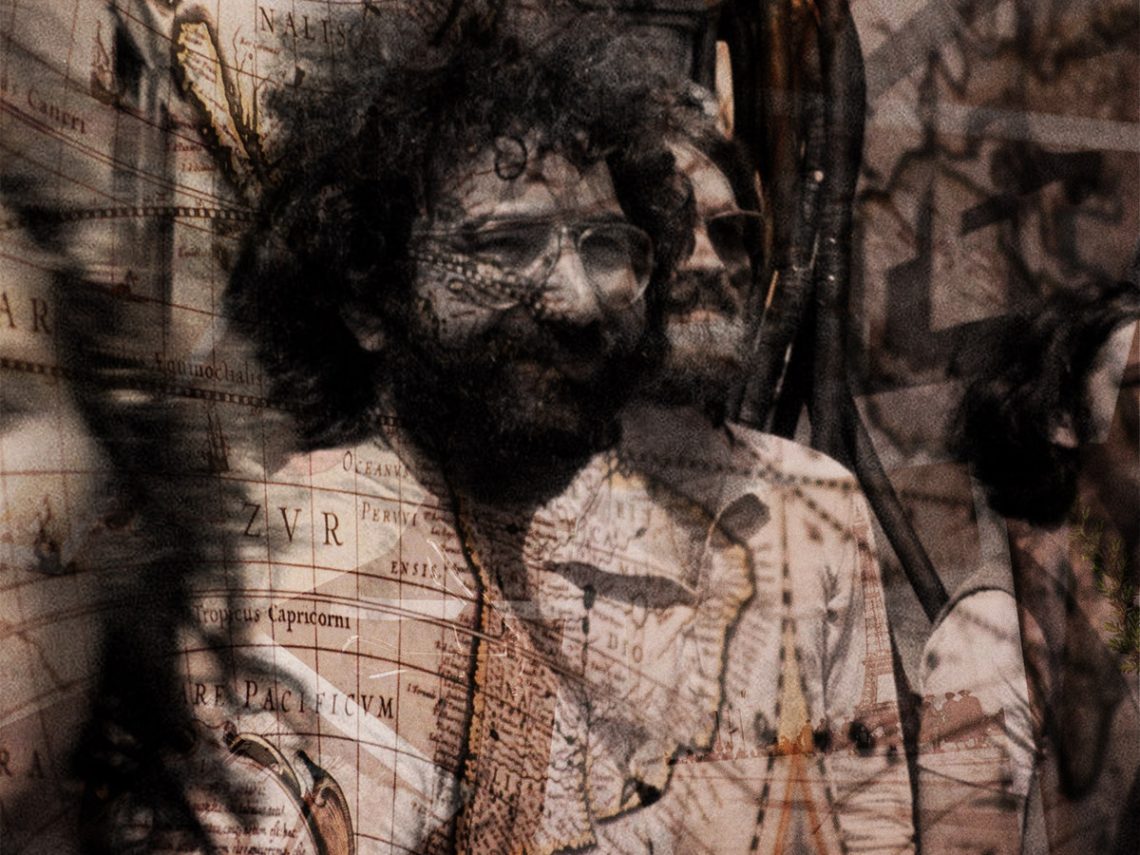
Tripping through the geography of the Grateful Dead

The Grateful Dead always had a singular view of America. Initially inspired by revolutionary beat poetry and Jack Kerouac’s On The Road, the members of the Dead were keen to show a different side of America than the clean-cut 1950s had to offer. What they promised was a freaky and fascinating take on fun. Initially confined to their native California, the Dead’s observations began to expand as they toured throughout America and soon across the globe, leaving a trail of weirdness and mind expansion wherever they went.
By the late 1960s, the Dead had their most valuable asset in translating their trailblazing path: lyricist Robert Hunter. Hunter saw America through his own weathered lens, with old-timey imagery bumping up against psychedelic landscapes. Whether you were taking shifts down at the Cumberland mine or listening to the river sing sweet songs in ‘Ripple’, Hunter found his niche in combining nature observations with American history and new frontiers.
In many ways, the Grateful Dead were the most American of all American bands. With a few exceptions (sorry, Delaware, Arkansas, Wyoming, and North/South Dakota), the Dead went around every state in the Union during their 30-year trek. Along the way, they tuned into some uniquely American characters like Uncle Sam, Casey Jones, and Wolfman Jack, just to name a few. They also made quite a few of their own mythical figures, including Tennessee Jed, Jack Straw, and Cosmic Charlie.
As the band began to extend beyond the borders of the United States, points of reference from around the world began to infiltrate their music. ‘Mexicali Blues’ brought in the bars by the Southern line of the US, while Jack the Ripper and Grosvenor Square gave England some stakes in Dead lore. The group made it all the way to Egypt in 1978; by then, the Dead were truly a global phenomenon.
With each new song came a new setting and a new story to tell. Fascinatingly, quite a bit of the Grateful Dead’s material takes place in specific locations, whether real or fictional. Taking a trip through these realms is a rite of passage for every Deadhead, but keeping track of every stop along the way can get confusing. Whether you’re looking to run through all the real-world locals or simply want to inhabit that set and setting that the Dead unfurl in song, it helps to know where you are at any given time.
Before we get into it, a quick note: we’re compiling only material from original Grateful Dead songs. Thanks to songs like ‘Dancing in the Street’, ‘Big River’, and ‘Promised Land’, we would be here all day if we had to tally every location in the band’s covers. That means no ‘El Paso’, no ‘Deep Elum’, and no ‘Cold Jordan’.
Lace up those truckin’ boots and pull out your maps because we’re trekking through the most prominent locations featured in the Grateful Dead’s classic songs. Broken up by region and the constraints of reality, get ready to dive into every location that you can visit through the original music of the Grateful Dead.
Grateful Dead in America
It should come as no surprise that the Grateful Dead were most infatuated with their home country. Going in chronological order, surprisingly, the first reference to the US wasn’t anywhere in California. Instead, ‘The Golden Road (To Unlimited Devotion)’, the first song from the band’s first studio album, gave a shout-out to a future favourite state by calling out “your mother’s in Memphis”.
Memphis is quite a popular destination in Dead songs, even if it mostly comes up in covers. One original that also features Memphis is ‘Candyman’, where the song’s narrator hails from. Of course, Tennessee has a strong connection to Dead lore thanks to the titular dope that stumbles through ‘Tennessee Jed’.
By the band’s second LP, Anthem of the Sun, it was time to make some hometown references. ‘Alligator’ calls for the destruction of some of the band’s hometown San Francisco venues, with shouts to “Tear down the Fillmore, gas the Avalon.” Oddly enough, it wouldn’t be until the end of the band’s career that their home city would get another shout-out, with both ‘Standing on the Moon’ and ‘So Many Roads’ referencing where the band made their name.
The city’s specific neighbourhoods and general areas got their own call-outs over the years. Ron ‘Pigpen’ McKernan was almost certainly talking about San Francisco’s Chinatown in his Europe ‘72-era ‘Chinatown Shuffle’, while it was Jerry Garcia who highlighted the Mission district in ‘Mission in the Rain’. Bob Weir and John Perry Barlow also got in on the action with their reference to Market Street in ‘Picasso Moon’.
It’s not directly mentioned, but the Wharf in ‘Wharf Rat’ was explicitly inspired by Hunter and Garcia’s observations of down-and-out souls in the city’s waterside areas. Just as well, the titular ‘Shakedown Street’ was meant to reference the band’s Front Street headquarters/studio in San Rafael.
More scattered references to various cities in their home state were made over the years, including Cucamonga in ‘Pride of Cucamonga’ and Bakersfield in ‘Mexicali Blues’. While it wasn’t directly mentioned in the lyrics, the titular speedway in ‘New Speedway Boogie’ was the Altamont Speedway, the home of the infamous Altamont Free Concert in 1969. The Dead didn’t always need to get specific: ‘Estimated Prophet’ follows a looney who just wants to get to California.
The Dead had an interesting relationship with Los Angeles. They recorded their first album there and even attempted a brief move there in 1966, but the difference in attitude and philosophy proved to be too great. Still, L.A. has two distinct mentions within Dead lyrics, appearing in both ‘I Need a Miracle’ and ‘West L.A. Fadeaway’.
Just outside of Los Angeles sits the city of Chino, probably the same place where Jerry Garcia’s narrator has a wife living in ‘Friend of the Devil’. A few hours north is the home of his other wife, this time in Cherokee. ‘Friend of the Devil’ contains a number of notable locals, specifically Reno, Nevada and Utah, where the narrator takes refuge in a cave up in the hills.
Utah isn’t just a one-hit wonder in the Dead’s lyrics, either. Pigpen gave a shout-out to the state in his song ‘Operator’. Other areas mentioned include Texas and Baton Rouge, Louisiana, along with Portland, Oregon. Not to be outdone, Phil Lesh mentions the state of Oregon as well in ‘Pride of Cucamungo’. Barlow even gave a cursory history lesson in Mormonism in the lyrics to ‘Salt Lake City’, which also mentions Des Moines, Iowa. Evidently, the Dead had more than a casual preoccupation with Utah.
There are two notable contentious locals in the Dead’s world. There are a ton of Cumberlands for ‘Cumberland Blues’ to take place in, but being a native of the state, I like to think it takes place in Maryland’s city of that title. The other is Fenarrio – ‘Dire Wolf’ doesn’t specify where the town is, but the Dead’s cover of ‘Peggy-O’ puts it in Louisiana.
All of the Grateful Dead’s geographical name drops were simply lead-ups to their crowd jewel of road songs, ‘Truckin’. The autobiographical recitation of the band’s nonstop touring and 1970 drug bust, it’s fitting that New Orleans and Bourbon Street become the primary settings of the song. It wouldn’t be the last time that the Dead mentioned New Orleans: both ‘Reuben and Cherise’ and ‘Liberty’ memorialize the city. It’s not specific, but the Bayou in ‘Easy Wind’ is probably also referring to Louisiana.
The other major stop in ‘Truckin’ is New York, a city that became the Dead’s home away from home across their 30 years together. The City is where the Dead give most of their attention, including dropping it into the songs ‘Ramble On Rose’ and ‘So Many Roads’, but Truckin’ references a much colder area of the state, Buffalo. ‘Truckin’ is a veritable citizenship test for the US, finding room to mention Chicago, Dallas, Detroit, and Houston.
The state of Texas gets its own setting in a classic Dead story with ‘Jack Straw’. There are a couple of Abilene cities and towns in America, but when Garcia wants to arm one in ‘Loser’, he’s most likely talking about the one in Texas (or maybe Kansas). Going back to ‘Jack Straw’ reveals a road trip of death that includes stops in Santa Fe, New Mexico; Cheyenne, Wyoming; Tulsa, Oklahoma; Wichita, Kansas; and Tuscon, Arizona.
Controversially, Weir refers to St. Louis as the “City of Blues” instead of Chicago in the lyrics to ‘Black-Throated Wind’. The Midwest isn’t one of the most prominent areas in Dead geography, but a short trip down the Mississippi River will bring you to the eponymous Mississippi from ‘Mississippi Half-Step Uptown Toodaloo’. If we’re talking rivers, ‘Toodaloo’ has another: the Rio Grande. But if you want full bodies of water, you’ll have to return to ‘Standing on the Moon’ to get to the Gulf of Mexico.
Of course, if you’re going down south, you have to include Alabama. The state gets personified as a nagging woman in ‘Alabama Getaway’, but it still needs recognition as a reference point. With that, the tour around the United States comes to a long and strange end., except for one full reference to the entire country in ‘U.S. Blues’.
Grateful Dead worldwide
While the Dead might have favoured the US in their song references, it wasn’t the only part of the world that they spoke of in their lyrics. A few international destinations get a word in, including two distinct references to England. Hunter was fond of Britain, eventually moving there full-time in the 1970s. It’s appropriate then that Grosvernor Square and Carlisle get shout-outs in ‘Scarlet Begonias’ and ‘Terrapin Station’, respectively.
Believe it or not, Mexicali is a real city (the capital city, in fact) in the state of Baja California, Mexico. Some quick hits around the world also include El Salvador and Southeast Asia in ‘Standing on the Moon’, the deserts of Arabia in ‘Blues for Allah’, Jericho in ‘Ramble On Rose’, France in ‘France’, the Serengetti in ‘Serengetti’, and Timbuktu in the early Pigpen song ‘Tastebud’.
Through song, the Grateful Dead have been just about everywhere. If you want to check out a full map of the Grateful Dead experience, check it out down below.

Never Miss A Tale
The Far Out Classic Rock Newsletter
All the latest Classic Rock content from the independent voice of culture.
Straight to your inbox.