


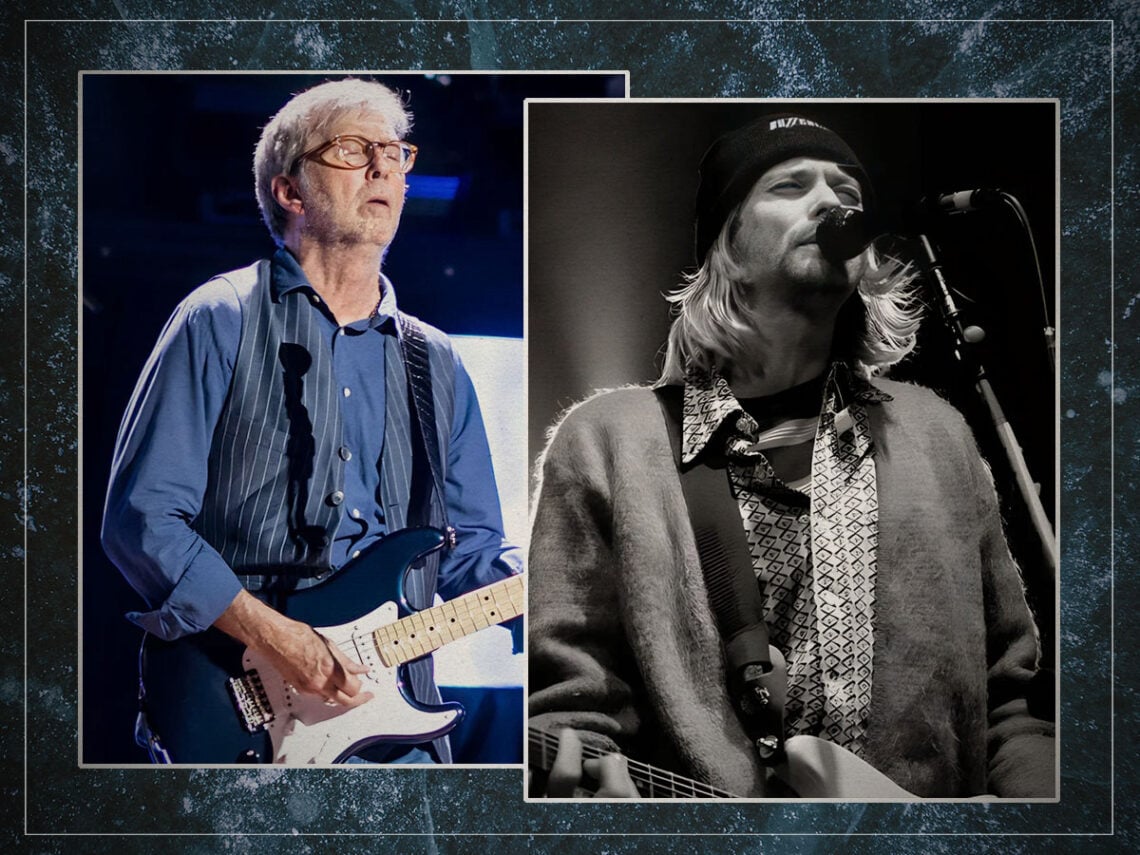
The touching tribute Eric Clapton paid to Kurt Cobain: “I thought he was beautiful”

When people think of the grunge explosion of the early 1990s, they do not think just of the great music created by the likes of Nirvana, Pearl Jam and the Smashing Pumpkins, but of a pop-cultural changing of the guard. Out went the dinosaurs of classic rock colonising the charts with featherweight pop-rock, in came music that actually meant something. One would assume that Eric Clapton, a man who by the early 1990s was coming into his third decade as a world-conquering rock star, would be among the first on the chopping block.
The truth is, though, he was always a special case. After all, Eric Clapton had grown out of the need for any kind of chart success by the time Cream split up. While the 1980s had been something of a banner year commercially, he wasn’t the problem being swept away by the grunge movement. That was the hair metal movement that Mötley Crüe and Def Leppard spearheaded, which by the end of the decade was already showing signs of flagging.
By the 1990s, something had to give. Music fans were crying out for not only something new but something a little more real. The 1980s had been the decade of the giants, where the biggest acts in music had the biggest personalities. Even Bruce Springsteen became a megastar you could identify by a silhouette. When the decade ended, people were sick of cartoon characters and wanted people they could actually identify with.
Younger audiences went with grunge and hip-hop, both authentic voices of the new generation in their way. Older audiences went with something calmer, but no less authentic. The reinvention of Eric Clapton from an electric guitar-toting bluesman to a haunted, acoustic troubadour, combined with the horrific tragedy that befell his family in 1991, completely turned public opinion of him around. The high point of this came in 1992 with the release of his MTV Unplugged session as the live album Unplugged.
Which grunge legend did Eric Clapton relate to?
Still, there’s a world of difference between grunge’s caustic, excoriating howl and Clapton’s blazer-‘n-Gibson combo, so one would assume he’d have no time for the scene turning the pop world upside down. Except Eric Clapton is nothing if not full of surprises. In an interview with Neil Strauss published in the book Everyone Loves You When You’re Dead, Clapton doesn’t just have ebullient praise for a leading light of the grunge scene, but feels that his work can barely compare to his.
Strauss prompts Clapton by asking about the death of Kurt Cobain, specifically whether he felt like that could have been him in another life. Clapton responds in the affirmative, saying, “He was quoted as saying things that I totally identified with. Like being backstage and hearing the crowd out there and thinking ‘I’m not worth it… if they knew what the truth was about me, they wouldn’t like me.'”
However, it’s not just the sentiments that Clapton agreed with. He went on to say, “He was very, very talented and a lovely man. I mean, to my eye. I did this MTV show. And for most part, it was hype and Hollywood packaging and bullshit. And then Nirvana came on, and they blew my mind. I thought he was beautiful.”
Clapton is a complicated man to his core. There is something heartening about the fact that no matter how different the music was, he could always identify a kindred spirit across different generations. Would that we all could do the same as time goes on.
