


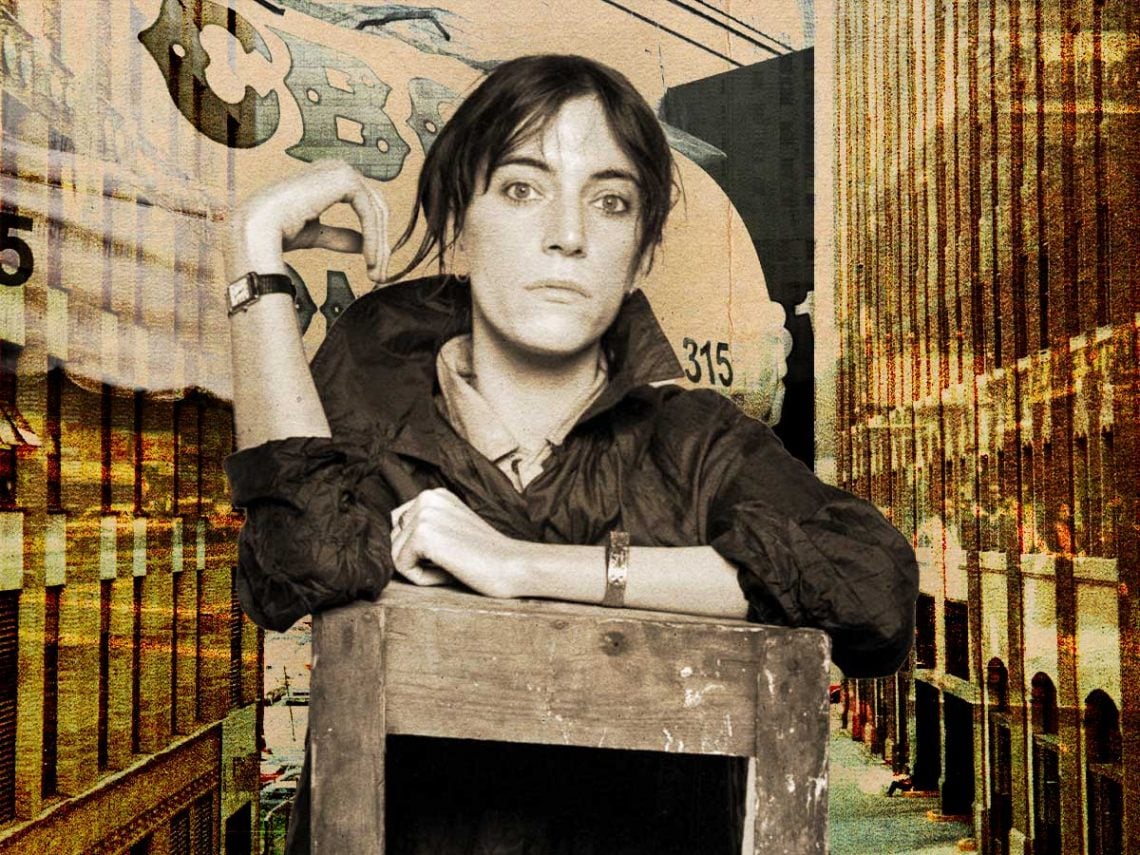
Travel in the footsteps of Patti Smith’s New York

Patti Smith made waves in New York’s punk scene when she released her debut album, Horses, which blended avant-garde techniques with simple chord progressions and spoken word poetry. She is now regarded as a “punk poet laureate” and has significantly influenced artists from Madonna to Johnny Marr and Morrissey to Orville Peck.
During her time in New York, Smith developed an intense relationship with artist Robbert Mapplethorpe, who she saw as her kindred spirit. The pair were bound to each other romantically, platonically, and creatively, remaining close until he died in 1989. On his deathbed, Smith promised Mapplethorpe that she would write a book recalling their life together.
She said: “I wrote it because Robert asked me to… Our relationship was such that I knew what he would want and the quality of what he deserved. So that was my agenda for writing that book. I wrote it to fulfil my vow to him, which was on his deathbed. In finishing, I did feel that I’d fulfilled my promise.”
The result was Just Kids, a gorgeous memoir that details Smith’s move to New York, her relationship with Mapplethorpe, and her rise to stardom. Emotional, tender, and full of music history, Just Kids won a National Book Award alongside countless other accolades.
The city of New York was vital to Smith’s journey as an artist. She wrote: “My few comrades had moved to New York to write poetry and study art and I felt very much alone.” Smith took a leap of faith and travelled to the city with nowhere to stay and no prospects. Soon she met Mapplethorpe, and her life as a New York City artist began.
Here are some essential locations from Smith’s time in New York…
Patti Smith’s New York:
Brentano’s Bookstore and Scribner’s Bookstore
When Smith arrived in New York, she briefly met Mapplethorpe in an apartment, describing him by saying, “I had never seen anyone like him.” Shortly after, she was hired as a cashier at Brentano’s Bookstore on Fifth Avenue, where she met Mapplethorpe again, who came in to buy a Persian necklace.
Eventually, Smith started working at a different shop, Scribner’s Bookstore, also on Fifth Avenue. She enjoyed working in the lavishly-designed building, writing: “It seemed like a dream job, working in the retail store of the prestigious publisher, home to writers like Hemingway and Fitzgerald.”
St. Mark’s Place
After a terrible dinner date which Smith accepted out of desperation for a good meal, she happened to see Mapplethorpe, who she described as looking like “a hippie shepherd boy”, and asked him to pretend to be her boyfriend. They fled the date together and ran to St. Mark’s Place, where Mapplethorpe bought Smith an egg cream at Gem Spa.
Just down the road, Smith played her first gig at the St. Mark’s In-The-Bowery Episcopal Church in February 1971. Here, alongside Lenny Kaye on guitar, Smith read her poetry, including ‘Oath’, which turned into ‘Gloria’ from her debut album.
Hotel Chelsea
Smith and Mapplethorpe’s first apartment together was at 160 Hall Street, Clinton Hill. They stayed in a few more run-down apartments and hotels before moving into the iconic Hotel Chelsea. Rich with history, the hotel has been immortalised in countless songs, such as Leonard Cohen’s ‘Chelsea Hotel #2’, and was the site of Nancy Spungen’s death, the conception of Arthur C. Clarke’s novel 2001: A Space Odyssey, and the home of artists such as Bob Dylan, William Burroughs, and Jack Kerouac.
The pair of lovers stayed in Room 1017, the cheapest in the hotel, costing $55 a week. Smith wrote her first song at the Chelsea, ‘Fire of Unknown Origin’, and Mapplethorpe met Sandy Daley there, who lent him her camera, leading him to fall in love with photography.
Max’s Kansas City
As struggling artists, all Smith and Mapplethorpe wanted was to be noticed by their idols. Luckily, they were in close proximity to Max’s Kansas City, where Andy Warhol and his associates hung out. You could find The Velvet Underground, David Bowie, and Iggy Pop here, to name just a few, and Mapplethorpe was determined to get in and meet his heroes.
Eventually, the pair managed to enter but didn’t make any connections until Danny Fields invited them to sit at a centre table. By 1973, Smith had secured an opening slot for Phil Ochs, and the following year she opened for Television, who had a week-long run at the venue. She also frequently opened for acts at The Mercer Arts Centre around this time, such as The New York Dolls.
CBGBs
In 1973, Tom Verlaine and Richard Lloyd of Television managed to convince the owner of CBGBs, Hilly Krystal, to let them play one night a week. This inspired Smith to ask for her own gig, and she scored one on Valentine’s Day in 1975.
Later that year, Television and The Patti Smith Group would perform together for a seven-week residency, which helped to give CBGBs a reputation as the hottest place in town for underground music. Smith continued to play there regularly. When the venue closed for good in 2006, she was the last person to perform.
Robert Mapplethorpe’s Studios
Located at 24 Bond Street, Mapplethorpe acquired a space here to use as a studio. Smith regularly visited the photographer here, and the pair even filmed a project in the building called Still Moving, which was made as part of a joint exhibition. It was shown at the Robert Miller Gallery in 1978.
Mapplethorpe owned the studio from 1972 until he died in 1989. He created some of his most famous images here, including erotic black-and-white photos that explored BDSM, homosexuality, and the naked form.
Electric Lady Studios
Smith recorded her debut album, Horses, at Jimi Hendrix’s Electric Lady Studios, becoming the first of the CBGBs bands to record an album. She also recorded her debut single ‘Hey Joe’/’Piss Factory’ here, which Mapplethorpe financed.
In a 1977 interview, Smith said: “Electric Ladyland has all these pinball machines and you can get really stoned in Electric Lady.” She also called it “more cosmic than a technically oriented studio.”
Just around the corner from the studio was Sam Wagstaff’s apartment. Mapplethorpe decided to photograph Smith there in a white button-down shirt, and one of these images became the cover photo for Horses.

Never Miss A Beat
The Far Out Punk Newsletter
All the latest Punk content from the independent voice of culture.
Straight to your inbox.