


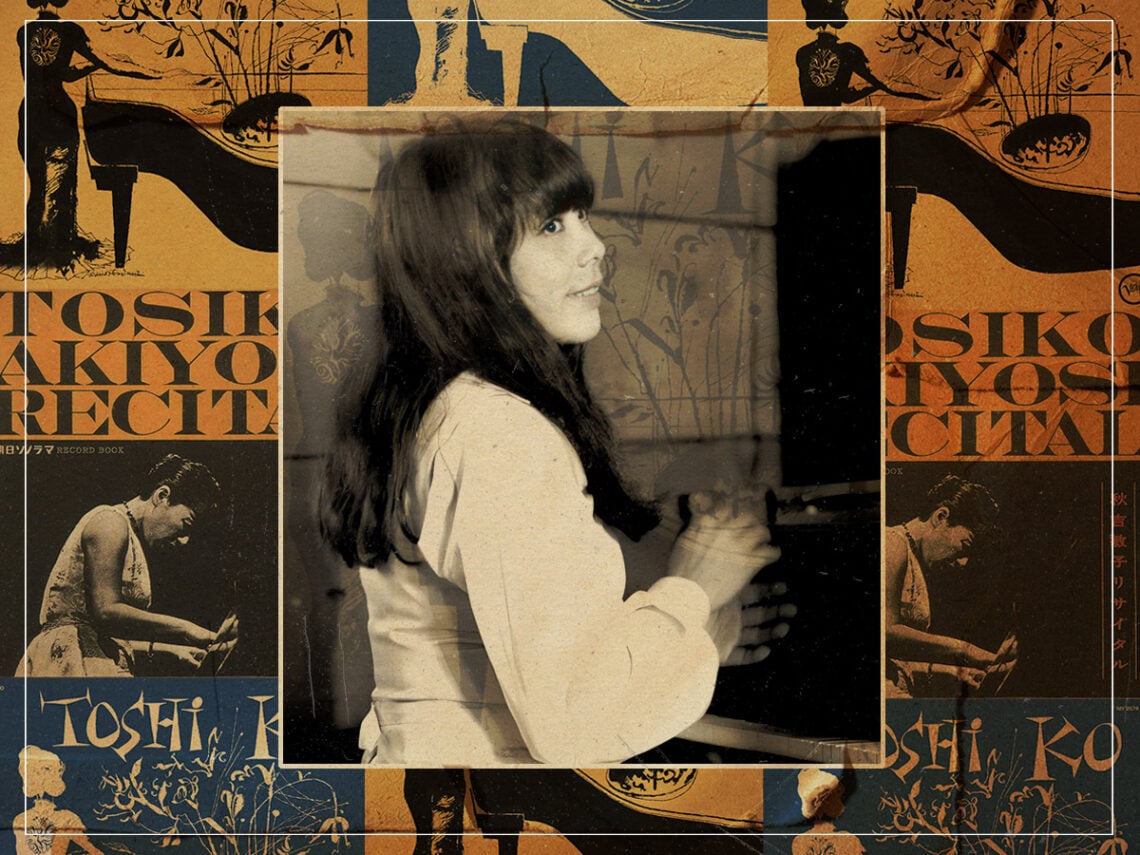
Toshiko Akiyoshi: the woman who birthed Japanese jazz

While jazz is rightly associated with America, it being one of the nation’s most significant cultural exports and born in the Black communities of New Orleans at the end of the 19th Century, jazz‘s fluid and nebulous character has found itself embedded in corners all over the world, from Europe’s continental jazz swing, 1950s Indo jazz that swept the new Indian republic, or the Cape jazz as pioneered by Abdullah Ibrahim in South Africa.
Jazz found itself most welcome in Japan, too. The home of the jazu kissa bars that hide in Tokyo’s alleys and backstreets, since the 1920s, jazz enthusiasts have flocked to these late-night bars and immerse themselves in Miles Davis or John Coltrane with the volume way-up, not as some background muzak to provide tepid ambience. While shunned during the Imperial era, the post-war relaxation of Western culture coupled with the boom in affordable high-fidelity audio gear meant a proliferation of jazu kissa bars, including author Haruki Murakami running Peter Cat in the 1970s in Kokubunji before his literary fame.
“I got a lot of press. You know why? Because I was an oddity,” Japanese jazz pioneer Toshiko Akiyoshi told the Los Angeles Times in 1993. “In those days, a Japanese woman playing like Bud Powell was something very new. So all the press, the attention, wasn’t because I was authentic. It was because I was strange.” While no doubt the target of media attention due to her race and gender back in the 1950s, Akiyoshi fought against perceptions of ‘novelty’, forging a respected presence in modern jazz, sitting in with giants Miles Davis, Dizzy Gillespie, working with Charles Mingus, and fronting her own acclaimed trios.
Born in 1929 in Manchuria and the youngest of four sisters, the Akiyoshi family lost their home amid the ruins of World War II and settled in Kyushu island’s Beppu city. Initially playing as a dance hall pianist, an exposure to Teddy Wilson’s ‘Sweet Lorraine’ instilled a life-long love of jazz: “I thought, ‘Jazz can be so beautiful’… Teddy’s runs were so even, like the same-sized pearls on a string. That’s when I became a serious student of jazz.”
Making a name for herself playing the clubs of Tokyo’s trendy Chūō district, Canadian ‘King of Inside Swing’ Oscar Peterson spotted Akiyoshi playing on the Ginza and was so impressed he convinced his producer Norman Granz to record her. Heading to Radio Tokyo Studio 2 in November 1953 and assembling members of Peterson’s touring rhythm section, including guitarist Herb Ellis, bassist Ray Brown and drummer JC Heard, Toshiko’s Piano was released to acclaim the following year, issued on Granz’s Norgran Record label.
Relocating to the States to study at Boston’s Berklee School of Music and Peterson assisting on a contract with legendary Jazz label Verve Records, Akiyoshi’s career seemed to be going strength to strength. But despite a string of well-received releases such as The Many Sides of Toshiko and Miwaku No Jazz, plus performing at 1957’s prestigious Newport Jazz Festival, by the end of the ’60s, Akiyoshi was playing Holiday Inns and even considered retraining as a computer programmer. With encouragement from her husband and saxophonist Lew Tabackin, she stuck to her guns, and the couple formed their 16-piece big band, going on to release the Grammy-nominated Kogun in 1974.
A turning point for Akiyoshi, both personally and creatively, was the death of jazz orchestra leader Duke Ellington. “When Duke died, I read that he was very conscious of his race, and I thought that maybe that was my role, to portray my heritage within jazz, to utilise both,” she confessed to the Los Angeles Times. “That was probably my most important discovery.”
What followed was a series of works reconnecting with her Japanese heritage on a deeper level, incorporating traditional instruments such as the kotsuzumi, kakko, and utai into her pieces. “I’m deeply interested in various social and environmental issues,” she declared, “If something concerns me, then I want to express my feelings via music.”
Akiyoshi’s explorations of heavier subject matter reached their apex when approached by Buddhist monk Kyudo Nakagawa wishing to score his hometown Hiroshima’s nuclear attack. Initially too horrified to contemplate when assessing photos of the atrocity, a picture of a girl emerging from an underground shelter with a smile on her face guided 2001’s Hiroshima: Rising from the Abyss, Akiyoshi deploying the image’s undercurrent of hope as the piece’s theme.
Still active into her 90s, having released The Eternal Duo! in 2019, performing with her daughter Monday Michiru at Tokyo’s Blue Note, and receiving numerous awards, including Japan’s Order of the Rising Sun, Akiyoshi is still enjoying her legacy in the jazz world: “I’m glad I didn’t quit music… Otherwise, I wouldn’t be doing what I’m doing today.”
