


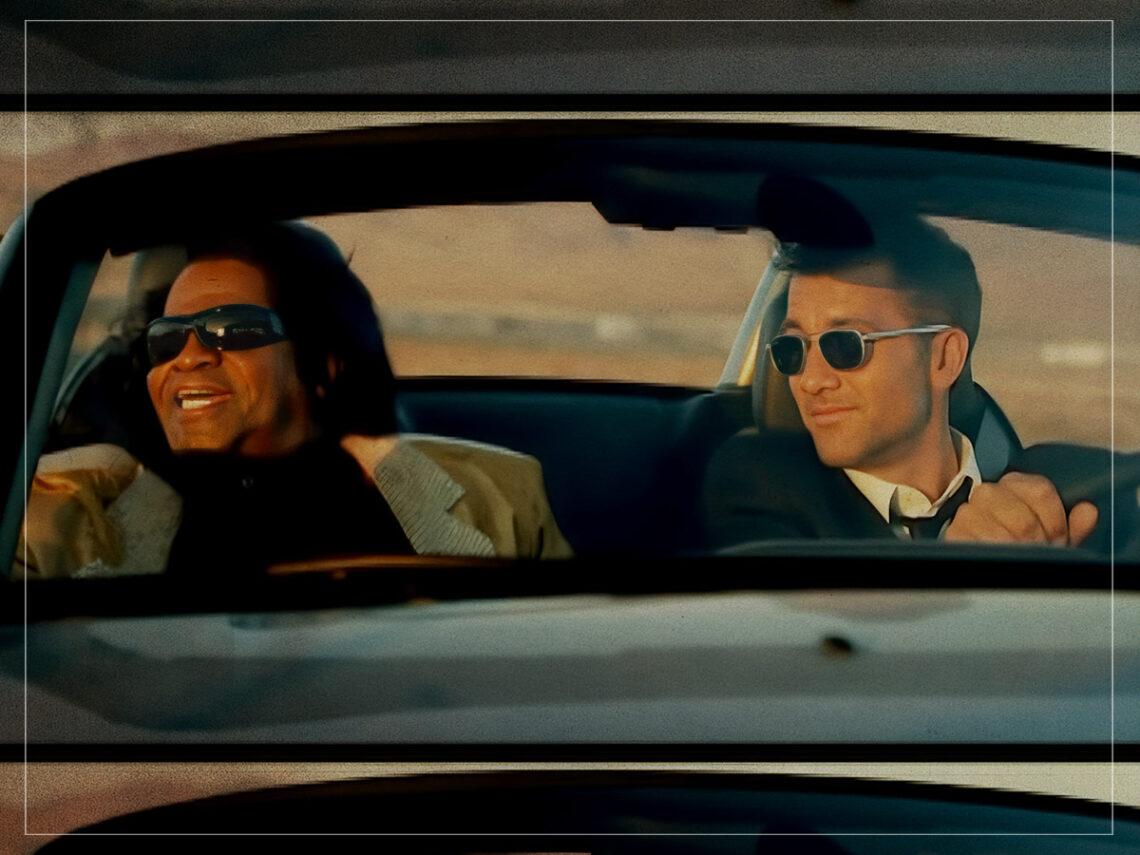
‘Beat The Devil’: Tony Scott’s bizarre advert with James Brown and Gary Oldman

In the early 20th century, the now-quasi-mythic blues guitarist Robert Johnson was said to have sold his soul to the devil at a Mississippi crossroads to secure his musical legacy. Skip to the early 21st century, and filmmaker Tony Scott recreates this modern American folklore tale on the Las Vegas strip with soul icon James Brown. Featuring Gary Oldman, Clive Owen and a surprise cameo from another shock-rock star at the end, Beat The Devil is a pulse-pounding piece of bizarre 2000s ephemera.
Commissioned by BMW, the nine-minute advert is part of a series of eight released online between 2001 and 2002, collectively titled The Hire. Clive Owen serves as the throughline through each chapter, known simply as ‘The Driver’, who, much like Ryan Gosling’s subdued protagonist in Drive, is a man-for-hire with a particular set of skills: namely, transporting clients around and evading underworld bad guys at top speeds.
Each short ‘starred’ a specially chosen BMW vehicle for Owen to show off. Human co-stars included established famous faces like Madonna, as well as future ones like Forest Whitaker, Don Cheadle, Stellan Skarsgård, Jon Bernthal and Dakota Fanning. Scott was in strong directorial company, too: John Frankenheimer, Ang Lee, Wong Kar-wai, Alejandro González Iñárritu, John Woo, Joe Carnahan, Neill Blomkamp and Guy Ritchie took the reins on the other seven films. (No prizes for guessing who directed Madonna’s entry).
Like his brother Ridley, Scott came from the world of advertising and rose to prominence in Hollywood in the 1980s with the action classic Top Gun. He cemented a reputation for highly stylised, frenetic filmmaking with the Quentin Tarantino-penned True Romance in 1993. All of this, including a typically unhinged performance by Gary Oldman, who Scott worked with for the latter film, comes together in Beat The Devil, which accomplishes an extraordinary amount of storytelling, character work and action in its compact runtime.
In the short, an opening flashback shows a young James Brown in 1954 on a dusty crossroads. Whipping ahead to 1994, Owen’s Driver chauffeurs Brown to a Vegas building named – can you guess? – Crossroads, to petition Oldman’s Prince Of Darkness to renegotiate their deal. Despite a successful career as promised, Brown laments “the ageing process”, longing to be able to do his iconic splits on stage again. Oldman, decked out in Joker-esque red lipstick and sinfully tight overalls, challenges Owen to a drag race against his driver, played by Danny Trejo.
Speaking to Chud while promoting his 2005 film Domino, Scott reflected on how Beat The Devil impacted his subsequent cinematic work. “I always do commercials in between movies because it’s a great way to – commercials aren’t as expensive as movies, so you get a chance to experiment and try stuff,” he said. “I’m lucky I could get James Brown and Gary Oldman together. It was fucking great fun. That was my experiment for Domino – outrageous characters.”
He added: “And also stylistically as well, I took some of it to Man on Fire and some of it to Domino, but my next movie, you’ll see, will be very different. All my style is motivated by the interior of the characters and motivated by the world that I’m touching. I always saw this as bounty hunting on speed, you know; it was the nature of the characters that I encountered during the course of 12 years with the real people. That’s how I felt the movie should be. It’s rock-and-roll. It’s a lot of energy.”
It’s tempting to imagine the world-building possibilities in expanding the short story, especially the end gag revealing that the Devil has an annoyingly loud neighbour in the form of Marilyn Manson. However, the brevity of Beat The Devil strengthens it as both a quintessential slice of Tony Scott’s “rock-and-roll” creativity and peak early-2000s pop-culture excess. It’s just a shame Scott was never tapped for a Fast and Furious film.
