


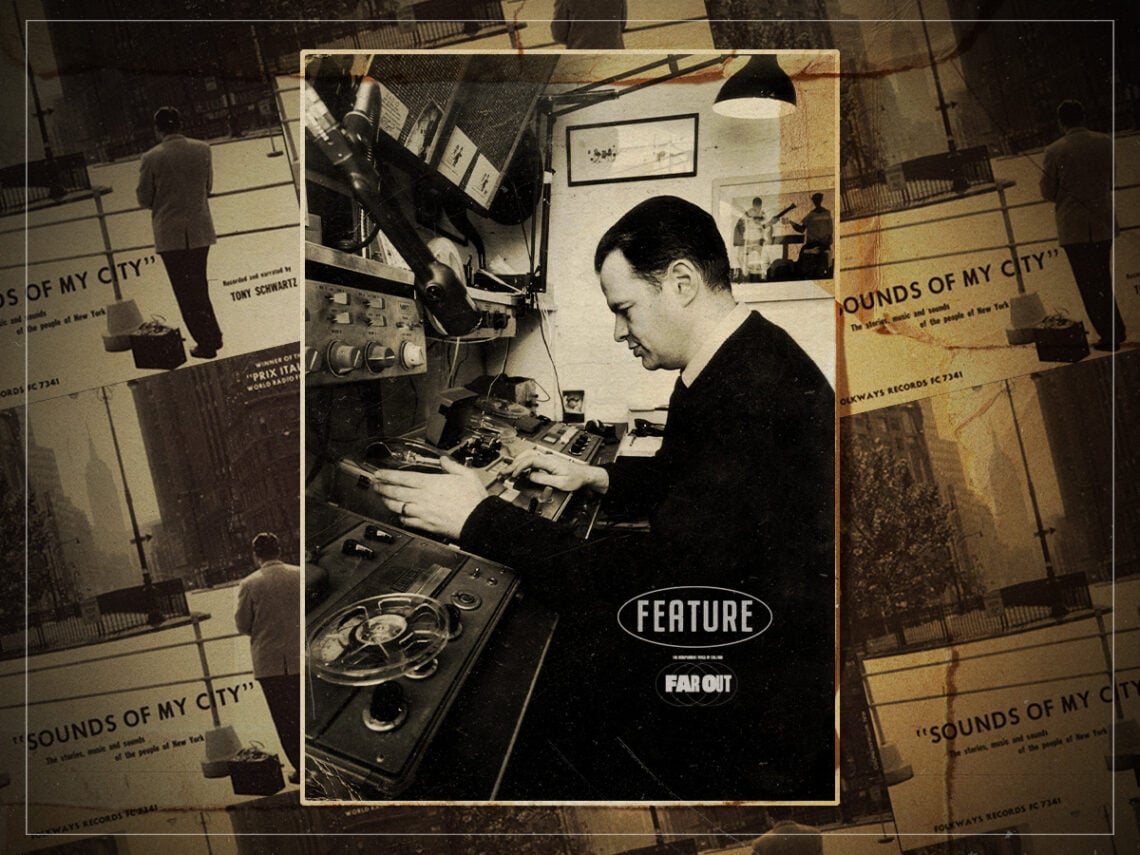
Tony Schwartz: The sound archivist who turned New York City into a symphony

One might wish to make a distinction between what is classified as music and what ought to be deemed as ‘sound art’, but ultimately, the two are far more intrinsically linked than one may wish to concede.
Whether it’s in the form of an audio documentary, sound collage or existing under the guise of musique concrète, these are all auditory projects created with the aim of creating an atmosphere, and therefore, it’s music, right?
However, when we use this as a yardstick for what constitutes the existence of something as music, so many other things can then be described as such, and it becomes difficult to decide where the line should ultimately be drawn. The buzz of the refrigerator becomes music, the mating calls of wild animals become music, and the honking horns of impatient drivers in traffic become music when we measure things this way, because they’re all sounds that one can manipulate in a way that turns them from mundane, everyday sounds into an expression of our own reality.
While the works of Tony Schwarz fall largely under the umbrella of found sound, field recordings and audio interviews, the main objective of his work was to turn regular sounds into a symphony of the everyday. To Schwartz, overheard conversations at bus stations, shrieks from playgrounds and the whirring noises of industry were not the annoyances that most heard them as; they were all of the musicians playing their respective instruments in an orchestra who performed for New York City on a daily basis.
Schwartz may have been obsessed with sound from a young age, but that meant overcoming an aversion to the people and environments who were generating it. He experienced temporary blindness at the age of 16, and developed a severe case of agoraphobia as a result of this, afraid to immerse himself in the overstimulating environment of the city that would eventually provide him with the soundtrack of his experiences.
After a period of readjusting to his surroundings, he would then go on to record obsessively, constructing compositions from all sorts of source material he was hearing in his native city. While he’s produced records consisting of conversations with cab drivers, interviews with children and the sounds of Puerto Rican neighbourhoods, it was his 1956 album, Sounds of My City, that was the truest celebration of everything that New York City had to offer from an auditory perspective.
Piecing together recordings of everything from street musicians to block parties, Sounds of My City is an audible portrait of what it’s like to walk down any given street in the centre of New York, and while it lacks structure and melody in the same way that most compositions do, it perfectly captures the unpredictability and impromptu nature of the sounds that we’re confronted with when out in public. This could realistically have been done in the heart of any vibrant city, but given how New York is so frequently cited as being a restless and chaotic place to exist, this captures a side of it that provokes curiosity and makes the listener want to explore their own hometown from a new perspective.
Schwartz would eventually get asked to offer his services to advertising campaigns due to his innovative approaches to recording sound, and his work has been preserved by many different institutions, including the Smithsonian and the Library of Congress. While the likes of Steve Reich and Gavin Bryars would take the idea of recording people in the street and manipulating them into new compositions, Schwartz instead didn’t look at his recordings from a composer’s perspective, he was simply a collector of sounds, and the city was composing them for him.
