


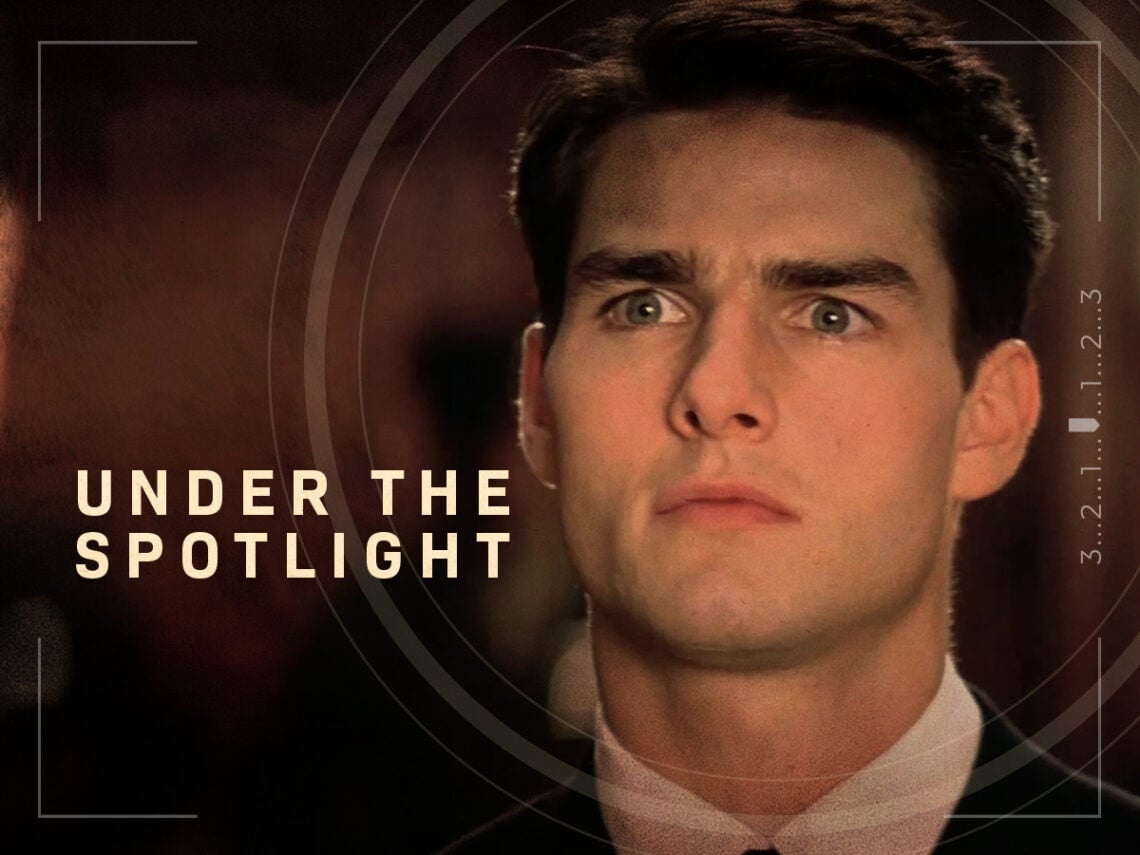
Under the Spotlight: Tom Cruise’s balance of bravado and vulnerability in ‘A Few Good Men’

There are some lines of dialogue that become cemented into the collective consciousness, with some movie moments ingrained in our everyday lingo, sometimes without knowing exactly where they came from. From Dorothy’s exclamation of “We’re not in Kansas anymore!” to Dustin Hoffman‘s “I’m walking here!” and the cheesecake scene in When Harry Met Sally that is now an ear sore for anyone working in hospitality, there is no denying that the language of cinema has forever shaped our everyday expressions, with words written by Hollywood screenwriters seeping into the real world.
As a result, there are some films with reputations that exceed them, with audiences seemingly knowing a penultimate scene or line of dialogue from birth, like the way people never have to learn the lyrics to Mr Brightside or Bohemian Rhapsody—it’s just already there.
This is certainly the case for the 1992 film A Few Good Men, creating its towering reputation through the final courtroom scene and Jack Nicholson’s infamous bellowing of “You can’t handle the truth!”, which still reverberates today and is cited as one of the greatest lines of all time. While some films lose their power over the years, that is not the case for A Few Good Men. And while this scene is undoubtedly a pivotal moment, I would argue that the film’s timelessness comes from Cruise’s utterly charming portrayal of Daniel Kaffee and the unexpected humour he brings to an otherwise heavy story.
From his very first minute that Cruise is on screen—he is annoyingly watchable in everything he does—he exhudes the schmoozy cockiness of someone who thinks of themselves as too cool to be seen trying. After his first meeting with Joanne, played by Demi Moore, he comes across someone undeniably smart but unwilling to put in any real work, coasting by on the bare minimum and sailing through life without the stress of being ambitious.
Every choice that Cruise makes, both big and small, adds to Kaffee’s unbothered hue and his frustratingly natural charisma. His character is the kind of person who could talk their way out of any wrongdoing and somehow leave you completely charmed, with a brash confidence and glib humour that leaves people both amused and subsequently irritated. Cruise makes choices that capture the boyish charm of someone unwilling to grow up and face the truth, with a languidness to his mannerisms as he strolls around the army base, with no trace of urgency to his work as he sets his sights on a life in the easy lane; he literally “crusies”. Simple gestures such as rifling through a box of doughnuts and touching each one as he goes, or casually searching for a pen to take notes in a meeting, are all conscious choices on the actor’s part to convey Kaffee’s laid-back philosophy.
Given the weight of the ethical dilemma at the heart of the film, with Sorkin exploring the line between duty, honour and morality, Kaffee’s mannerisms add a much-needed comical and vulnerable edge to the film. However, the heaviness is shown through his inner battle over whether he should follow through on his personal duty to honour his father and live up to the legacy of his family name.
Thus, as the film progresses, we see Kaffee shift from an uncaring and immature officer, afraid of fulfilling his potential, to someone who finds his spark through allowing himself to act on his passions and embrace the possibility of success. For a film that revolves around order and the regimented lifestyle of those in the army, Cruise adds fluidity and life through the simultaneous vulnerability and bravado of Kaffee. Someone who is trying so hard not to care but inevitably finds himself completely invested in the task at hand, while also maintaining the same childish spark of a brilliant but temperamental mind.
His inner conflict over trying and the fear of failure drives the unpredictable erraticism of his character, with his spell of indifference being broken in moments such as his manic monologue, where he shouts at Joanne about his fear of losing the case, or the moments of innocence as he struggles to come up with adequate insults, or his endearingly surprised expression after actually winning.
Given the rigid framework of the story, created through Sorkin’s water-tight dialogues (barring some truly awful lines that still make me cringe in my seat) and Rob Reiner’s simplistic yet engrossing direction, it remains impressive that something so militaristic can still contain so much heart, something that is entirely due to the chemistry of the central trio and Cruise’s magnetic portrayal of Kaffee as someone who masks their sensitivity through wit. What arguably makes the film timeless is Cruise’s bringing an unpredictable spark and vulnerability to an otherwise controlled story about order, allowing the audience to let go and give in to their human instincts.
