


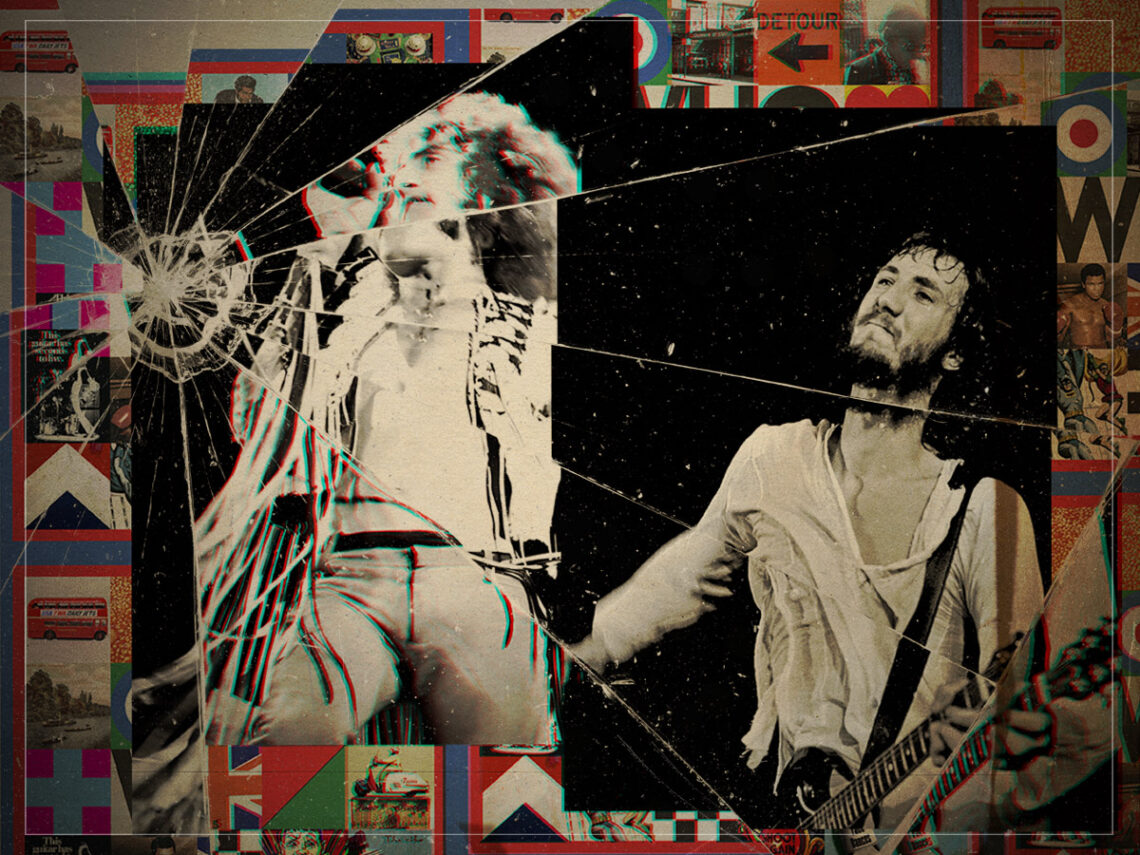
A History of Violence: A timeline of The Who’s feuds

Rock and roll has played host to countless feuds over the decades, from plagiarism disputes to ego clashes and sibling rivalries to chart battles. Some groups seem more predisposed to these vicious clashes than others, The Who being a notable example. Harbingers of rebellious mod rock during the 1960s, the band grew a reputation for their loud and anarchic live shows, becoming the defining voice of Britain’s post-war youth in the process. However, their history was often noted by arguments, infighting, and feuds.
This fact should not be all that surprising. After all, The Who lived the archetypal rock and roll life. Behind their incredible discography, chock full of youthful anthems, profound rock operas, and postmodern masterpieces, there was a band dealing with a tireless touring schedule, worsening drug habits, and the tedious effects of being cooped up with the same few blokes night after night. Before too long, tensions arose within the band’s line-up itself.
Throughout their history, guitarist Pete Townshend has clashed with frontman Roger Daltrey, who had clashed with drummer Keith Moon, and vice versa, in varying combinations. Bassist John Entwistle seems to have largely evaded the prevalence of these conflicts, or perhaps he simply wasn’t as outspoken about his views on his comrades and fellow musicians. The Who’s feuds weren’t contained to the band’s line-up itself, either. Over the years, they clashed with their management, production staff, record labels, and, of course, other bands.
Pete Townshend, in particular, has often denounced other artists and being inferior to his own, taking aim at everybody from Deep Purple to The Beatles at some point or another. This outspoken hatred of countless other groups did not necessarily make The Who the most popular group within Britain’s rock scene, but Townshend has always stuck to his opinionated guns when it comes to slagging off other groups.
The Who have existed on and off for over six decades at this point, and the band has become embroiled in countless battles during that time. While it is true that the rock and roll lifestyle tends to make people more volatile than typical, that fact does not entirely justify their seemingly constant ability to attack various other artists and individuals, whether those criticisms were deserved or not.
With such an extensive and enduring history of arguments, fights, and feuds, we have taken it upon ourselves to timeline some of the most notable spats The Who have been involved in thus far. It is worth noting, at this point, that Roger Daltrey and Pete Townshend – the band’s two surviving members – are both well into their old age now, and are still finding the opportunity to engage in feuds.
1965

Shel Talmy
During the early days of The Who, Pete Townshend wrote a range of songs to appeal to producer Shel Talmy, who had found success with The Kinks and their defining anthem ‘You Really Got Me’. The guitarists’ tactic worked, and Talmy went on to produce the band’s first single, ‘I Can’t Explain’, and debut album My Generation. However, the relationship between the band and their producer soured soon thereafter.
Talmy retained the master tapes to the debut album, preventing a reissue until the early 2000s, and the band temporaily split from their deal with Decca/Brunswick to release ‘Substitute’ on Reaction/Atco Records. In retaliation, Talmy pushed Decca to release ‘A Legal Matter’ as a single at the same time, in the hopes of diluting the sales and success of ‘Substitute’.
1965

Kit Lambert
Adding to the band’s feuds with their own team, the band butted heads with manager Kit Lambert during their early days. Lambert and his managerial partner, Chris Stamp, were essential in the success of The Who, pushing the band to reach the global heights of rock stardom. However, Roger Daltrey was largely content with the band being a British R&B outfit during the mid-1960s.
Lambert, on the other hand, pushed the band to write and record original material. The likelihood is that he learnt this management tactic from Andrew Loog Oldham, who had encouraged The Rolling Stones to write original material after seeing the success of The Beatles, whose material largely resulted from the Lennon-McCartney songwriting partnership. Sessions of R&B and Motown cover songs were ignored in favour of original material, which never sat right with the frontman.
While this push for originality undoubtedly boosted The Who’s career, the band – and Daltrey in particular – were not pleased with the idea of their musical direction being dictated by a perceived ‘outsider’.
1965

Keith Moon
It didn’t take The Who long to engage in infighting within the band. In 1965, the very same year that their debut album hit the airwaves, Roger Daltrey came to blows with drummer Keith Moon. Moon’s anarchic, amphetamine-fueled existence had already caused a multitude of arguments with his bandmates, often Townshend, but after a particularly tumultuous performance in Denmark, it was Daltrey who attacked Keith Moon.
The story goes that Daltrey had become fatigued with Moon’s dependency on drugs, and had flushed his stash down the toilet following the show in Denmark. A scuffle then ensued and Daltrey assaulted the band’s drummer. “It took about five people to hold me off him,” the frontman recalled in Roger Daltrey: The Biography. “It wasn’t just because I hated him, it was just because I loved the band so much and thought it was being destroyed by those pills.”
Daltrey was sacked upon the band’s return to the UK, but was reinstated as the singer before the release of The Who’s next single, ‘My Generation’. Nevertheless, tensions would continue to bubble under the surface when it came to Daltrey, Moon, and Townshend.
1966

The Beatles
The Who created a plethora of the 1960s’ most iconic sounds, but even they could not live up to the unparalleled success story of The Beatles. From a teenage skiffle band in Liverpool, to a global pop sensation in a few short years, the Fab Four dominated the music of the decade. Despite this – or perhaps because of it – Townshend felt a necessity to denounce their quality. During a 1965 interview, the guitarist declared that the band’s instrumental performances were “flippin’ lousy”.
“Actually, this afternoon, John [Entwistle] and I were listening to a stereo LP of The Beatles — in which the voices come out of the one side and the backing track comes out of the other,” he shared in the interview. “When you actually hear the backing tracks of The Beatles without their voices, they’re flippin’ lousy.”
Years later, speaking to Rolling Stone in 1982, Townshend attacked Paul McCartney’s solo album Tug of War. The guitarist questioned whether Macca “ever really had anything to do with rock”, adding, “You know, I could sit down and have a conversation with Paul about rock and roll, and we’d be talking about two different things.”
1967

Jimi Hendrix
On the topic of iconic sounds of the 1960s, The Who also clashed with guitar hero Jimi Hendrix. Both artists were booked to play the 1967 Monterey Pop Festival, but this hippie free-for-all soon gave way to serious mind-games and ego battles. Reportedly, there was a dispute over whether Hendrix or The Who would take to the stage first, and neither camp was willing to back down.
Townshend went backstage to try to smooth things out with Hendrix, but his plan didn’t exactly work out. Often described as a ‘jam session’ between the two legendary guitarists, the reality was much closer to Jimi Hendrix showing Townshend who was boss. Speaking to Ultimate Classic Rock, The Who songwriter recalled, “I’ve heard Roger talk about it as a jam session, but it wasn’t a jam session. It was just Jimi on a chair playing at me. Playing at me like ‘Don’t fuck with me, you little shit’.”
1972

Lambert and Stamp
The Who’s relationship with their management duo was rarely harmonious, but by the early 1970s it has reached an ultimate breaking point. Lambert and Stamp might have been essential to the enduring success of the band, but they had neglected some of their managerial duties in the process. Lambert, who often took on production duties for the band, had developed a crippling addiction to hard drugs, which rendered him incapable of producing their work.
Meanwhile, the pair had failed to keep proper documentation of the band’s finances, as was discovered by Daltrey upon an audit in 1972. The singer wanted to dismiss the pair there and then, but Moon and Townshend disagreed. However, by the time the band came to record Quadrophenia in 1973, tensions between the musicians and managers had reached breaking point, and the pair were replaced by Bill Curbishley.
1973

The Who
Quadrophenia, despite arguably being the band’s defining work, was plagued with arguments, both in the recording process and during the subsequent tour. That tour saw two notable clashes, between Pete Townshend and Roger Daltrey, and between Townshend and Keith Moon. Firstly, during a rehearsal for the tour, Daltrey had become frustrated with the guitarist’s desire to recruit a new keyboardist for the tour, along with his adoption of primitive synthesiser technology.
Eventually, this resentment boiled over into an all-out brawl. Townshend reportedly swung a Les Paul – which, as any guitarist will tell you, has a lot of weight to it – at the singer’s head. Seemingly, the singer came out on top, hooking Townshend in the jaw and knocking him out clean. However, that fight was a sign of things to come for the Quadrophenia tour.
Keith Moon’s drug addiction had become unavoidable and disruptive to his performing quality. At multiple stops on the tour, the drummer had actually passed out behind the kit, resulting from his usual cocktail of amphetamines. Inevitably, the band became frustrated with this disruption and, during a show in California towards the end of 1973, the guitarist recruited an audience member to replace Moon, who had passed out twice. “Can anyone play the drums? – I mean somebody good,” he asked in anger.
1995

Led Zeppelin
The Who have always had something of a shared history with hard rock progenitors Led Zeppelin. In fact, it was Keith Moon who christened Jimmy Page’s trailblazing outfit with their name, and Roger Daltrey has routinely heaped praise onto his fellow vocalist Robert Plant. Pete Townshend, on the other hand, had taken every opportunity to discuss his dislike of the group. During a 1995 interview, over a decade after the break-up of Zeppelin, he sneered, “I don’t like a single thing that they have done, I hate the fact that I’m ever even slightly compared to them.”
Years later, when The Who were promoting their 2019 album Who, the guitarist told Toronto Sun, “It doesn’t sound like The Who from those early heavy metal years. We sort of invented heavy metal with Live at Leeds. We were copied by so many bands, principally by Led Zeppelin, you know heavy drums, heavy bass, heavy lead guitar.”
In turn, Robert Plant has criticised The Who on a few occasions, once telling Rolling Stone, “I saw the Who trundled around the stadiums of America, and I found it so dull, obvious and sad. The fact that they carried on without Keith Moon was always a mystery to me, but the fact that they did it again and again, augmenting it with more and more musicians … I don’t want to be a part of that aspect of entertainment. I’ve played Vegas already.”
2025

Zak Starkey
Following the tragic death of Keith Moon in 1978, The Who were tasked with finding another drummer who could live up to his distinctive and endlessly energetic playing style. Eventually, in 1996, they landed upon Zak Starkey – son of former Beatles drummer Ringo Starr – whose first drum kit had actually been bought for him by Moon himself. For the past 30 years, Starkey has been a faithful live drummer for the band, and Roger Daltrey declared him the best fit for the band since the departure of Moon.
However, Daltrey grew frustrated with Starkey’s playing during a performance at the Royal Albert Hall in March 2025. So, on April 16, it was announced that the band had parted ways with the drummer, with Starkey later revealing “I’m surprised and saddened anyone would have an issue with my performance that night,” the drummer has shared in a statement, “but what can you do?”
A few days after this feud was aired in public, Townshend took to social media to reinstate Starkey as the band’s drummer. “Roger and I would like Zak to tighten up his latest evolved drumming style to accommodate our non-orchestral line-up up and he has readily agreed,” the guitarist wrote on social media, apologising for the communication breakdown. So, for now at least, it seems as though Starkey’s position in the band is safe.
So what is next for The Who?
With the recent news about Zak Starkey’s dismissal and subsequent rehiring, the future of The Who has certainly been called into question. The band’s two surviving members, Pete Townshend and Roger Daltrey, are 79 and 81 years old, respectively, and it is fair to say that neither is at their performing peak. Daltrey has spoken multiple times about packing it all in. “I’m looking towards the end of a singing career,” the vocalist shared in an interview back in early 2024.
At the time of writing, their most recent performances occurred in March 2025 at the Royal Albert Hall, in aid of Teenage Cancer Trust, a charity which Daltrey and the band have supported tirelessly over the years. In terms of the future, the band have two dates in Italy scheduled for July, while Daltrey is set to embark upon an extensive solo tour throughout the summer months. Whether those shows will inspire the band to continue their performing career or throw in the towel for good remains to be seen.

Never Miss A Beat
The Far Out Led Zeppelin Newsletter
All the latest stories about Led Zeppelin from the independent voice of culture.
Straight to your inbox.