


‘Time and Water’ movie review: A poetic reminiscence on family and nature

The latest nature documentary from Fire of Love director Sara Dosa equates environmental collapse with the loss of collective memory.
Although non-fiction cinema requires a strict adherence to the facts, there’s also room for an auteur to use the medium to make personal statements. One of the more distinctive achievements in contemporary documentaries was Fire of Love, an extraordinary exploration of the love story between French volcanologists Katia and Maurice Krafft.
The film’s director, Sara Dosa, has an eye for using intimate stories of human connection to interrogate mankind’s relationship with the natural world, and her latest documentary feature, Time and Water, is an equally gripping experience.
The subject of Time and Water is Andri Snær Magnason, a prolific Icelandic writer who has dipped his toes into theatre, short stories, essays, poetry, and both fiction and non-fiction novels. Among Magnason’s most resonant pieces was a 2019 article that he wrote commemorating the loss of a massive glacier, which had deteriorated at a faster rate than anticipated due to global warming. As Time and Water reveals, Magnason had a personal connection to the story because his grandparents, Jón and Hulda, were among the first Icelandic explorers to begin tracking the evolution of glaciers.
Although Dosa has strung together images and collected an impressive array of archivable footage from the initial expeditions of the 1950s, it is Magnason who narrates the story as a means of creating a time capsule. It’s upon his revelation that he is now the same age that his grandparents were when they were making their travels that the writer is compelled to make a memory piece to share with his own children. While this might seem like the framework for a more sentimental approach, Magnason’s storytelling is inspired by fear; it’s because he doesn’t know how much of the natural world will survive that he wants to preserve its memories for his next of kin.
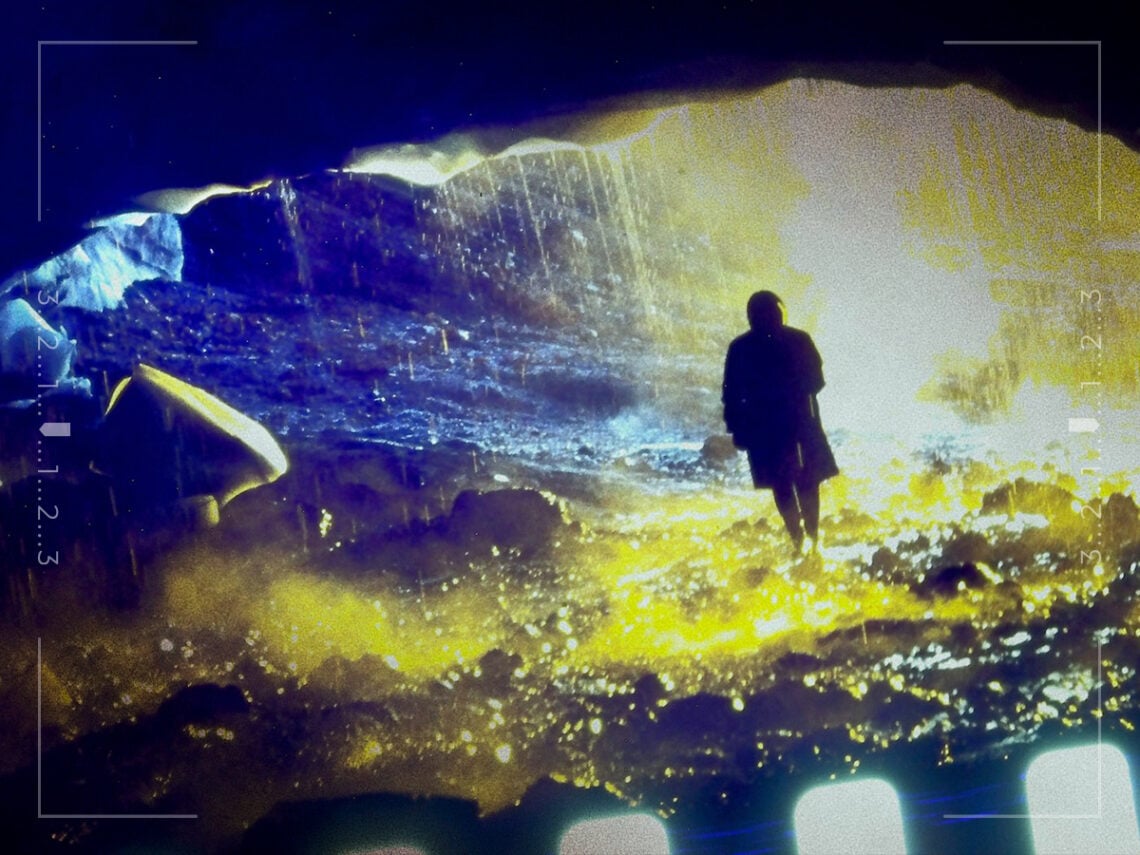
Time and Water utilised a cosmic, colourful visual design to intertwine Magnason’s elegiac prose with imagery collected from satellites, scientific studies, and archived photographs; by taking from a multitude of perspectives, the film creates a personality and life story for the glaciers, whose existence is one of great beauty. The collapse of these natural wonders is something that Magnason and Dosa are able to describe in both scientific and mythological terms; although the rapid shrinking of the ice masses can be compared to the erosion of glaciers in other points in history, Time and Water also invites creative animated segments that illustrate the role that the environment had in various stories of Norse culture.
The fear that illuminates Time and Water is that without literal representations of time, memories will cease to exist. Magnason doesn’t just express sadness that moe glaciers might shrink in the next few decades of his own lifetime, but that the wonders that his grandparents helped to uncover are now rendered meaningless.
It’s so often that environmental documentaries appeal to the logic of preserving the Earth that Time and Water’s emotional appeal is more appealing; Magnason’s quote that this is the generation to “first to say goodbye to something that we never thought we could lose” has the same existential profundity of the description of Middle-earth in The Lord of the Rings: The Fellowship of the Ring.
Many of the documentary titles from this year’s Sundance Film Festival are bound to eventually make their debuts on streaming services, as the market for theatrical non-fiction cinema has dwindled significantly within the last few years.
However, Time and Water is a film worth seeking out in a premium format, and not just because of the jaw-dropping visuals that are just as worthy of IMAX projection as any Marvel project of the last decade. Some of the most moving moments in Time and Water are those of silence and stillness; it’s best to be absorbed within this meticulous approach in the largest, most distraction-free format possible.
