


The chilling thriller that inspired Spike Lee, the Coen brothers, and William Friedkin: “It terrified me then, and still does”

There are a lot of ways to make a movie creepy. A good soundtrack helps. Lighting can alter the mood considerably. And a well-pitched performance can strike fear in the hearts of viewers. Charles Laughton’s 1955 directorial debut has all these things, but it goes far beyond cliché to create a tone that is as uneasy as it is unpredictable. Although it has proven to be enormously influential over the years (Spike Lee, the Coen brothers, and William Friedkin are just a small fraction of those who owe a debt to it), it was a box office and critical bomb when it was released, and it remains a confounding, enigmatic piece of work.
The story follows Robert Mitchum as Harry Powell, a self-proclaimed preacher who moves from town to town, conning people out of their money. When he discovers that his prison cellmate has hidden a small fortune back home with his two small children, he kills the man and travels to his hometown to prey on his family.
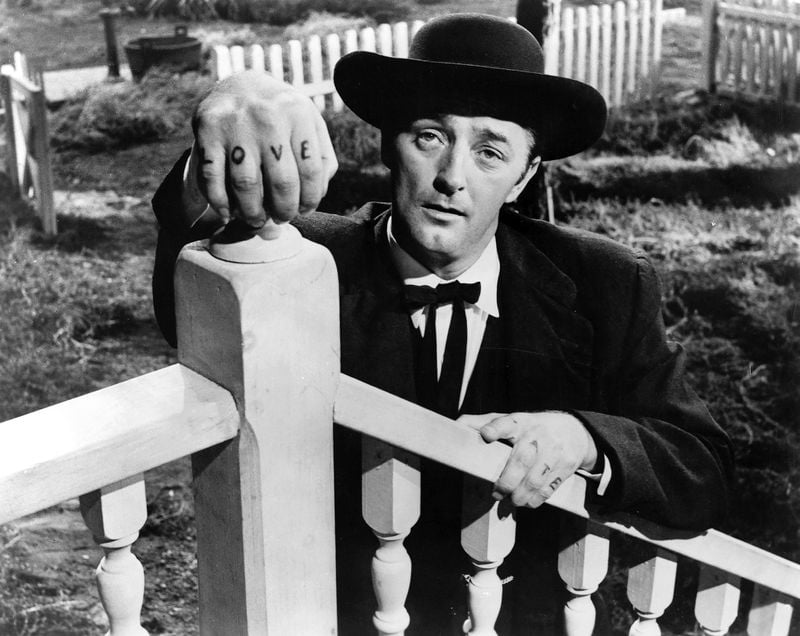
Mitchum’s character has become the most recognizable part of the movie, with the tattoos of “LOVE” and “HATE” on his fingers becoming so iconic that many people are probably unaware of their origins. As the preacher, the actor turns in a spine-chilling performance, his deep, melodic voice intoning Biblical verses at one moment and threatening the children with death the next. In one particularly hair-raising scene, he appears outside their house at night, softly singing the hymn “Leaning on the Everlasting Arms” as he circles their picket fence.
Laughton borrowed heavily from silent movies and the German Expressionists to create the overriding tone of the film. Even as the rest of the industry was transitioning toward colour, the first-time director stuck with black and white to recreate classic techniques of light and shadow to tell a story of fear and foreboding without dialogue.
With children as protagonists, Laughton gave the film a heightened, occasionally fantastical quality. When they finally escape the house and flee down a river in the small boat that had belonged to their father, they float past a world full of wildlife and a vast sky gleaming with stars. As the boy sleeps, his younger sister sings a soft lullaby, the boat drifting in the back of the frame as animals – a frog, a spider in its web, rabbits – appear in the foreground. It’s an interlude that feels more like a fairytale than reality but is heavy with a sense of foreboding.
Another scene that uses the natural environment to beautiful and terrible effect is when the preacher murders the children’s mother and disposes of her body. Tying her to a car and driving it into the river, he lets her sink to the riverbed, where an extended take shows her still, seemingly peaceful face and white nightgown, her hair softly undulating with the seaweed.
Both scenes show the natural environment as a place of serenity, a respite for the weary children fleeing for their lives. Meanwhile, civilization, even their home, is full of danger. This is a particularly notable feature for 1950s Hollywood when most movies, even ones with extensive outdoor settings, were filmed on soundstages, and the natural environment was rarely shown in such intimate, lyrical detail.
When The Night of the Hunter was released, it was a financial and critical disaster. New York Times film critic Bosley Crowther was relatively positive when he called it a “weird and intriguing endeavor,” while Gene Arneel in Variety said it had “too many offbeat touches.” Laughton was so distraught by the reaction that he never attempted to make another film and was even replaced on the movie he had been set to direct before The Night of the Hunter was released. The many failed or reconstructed projects of Orson Welles are often cited as great tragedies in the history of cinema, but it’s hard to watch The Night of the Hunter and not feel that Laughton’s lost potential is even more heartbreaking. Welles managed to make dozens of movies, but Laughton, who had been a successful actor on the stage and screen, only managed to make one.
As for legacy, The Night of the Hunter looms large. A scene in Spike Lee’s 1989 Do the Right Thing features a character with Mitchum’s “LOVE” and “HATE” tattoos emblazoned on a pair of brass knuckles, delivering a nearly identical explanation that the preacher does in Laughton’s film.
The Coen brothers have cited the film in multiple places. The tagline in The Big Lebowski, “The Dude abides” is drawn directly from a repeated phrase in the film spoken by silent film star Lillian Gish – “Lord save little children. The wind blows, and the rains are cold. Yet they abide.” In their 2010 Western True Grit, the Coens featured a similar story of a child fleeing evil, and even used the hymn “Leaning on the Everlasting Arms” to deepen the connection.
When William Friedkin gave Criterion his list of top 10 movies, The Night of the Hunter was number one. “I was twenty years old when I first saw it,” he said. “It terrified me then, and still does.The preacher, played by Robert Mitchum, is the most frightening psychopath I’ve ever seen depicted.”
That’s high praise indeed from a man credited with making the scariest movie of all time.
