


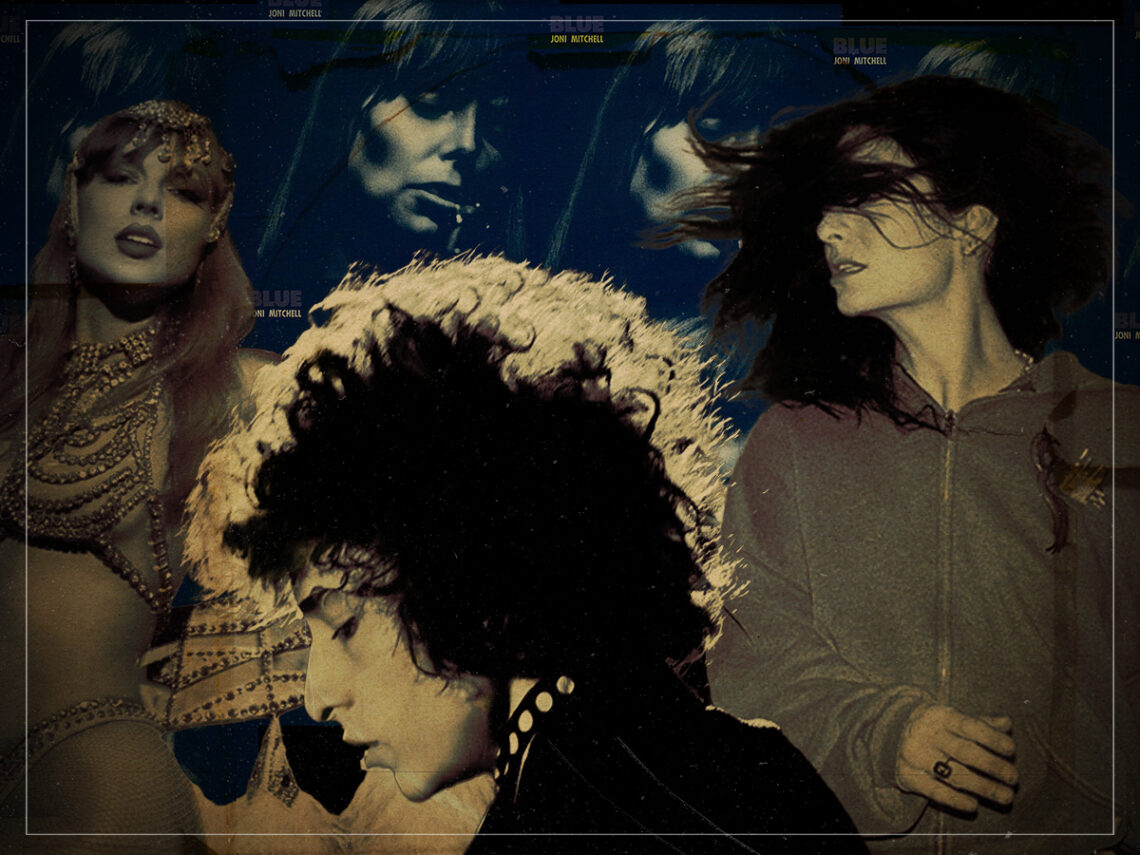
Three albums that wouldn’t exist without Joni Mitchell’s ‘Blue’

Lorde, Bob Dylan, and Taylor Swift walk into a bar – and, granted, they’re not going to have much in common, except for one divine inspiration: Joni Mitchell.
There’s no question that the folk singer’s shining songbook has influenced a myriad of artists in a litany of ways, ranging from bona fide geniuses themselves like Prince, right down to the freshest artists just emerging on the scene. That’s her magic – being able to captivate quite literally anyone from any walk of life, not through production value or fancy flourishes, but from the power of her voice alone.
Yet within this mystical allure, all roads lead back to Blue, the 1971 masterpiece by which the legend and legacy of Mitchell finds its lynchpin. Every lesson your favourite artist has learned in songwriting about truth, vulnerability, identity, and heartbreak all lead back, in some way, to that magnum opus, with the sonic proteges of just that one album alone spanning every aspect of time, space, and genre.
The ironic thing is, despite artist after artist falling at the feet of Mitchell and lavishing praise on her seminal record, she has never been in much of a mood to return the compliment. Indeed, for a number of musicians who have said they actually owe entire sections of their careers to Blue, Mitchell has utterly eviscerated them in response, not least her own folk contemporary, Bob Dylan.
Although the ‘Tambourine Man’ would all too gladly tell you that he is more than capable of standing on his own two feet without having to pawn inspiration from anyone else, in a rare moment of humility, Dylan laid bare exactly what Blue meant to him. His own stellar effort, Blood on the Tracks, opens with the not-so-subtly titled ‘Tangled Up in Blue’.
Rumoured to have been inspired by Dylan’s incessant playing of the massive record, Mitchell didn’t seem to be too enamoured by this charm. Instead, she later branded the songwriter a “plagiarist”, in a roundabout way of saying that, indeed, she felt he leaned on albums like Blue a little too much.
Someone else who had no qualms about voicing precisely in which ways Blue overtly influenced her work is Taylor Swift, who readily admitted that her 2012 album Red was inspired by both Mitchell’s poignant songwriting and colourful titular sentiment. But Swift even went to the extreme of devoting an entire interview on her Red promotion tour to discussing how Blue was her guiding light, saying, “Songs like ‘River’, which is just about her regrets and doubts of herself – I think this album is my favorite because it explores somebody’s soul so deeply.”
Similarly, Mitchell was seemingly unmoved by the reverence, and has even taken steps to stop Swift playing her in a much-flaunted biopic. But one person who she has never seemed to cross orbits with is Lorde, whose equally seminal Melodrama from 2017 almost acts like Blue for the 21st century. The New Zealand singer even admitted as much back when the album was first released, telling The New York Times: “You could play the whole album acoustically if you wanted—it’s like Blue.” The similarities were even there as far as the cover.
Regardless of whether she necessarily approves of it or not, Blue is undeniably one of the most influential albums ever created. There’s nothing that Mitchell can ever do about that, despite all her wieldy powers. If the music is new or classic, aimed at the young or old, those cerulean hues can be found tinged into every space.

Never Miss A Tale
The Far Out Bob Dylan Newsletter
All the latest stories about Bob Dylan from the independent voice of culture.
Straight to your inbox.