


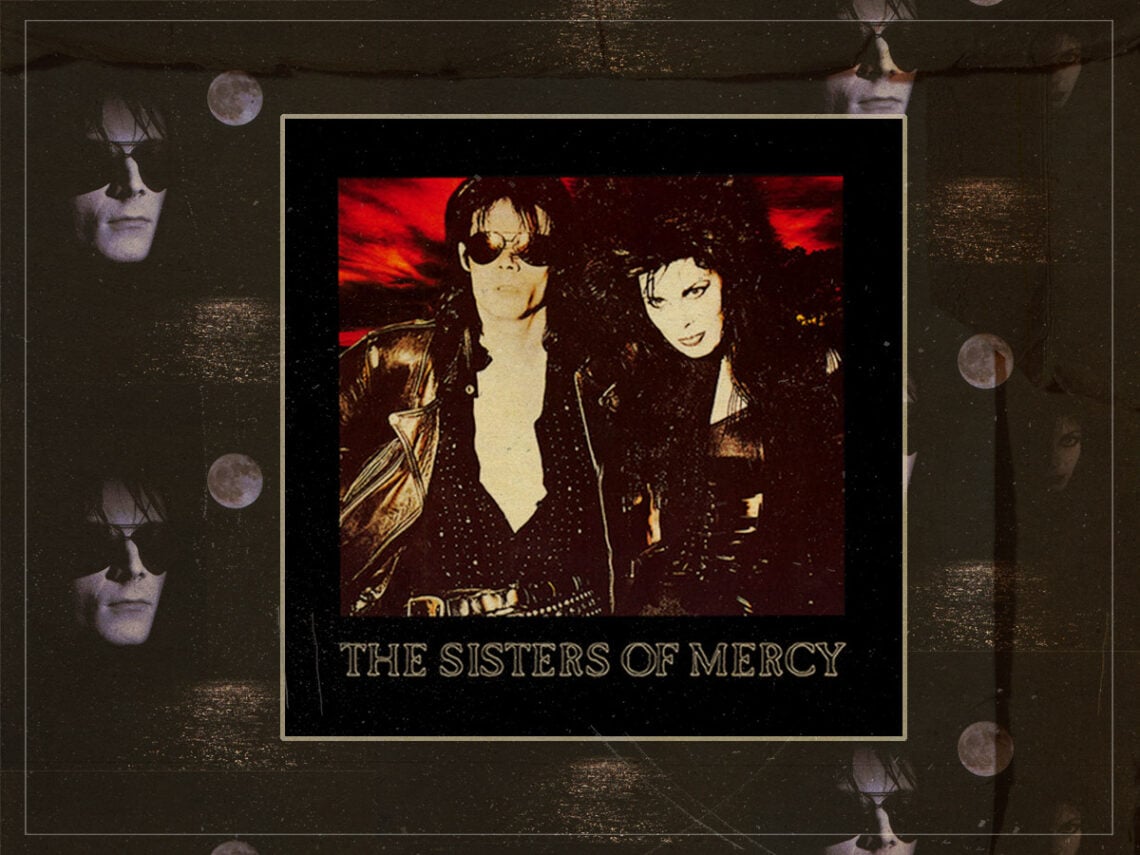
‘This Corrosion’: The song that transformed The Sisters of Mercy

While they’ve always claimed to be simply a rock and roll band, Leeds‘ The Sisters of Mercy have forged an archetypal and leading presence in the UK gothic subculture. Fronted by Andrew Eldritch and their sole creative force amid a revolving cycle of line-ups since 1980, everything about their sound and aesthetic thrusts them to the centre of darkwave poster boys. Spidery post-punk, brittle beats courtesy of their Doktor Avalanche drum machine, and Eldritch’s baritone croon won them acclaim from the goth underground that spooked on music’s fringes across the decade.
Some artists take their music seriously, but themselves less so. The Sisters of Mercy belong to the tradition of Frank Zappa, Devo, or Kool Keith in conjuring a front which coyly leaned on just enough humour to carry the preening goth spectacle a long way. With a love of glitter-beat glam and Meat Loaf at their most theatrical, Eldritch imbued their gothic snarl with an unabashed grab for pop embrace, quite happy to feature in Smash Hits as much as NME during their leather-clad pomp.
Following a string of cult EPs and 1985’s First and Last and Always debut LP, The Sisters of Mercy began to unravel. Creative differences and Eldritch’s unwavering vision resulted in Wayne Hussey’s departure to form The Mission, and former bassist for The Gun Club, Patricia Morrison, jumping ship from Fur Bible to join Eldritch’s interim project, The Sisterhood.
Releasing only one album under the temporary moniker, 1986’s The Gift would signal where Eldritch’s artistic intuitions were heading, pursuing a new approach to songcraft that cared little for guitars and conventional band set-ups for deeper electronic textures and ambitious composition.
Eldritch wanted The Sisters of Mercy to go big. Keeping Morrison as a core visual motif of the band’s Mk II despite her next to no contributions to the recording of the album, 1987’s Floodland was a widescreen leap forward in every respect. Exotic, mammoth budgeted videos clamoured at by the MTV machine, expanded conceptual peripherals, and a deep dive into computer and sequencer production brought a richer sonic scope. Aside from some eager miming on Top of the Pops, Eldritch was more than happy to commit to a purely studio project, pouring all his resources and energy into his Floodland opus.
Leading Floodland was ‘This Corrosion’, a gargantuan attack of divine pop bombast that sat as the album’s near 11-minute centrepiece. Amid Floodland‘s lyrical canvass exploring Cold War tension and fraught geopolitics, ‘This Corrosion’ takes a swipe at his former bandmate Hussey, lampooning his songwriting style with a lyrical nonsense that flashed enough evocative symbolism on its surface while making its bitchy target well-known.
It’s its thumping production which dazzled The Sisters of Mercy’s fans and heralded their new chapter. Recorded at New York’s Power Station, assistance from Jim Steinman injected some Wagnerian flair, and his industry clout convinced their WEA distributor to fork out £50,000 for the single’s 40-piece choir. Leaping out of the speakers with a funk heft of cinematic pop and dancefloor gloom, ‘This Corrosion’ would endure as their definitive hit, a cartoon stomper that’s just the right degree of silly but still possessed with an authentically scorched Earth charge of thunderous drama.
Eldritch got exactly what he was after. A UK Top Ten hit that set Floodland to commercial heights while wowing the alternative world. 1990’s Vision Thing would follow, a return to the guitar attack of old backed by his expert programming knack, but ‘This Corrosion’ will always stand as The Sisters of Mercy’s most pivotal and transformative cut, a number which done away with goth’s earnestness and delivered on the band’s claim to playing rock and roll, pouring everything that made classic rock fun, escapist, stirring, and ostentatious into a perfect little monster of a single.
