


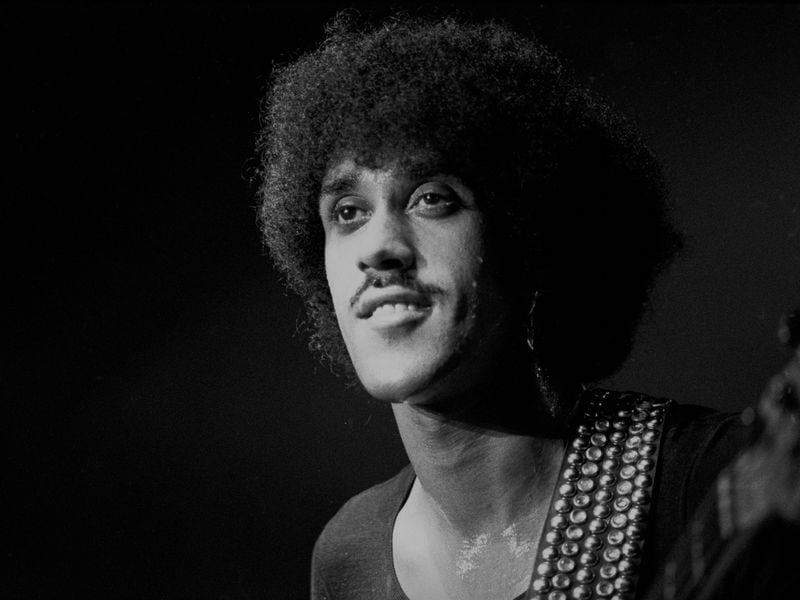
The troubled childhood of Thin Lizzy’s Phil Lynott

Phil Lynott was a rock icon in every sense of the word. He had exemplary skills as both a bassist and a vocalist, as shown in Thin Lizzy, with dashing good looks and a sense of old-school machoism that was specifically tailored to the working class bloke-centred rock and roll of the 1970s.
However, Lynott’s first years in the world were ones of turmoil and instability, perhaps explaining his overt masculinity and chauvinism, not to mention the heroin addiction that would contribute to his early death. Lynott was born – believe it or not – in West Bromwich as his mother, Philomena Lynott, had moved from Dublin to seek employment in the West Midlands.
Lynott’s father, Cecil Parris, was born on the British colonised island of Guiana in the West Indies. He had met Philomena in 1948, and they were together for a short while before Philomena moved to London. Shortly after arriving in the capital, Philomena discovered she was pregnant and moved to a home for unmarried mothers back in Birmingham. After Philip was born, she moved to Manchester for a short while.
During this time, Philomena also gave birth to two other children but sadly had to give them up for adoption. Reflecting on these years, Philomena once said: “The shame was unmerciful. I couldn’t let my mother know I had two more children. When I had those children, to have children out of wedlock was a terrible thing. In my day, to have a child out of wedlock, you were a slut. You were classed as soiled goods. It was awful”.
Soon enough, after several failed attempts to reconcile her relationship with Cecil when she had been living in Manchester and Liverpool, Philomena sent the young Philip to live with his grandparents, Frank and Sarah, in Crumlin, Dublin, on account of his experience of racism in school in Manchester. Grandfather Frank provided Lynott with the father figure he had always needed.
However, things were not initially easy in Dublin, as Phil was a rare black child in a town full of white kids. Phil’s uncle, Peter, was only two years his senior and, as such, they viewed one another as brothers. Peter once revealed: “We used to play in a nearby field in Crumlin called The Bangor Field, and Philomena arrived there with Philip. I was introduced to him and told I was his uncle. He then stayed with us, and she went back to England to work”.
He added: “To this day, I still remember the first day we arrived in the schoolyard. Young lads who didn’t know any better said: ‘Look at the blackie’. When the names started flying, the fists started flying. We stood back to back and fought our way out of it. It only lasted a few weeks. They didn’t notice colour anymore”.
Primarily, Phil Lynott’s time in Dublin would be a happy one. However, the familiar trodden trope of a young black illegitimate child without a father figure would be terribly suited to the future Thin Lizzy star. Cecil would reach out to Phil over the years, though by the time he had grown up, especially after having found fame in his band, Phil didn’t want to know.
One of Thin Lizzy’s lead guitarists, Scott Gorham, once recalled: “We were recording when his father walked in looking super fly and dressed in a white, three-piece suit with white patent leather shoes and a white hat. Phil and I just looked at each other as if to almost say, ‘What the fuck is that?'”
He added: “I couldn’t believe it, and the whole thing was really uncomfortable. I thought if I got out of the room, at least these two men could have a dialogue. So I started to get up, and Phil grabbed me and gave me a look, but I told him to sit and have a chat. I walked out, and literally, 10 minutes later, this guy came storming out the door, and that was the end of that. I think Phil pretty much told him to fuck off and that he didn’t need him now because he had never needed him before”.
Ultimately, Lynott would develop a heavy dependency on alcohol and drugs, leading to his death in 1986 at just 36. His estrangement from his father would be what most likely led to his need to express himself with an unrivalled degree of machoism. However, when he became a father himself, he loved his children with a level of affection that he had been unable to experience personally.
