


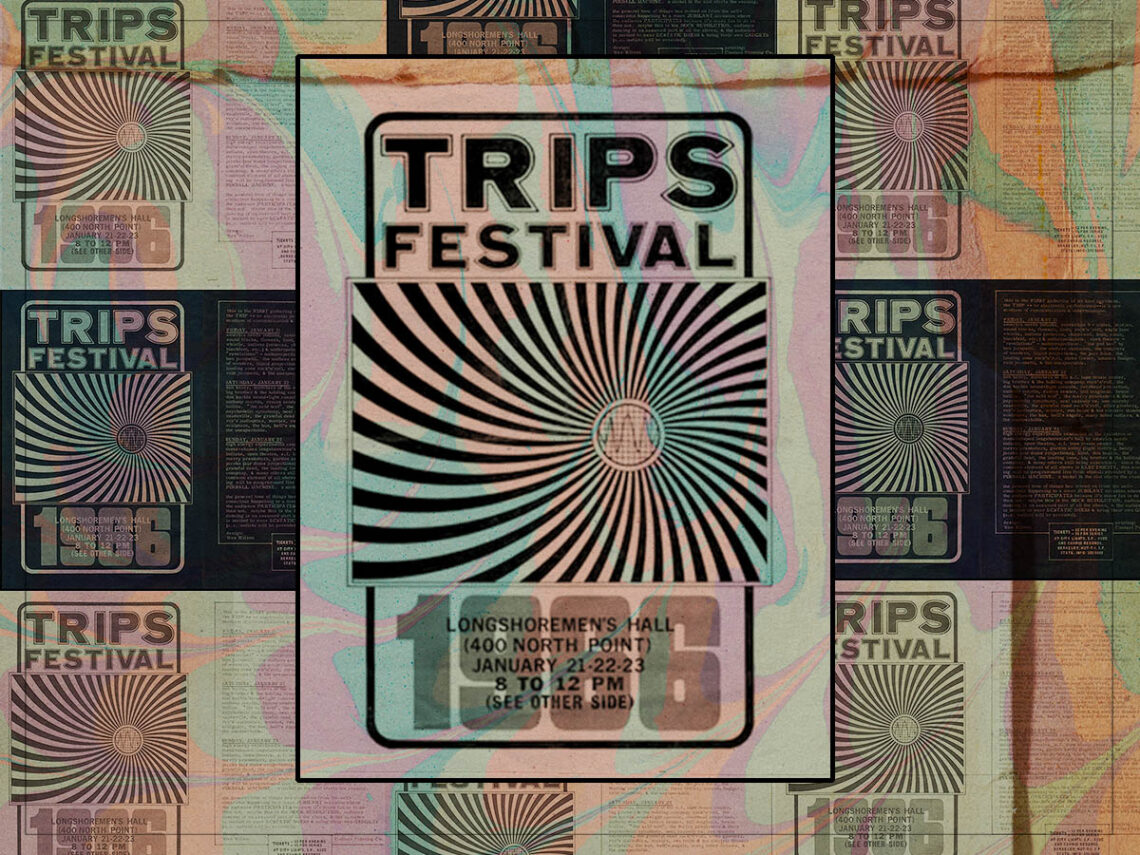
Trips Festival: the world’s largest acid test

It took ‘The Man’ a while to grasp the revolutionary sea changes bubbling away in America‘s counterculture. However, in October 1966, the Californian legislature headed by Ronald Reagan outlawed the use of lysergic acid diethylamide, the beloved hallucinogenic that exploded across the country’s youth, artists, and bohemians during a period of monumental social upheaval and challenge to authority. With LSD’s terrifying effect of mind-expanding consciousness and heightened communal affinity, naturally, a state that demanded uncritical patriotism and subservient consumerism had to crush any beautiful experiences to be had on the psychedelic elixir.
Of course, LSD wasn’t a new drug. First synthesised by Swiss chemist Albert Hofmann in 1938 when attempting to create an analeptic nervous system stimulant, the strange liquid became prevalent in the field of psychiatry into the 1950s, sold under the brand name Delysid and infamously researched in the CIA’s Project MKUltra interrogation experiments. LSD found its way out of the lab and onto the streets, entering a rapidly shifting youth base seeking purpose way beyond mainstream America’s fraying veil.
One keen dabbler was Ken Kesey. A relatively elder psychonaut who bridged the old Beat generation with the hippy radicals, the One Flew Over the Cuckoo’s Nest novelist in cahoots with his Merry Pranksters began hosting Acid Test parties at his La Honda farm in San Mateo County. Entirely legal, Kesey and his freaky crew would travel around the West Coast in their psychedelic Harvester school bus, stopping at various locations to hold further Acid Tests on the go, handing out free LSD to the brave and curious who turned up.
Their biggest event would be the lauded Trips Festival in January 1966. Held at San Francisco’s Longshoreman’s Hall on North Point Street, 10,000 eager trippers descended upon the old sailor’s union building for the three-day jamboree, the Saturday event featuring a giant punch bowl spiked with LSD and live shows from Grateful Dead and a newly formed Big Brother and the Holding Company, aided by a sophisticated light show and sound engineer Ken Babbs’ innovative amplifiers featuring volumes that could be cranked up without distortion.
Far too much self-discovery and collective joy was being had, and with the devastating announcement of LSD’s state-level outlaw from the suited ghouls in the Sacramento legislature, the hippy capital sought to protest in their own very far out way, slapping posters around the Haight-Ashbury district with posters instructing the clear directive: “Bring the colour gold… Bring photos of personal saints and gurus and heroes of the underground… Bring children… Flowers… Flutes… Drums… Feathers… Bands… Beads… Banners, flags, incense, chimes, gongs, cymbals, symbols, costumes, joy.”
On the fateful day of LSD’s ban, the Love Pageant Rally was held in the panhandle of ‘Golden Gate Park’, once again joined by free shows from Grateful Dead and Janis Joplin playing to a crowd of 30,000. This became a prelude to the Human Be-In event the following January, another festive protest which took on greater political dimensions and sets from the ever-reliable Grateful Dead and Joplin, plus Jefferson Airplane and Blue Cheer.
Following California, Nevada, and New York’s acid ban, Congress implemented the Staggers-Dodd Bill of ’68, imposing a nationwide prohibition on the now Schedule 1 drug and pulling the plug on the Acid Test’s fun for good. With renewed medical interest in the potential therapeutic benefits of LSD, coupled with the War on Drugs’ waning popular support, the freaky Acid Test parties may grow to become important milestones in drug policy and even the topic of cognitive agency.
