


The Wong Kar-Wai movie almost soundtracked by Massive Attack

With an introspective and deeply melancholic undertone to his films that has haunted audiences around the world, Wong Kar-Wai is one of the most innovative and poetic modern directors. His films masterfully convey a language of drifting and impermanence, of people stuck in time and unable to move forward, and one of the many ways he conveys this is through his use of music.
Wong Kar-Wai is known for his merging of visuals and sounds, creating a strange world in which little is conveyed through dialogue and most is communicated through sound. This technique is perhaps most prominent in In The Mood for Love, a film that is occasionally interrupted by words with an original score by Shigeru Umebayashi, music that accompanies the weighted interactions between the characters as they pass each other in hallways and exchange loaded glances, unable to act on their feelings for one another.
Given the influence of Wong Kar-Wai’s work, it’s hard to imagine that he would encounter any restrictions or setbacks during the pre-production process, but when he began working on his 1995 film Fallen Angels, the director had an entirely different plan for the film’s soundtrack that wasn’t possible.
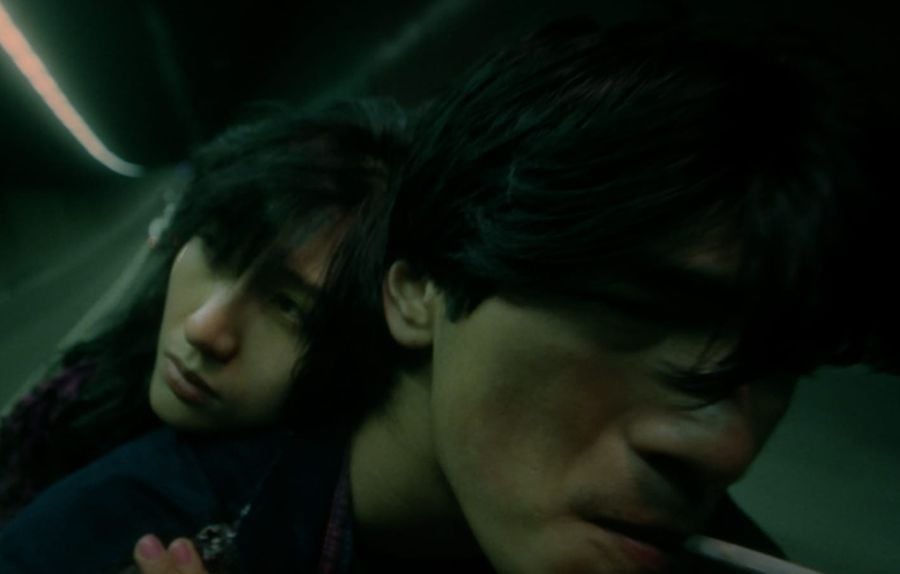
Fallen Angels follows an assassin who attempts to break free from his violent lifestyle, much to the objection of his partner, who is secretly in love with him. It’s bold and heavily stylised, perhaps less subtle than some of his other work. It constantly flits between different emotional tones, chaotic and tender at the same time.
The film has an original score composed by Roel A. Garcia, but the soundtrack includes a number of tracks by artists such as Marianne Faithfull, Laurie Anderson and Massive Attack. However, when Wong Kar-Wai first started working on the project, he originally wanted to collaborate with the group on the entire soundtrack, saying, “I wanted to use Massive Attack’s music, but it was too expensive, so I asked my composer in Hong Kong to do something like Massive Attack”.
The influence of Massive Attack’s style on the score can very much be felt, with a dark and electric sound that feels like the middle ground between multiple conflicting genres, creating the perfect landscape for a film that is so explosive and unfiltered. It’s both violent and beautiful and tender, a feeling that is distinctly unique to the world of Wong Kar-Wai, coming away from each of his films feeling as though you’ve been emotionally attacked and punched in the gut, left with feelings of simultaneous hope and despair.
Wong Kar-Wai later went on to work with Shigeru Umebayashi for the score of 2046, which acted as a partial sequel to In The Mood for Love. The film is set in the future as a writer grapples with his lost true love, mirroring the events of his previous film. The director is perhaps most well-known for In The Mood for Love and is still heralded as one of the greatest and most heartbreaking films about love and loneliness that has ever been made.
