


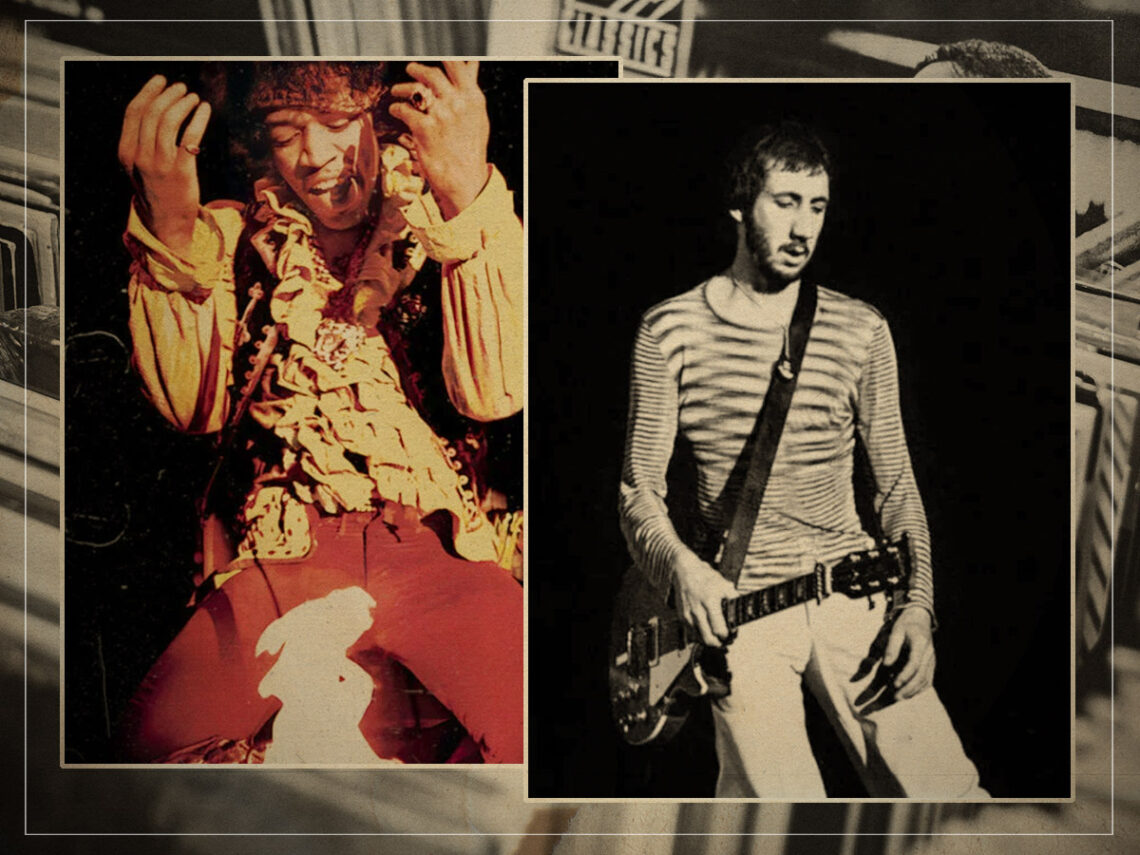
“It seemed mad for me to even try”: Pete Townshend on why ‘Live at Leeds’ wouldn’t exist without Jimi Hendrix

There are many things that wouldn’t exist without Jimi Hendrix—chief among them being fellows who show off by playing ‘Purple Haze’ in guitar shops without any intention of buying anything. But aside from the odd asterisk, his influence on the world has been bordering on the divine. As Pete Townshend once explained it, “When you saw him in the live arena he was like a shaman. It’s the only word I can use. I don’t know if it’s the right term. Light seemed to come out of him.“
It gets even more biblical than that, too. ”He would walk onstage, and suddenly, he would explode into light. He was very graceful,” he continued. Perhaps the greatest beauty of all is that it was all almost inadvertent. ”He didn’t know what he was doing,” he said. He was just a conduit for whatever inspiration hit him.
As John Frusciante put it, ”There’s absolutely no separation between him and his guitar—they’re completely one because he’s just putting every single bit of energy, everything in his whole psyche, and every single part of his body into his guitar playing.” This style did, however, mean that a few natural traits shone through, one of which was his note work alongside chords.
This is a style that Townshend, the proverbial master of chords, a man who was once hired by David Bowie and simply instructed to ”play Pete Townshend chords”, had never really comprehended until he paid close attention to what Hendrix was really doing. When the Seattleite took to the stage, he was liberated from playing in any one style—he would mix melodic strumming moments with rhythmic note tapping, searing solos, and subtle song construction.
“What Jimi was doing was sublime. It was an epiphany in the actual dictionary definition of the word. You felt pained because in his presence and in the presence of that music, you felt small. And you realised how far you had to go,” Townshend recalled. In 1970, The Who were in need of pulling off something similar. Their generation was in the process of giving way to another. The days of shock and liberation that they first propagated were put on pause by the horrors unleashed by Charles Manson and his cult. The band either had to push the dial further or acquiesce.
So, when they trotted out onto a mucky stage in Leeds, the group were on a precipice. With the wind of Hendrix behind their sail, they decided to push things further. The Live at Leeds album that was released soon after the fateful performance that February offered up a heaviness never before heard in rock ‘n roll music. They were a four-piece Tchaikovsky, blazed with such footloose style that they pretty much reinvented themselves.
Townshend told Sound International that it might not have been possible without the ‘Purple Haze’ performer. ”There was some nice stuff there,” he said about the live record. ”I don’t know what possessed me to actually start to play like that. I suppose it just must have been the influence of Hendrix. Because up to that point, I just wasn’t interested in single-note work.”
He explained, ”It seemed mad for me to even try to compete with the likes of Beck and Clapton and Jimmy Page.” But he soon found himself compelled to at least incorporate the full extent of a six-string. ”At one particular time after Hendrix, I decided it was worth trying to express myself through single-note work.”
The result changed him. As he concludes, ”It fitted my sound and had a lyrical quality to it because the neck was so uncluttered at the top you could play high.” It opened him to the potential of a full guitar blitzkrieg, and Live at Leeds is the blistering result.
