


The Week in Number Ones: Ed Sheeran, Jimin, and David Bowie

Welcome back to The Week in Number Ones, where all the biggest chart movers from the US and UK charts get condensed into one article.
Last week, we dove into a rejected Taylor Swift song that proved anything from the artist could be a hit in the modern day. We also looked at why Selena Gomez was on the charts in the US but not the UK and jumped into how 1960s psychedelic one-hit wonders The Turtles wound up changing the landscape of pop music.
This week, we take a look at Ed Sheeran’s domination over the pop charts and welcome BTS singer Jimin to the party. Then, we’ll take a deep dive into David Bowie’s ’80s reinvention as a global pop superstar with ‘Let’s Dance’. All that and more as we round up the best chart news of the modern-day and recent past.
Current UK Number One: ‘Eyes Closed’ – Ed Sheeran
Life is all about change. Knowing when to move forward and being comfortable with admitting that it’s time to do so. Evolution isn’t something that happens in a day: it’s a long and arduous process that can take years, decades, or even millennia. Today, I’m embracing evolution by turning over a new leaf and not talking shit about Ed Sheeran.
This column has been home to some harsh put-downs, and no one has been on the receiving end more than Sheeran. I’ve called his music “toothless pop schlock”, “inane crap”, and the man himself “a bit of a turd”. Here’s the thing, though: I can’t stop bringing him up. I’d like to blame the pop charts for constantly making me deal with him, but that’s not always the case. Even when I’m not talking about him, I’m talking about him.
The truth of the matter is that I secretly like a few Ed Sheeran songs. He’s not nearly as annoying as many of his peers, and even when he doesn’t hit, Sheeran seems relatively harmless. There’s only so much abuse you can hurl at a guy before you start to feel a bit bad.
Now, does this mean that I like Sheeran’s new song ‘Eyes Closed’? Absolutely not. Do I actually feel bad for a man who is a multi-millionaire global pop star? Not a chance. Was he still bad in Yesterday? A hundred per cent. ‘Eyes Closed’ is as neutral as any of Sheeran’s other chart toppers, and that’s not worth the time or the effort to write up a major takedown. Eddie, let’s officially call this a truce.
UK Singles Top Ten (Week of April 5th, 2023):
- ‘Eyes Closed’ – Ed Sheeran
- ‘Flowers’ – Miley Cyrus
- ‘Miracle’ – Calvin Harris & Ellie Goulding
- ‘People’ – Libianca
- ‘Die For You’ – The Weeknd & Ariana Grande
- ‘Calm Down’ – Rema
- ‘Ceilings’ – Lizzy McAlpine
- ‘Like Crazy’ – Jimin
- ‘As It Was’ – Harry Styles
- ‘Boy’s a Liar’ – PinkPanthress
Current US Number One: ‘Like Crazy’ – Jimin
I don’t know if you guys have noticed, but BTS are probably the biggest music group in the world. The South Korean pop stars have had major success (including number one songs and albums) in the US, but their global reach is both unprecedented and unrivalled. With a formula specifically based on highlighting the personalities of each of the members, it was only a matter of time before one of the BTS bunch scored a major solo hit.
My money would have been on RM, widely seen as the leader of the band. However, staging a surprise superstar coup this week is Jimin, one of the singers that usually stays in the background. Last month saw the release of his debut LP, Face. It’s only 20 minutes long, but I guess that’s long enough to be considered a debut record. I didn’t notice that the album’s first single, ‘Set Me Free Pt. 2’ became the highest-charting debut single from a Korean artist, but that was a pretty niche record to follow.
The record set by ‘Like Crazy’, however, is impossible to ignore. ‘Like Crazy’ is the first song by a Korean solo artist to top the Billboard Hot 100. You know who Jimin beat out for that distinction: Psy, whose inescapable hit ‘Gangnam Style’ only went as high as number two in the US in 2012. It’s also the highest-charting debut for any Korean solo single on the UK Singles Chart, starting out at number eight this week.
Let this be a lesson if you ever had a doubt about the popularity of K-pop, J-pop, or any foreign pop. Jimin, probably for this week and this week alone, is a bigger pop star than Taylor Swift, Miley Cyrus, SZA, and Harry Styles. With BTS, he’s bigger than all four combined. You might not know his name, but Jimin is one of the biggest pop stars in the world. Maybe it’s time you learned it.
Billboard Hot 100 Top Ten (Week of April 8th, 2023):
- ‘Like Crazy’ – Jimin
- ‘Flowers’ – Miley Cyrus
- ‘Last Night’ – Morgan Wallen
- ‘Kill Bill’ – SZA
- ‘Creepin’ – Metro Boomin, The Weeknd & 21 Savage
- ‘Die For You’ – The Weeknd & Ariana Grande
- ‘Boy’s a Liar, Pt. 2’ – PinkPanthress & Ice Spice
- ‘Calm Down’ – Rema & Selena Gomez
- ‘Anti-Hero’ – Taylor Swift
- ‘Players’ – Coi Leray
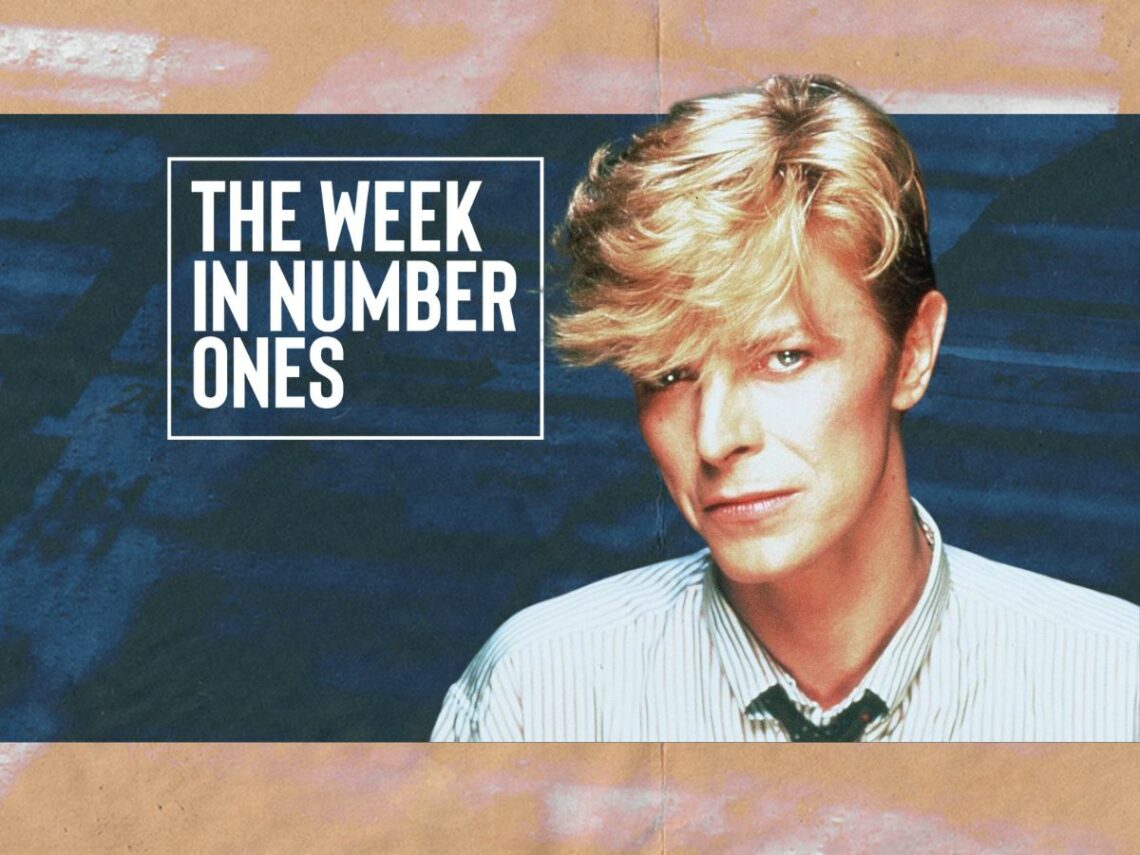
This Week in Number Ones: ‘Let’s Dance’ – David Bowie (#1 on the UK Singles Chart, April 9th, 1983)
It’s not like the world didn’t know who David Bowie was. Throughout the ’70s, the man born David Jones had become a global superstar, dipping his toes into genres as diverse as glam rock, R&B, funk, disco, synthpop, and new wave. The man had number one hits in both America and the UK. He was instantly recognisable, whether you saw him on TV or in concert. Pop stars didn’t get much bigger than David Bowie.
But in some strange way, nobody really knew who David Bowie was. He was Major Tom, or the Thin White Duke, or Ziggy Stardust, or Aladdin Sane. He would change guises and musical styles with every subsequent year, forcing his audience to stay on their toes to see what he would do next. All the while, stories of him living on nothing but peppers and milk (and cocaine) or him practising satanic rituals on tour began to proliferate. David Bowie was just a construct – the man behind the curtain was no one to be concerned with.
The ’80s was the prime time for Bowie’s established costume rock to go mainstream. As the ethos of glam rock began to mould with synthpop and new wave, Bowie was poised to make the jump from genre influence to contemporary ’80s pop star. He already snagged a number one song with the buzzy electronic track ‘Ashes to Ashes’. It seemed almost obvious that Bowie would bring his wardrobe of identities and storm the ’80s with feverish passion.
And then something strange happened: Bowie completely shed the outfits, guises, and personas. He began boxing and developed a male-model physique. He began dressing in stylish suits and quaffed his hair into a hyper-modern look for 1983. He almost looked… normal. When Bowie made the decision to lean into pop superstardom, he decided to leave his gonzo alter egos and eye-catching fashion behind him. The new David Bowie wasn’t a character, at least not obviously.
The brand new slick and stylish David Bowie made his debut with 1983’s Let’s Dance, a record that fulfilled its titular promise by unfurling eight dancefloor-ready tracks that weren’t strange or unconventional or boundary-pushing in ways that his music had been in the past. Instead, Bowie and his group of collaborators were subtly making mainstream pop more interesting.
That started with producer Nile Rodgers. Already legendary thanks to his pioneering work with disco titans Chic in the late 1970s, Rodgers had transitioned into his role as a producer to the stars, concocting major hit singles and albums for the likes of Diana Ross and Sister Sledge. Bowie handpicked Rodgers to help him lean into pop, but Rodgers’ iconic guitar skills would prove to be the biggest factor in pushing Bowie straight to the top of the mainstream.
While laying out some of the earliest demos at his home in Montreaux, Bowie went to Rodgers with a brand new song. Strumming out chords on his acoustic guitar, Bowie laid out what was, essentially, a folk song with a pop melody. Rodgers thought that it had some interesting elements, but the arrangement was all wrong. The Chic musician was not about to record a song called ‘Let’s Dance’ that you couldn’t dance to. Picking up his electric guitar and honing in on his background in jazz, Rodgers did what he always did: created something funky and irresistible.
Rodgers’ rearrangement fundamentally changed ‘Let’s Dance’. Now, there was room for a backbeat, cascading vocal harmonies, jubilant saxophones, Latin percussion, and synth stabs. There was also room for Bowie to unfurl his suave vocals, unencumbered by his guitar or any duties other than singing. The only thing missing was some stinging lead guitar. By chance, Bowie stumbled into his answer while walking outside his door and into the Montreaux Jazz Festival. The 1982 lineup featured a young Texas blues guitarist by the name of Stevie Ray Vaughan.
Vaughan had done it all by the ’80s: established himself in the blues underground, opened for legends like Muddy Waters, established his group Double Trouble, and gotten arrested for drug charges. When he and Double Trouble stormed the Montreaux Jazz Festival stage, it ended with the audience booing him. But Vaughan made an important fan backstage: Bowie was enthralled with his guitar playing.
The razor-sharp guitar licks that Vaughan adds to Let’s Dance are iconic in their own right. They have no business bumping up against Rodgers’ disco thump or the synth-pop arrangements on the rest of the album. Yet, Vaughan’s contributions are invaluable and perfectly mesh with the sound of the record. Vaughan was set to join Bowie on the ‘Serious Moonlight’ tour supporting the album, but a dispute between their respective managers led to Vaughan getting the boot. Bowie didn’t even know Vaughan had been fired, and while the rest of the band departed for the first show, Vaughan was left standing on the airport sidewalk scrounging up money to get a flight back to Texas. Luckily for him, Vaughan’s fortunes would pick up soon after.
With about three minutes cut off the master take, the ‘Let’s Dance’ single was unleashed on the world and immediately signalled a new era for David Bowie. After a full decade of experimentation, it was now time for Bowie to take on his most startling persona yet: global pop star. The power of ‘Let’s Dance’ was so overwhelming that it came to define Bowie’s entire artistic life for nearly a decade. After trying to chase its sound with the albums Tonight and Never Let Me Down, Bowie opted to subvert his established sound by forming the industrial alt-rock band Tin Machine. For the rest of his life, Bowie sought out more boundary-pushing sounds, but he probably wouldn’t have gotten the freedom to do so had he never made ‘Let’s Dance’.
UK Singles Top Ten (Week of April 9th, 1983):
- ‘Let’s Dance’ – David Bowie
- ‘Is There Something I Should Know?’ – Duran Duran
- ‘Boxerbeat’ – Joboxers
- ‘Speak Like a Child’ – The Style Council
- ‘Sweet Dreams (Are Made of This)’ – Eurythmics
- ‘Breakaway’ – Tracy Ullman
- ‘Ooh To Be Ah’ – Kajagoogoo
- ‘Total Eclipse of the Heart’ – Bonnie Tyler
- ‘Church of the Poison Mind’ – Culture Club
- ‘Snot Rap’ – Kenny Everett
