


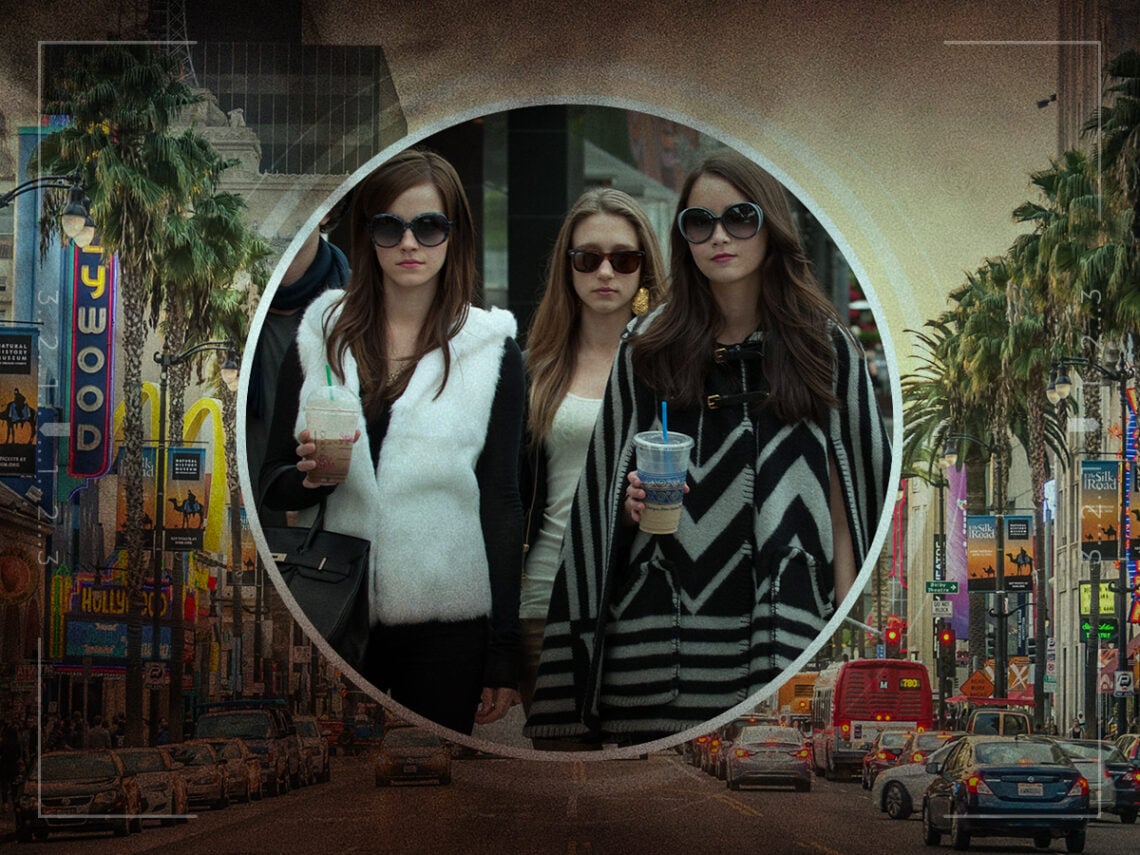
“Could not have happened anywhere else”: The vital role of California in Sofia Coppola’s ‘The Bling Ring’

When Sofia Coppola released The Bling Ring in 2013, it felt like an outlier in her filmography. Compared to films like The Virgin Suicides, Lost in Translation or Somewhere, it was far more brash and in-your-face, complete with Emma Watson putting on a questionable LA-girl accent to shout, “I wanna rob!” and dancing to Azealia Banks’ ‘212’.
It’s a perfect time capsule of the late 2000s and early 2010s. The sound of Sleigh Bells’ ‘Crown on the Ground’ marks the entrance of a group of detestable characters, strutting onto the screen with an air of privilege and superiority. These teenagers spend the film robbing the homes of celebrities, with Coppola basing the story on a real group of teens who did exactly that. Their exploits were first detailed in Nancy Jo Sales’ Vanity Fair article, ‘The Suspects Wore Louboutins’.
Yet, The Bling Ring is often considered one of Coppola’s weaker films – sure, people thought it was fun, but it didn’t seem to have the same brooding, melancholic energy that made her previous films so beloved, and while Coppola might have leaned into pop music, affected California accents, and Paris Hilton – and the performances here definitely aren’t as strong as in her other films – the movie doesn’t get enough credit for its commentary on vapid celebrity culture.
This isn’t any old crime movie. This is one with teenage girls at the forefront, with reality stars and Hollywood actors as their targets. Expensive shoes, bags, cars, and jewellery are the aim of the game, as is the kick of getting closer to a world that seems so illustrious, so foreign. These teenagers are privileged enough to live in close proximity to these famous figures, and Coppola narrows in on the shallowness of it all – the emptiness in chasing notoriety, cash, and designer goods. In some scenes, the lighting is so hazy, almost as if everything is bathed in a very light wash of pink, and it seems to communicate this deluded dream world that they’re living in.
We’re shown a world that looks beautiful yet hard to attain unless you happen to be born into it, and it’s as though Coppola is asking us if we want it, too. As someone who was born into a world of celebrity, Coppola was well-equipped to deal with the story, having grown up in California, immersed in the world of Hollywood thanks to her father, Francis Ford Coppola.
The movie’s California backdrop is vital. In some scenes, the city twinkles in the background, a world of possibility and privilege intrinsically wrapped up in the image of Hollywood, lavish homes, and endless opportunity. It lingers as a perpetual reminder. Coppola uses California as a setting to her advantage – it’s easily one of the ultimate representations of the American Dream, a vision of excess that lures these teenagers in, who are well-off enough to possess some twisted sort of delusion that makes them think they can get away with their crimes.
“Los Angeles plays a key role in American culture. This is what we see in this film: a world of celebrities and reality TV,” Coppola said during a press conference at Cannes Film Festival. “This story could not have happened anywhere else. These children lived right next to these stars.”
The deconstruction of the American Dream is a common theme in Hollywood – you only have to look at the work of David Lynch, for example – and it often seems to be those filmmakers who have a deep connection to a place like California, the centre of it all, who really know how to critique it. Coppola highlights just how easy it is for these naive teens to get sucked into this celebrity world because it’s all they know; they’re surrounded by it. California is a whole different climate, and Coppola expertly brings this elusive place to the big screen with an insider’s eye.
The Bling Ring might not be as striking as The Virgin Suicides, but it certainly brought a unique perspective to the crime genre, which is so often explored through the lens of adult men. California is at the heart of Coppola’s story, though, acting as the ultimate encapsulation of both privilege and the harsh reality of the American Dream.
