


The vital anti-racist history of Notting Hill Carnival

This bank holiday weekend, the Notting Hill Carnival, often described as ‘the biggest street party in Europe’, returned to the streets of London. Yet, alongside the event’s association with hedonism, striking colours, and loud music lies a far more significant cultural history.
Over the last month, Britain has been plagued with some of the worst racist violence in more than a generation as organised groups of fascists and racists rioted through British towns and cities, targeting mosques, asylum seeker accommodation and Black and Brown people who happened to be in the wrong place at the wrong time.
Shocking and frightening as the scenes of large-scale racist attacks were, it is sadly not a novel occurrence in British history. The early 20th century was littered with racist upsurges across the country in 1919, 1920 and 1958. However, in 1958, the role carnival played as a creative response to racist violence can guide us in beginning to address the divisions the far-right sought to entrench in communities across Britain earlier this month.
During the reprehensible revolt of the late ’50s, the Notting Hill area functioned as an organising base for infamous fascists Oswald Moseley’s Union Movement and Colin Jordan’s White Defence League. Both parties actively encouraged supporters to violently confront the local West Indian population and drive them out of the area. This led to two weeks of terror as mobs of young white men labelled as ‘Teddy Boys’ attacked the local black community and properties, resulting in over 100 arrests.
Earlier that same year, Claudia Jones, a Trinidadian-born political activist and journalist, launched the West Indian Gazette (WIG) newspaper to connect the Caribbean diaspora in Britain and highlight the anti-colonial struggles abroad. However, the 1958 racist riots in Notting Hill and Nottingham concurrently motivated Jones to do much more than just report on black communities in Britain and internationally.
Jones and her contemporaries at the Gazette decided to import the idea of a Caribbean carnival from Trinidad to London as a way of pulling together the region’s Caribbean community, following the riots, bringing them together in celebration centred around Trinidadian costumes and calypso. Their efforts brought about Britain’s first Caribbean Carnival fayre, which was held at St Pancras Town Hall in 1959 and televised on the BBC.

Jones and the other organisers decided to donate a section of the proceeds from the accompanying carnival brochures to the legal funds for black and white people arrested in the 1958 Notting Hill riots. Evidencing their broader motivations to use the carnival as an antidote to heal racial divisions underlying the riots. In the brochure, Jones wrote, “Our Carnival symbolises the unity of our people resident here and of all our many friends who love the West Indies”.
Similarly, community worker Rhaune Laslett, organiser of the forerunner to the Caribbean-themed Notting Hill Carnival of today, shared with Jones an awareness of the potential to strengthen the bonds between the various communities through a shared celebration of the music and cultural traditions represented in the area. At a time when parts of the Notting Hill neighbourhood were written off as slums, Laslett galvanised the local Caribbean, Irish, West African, and Polish communities to revive the borough’s English fayre and “bring some colour, warmth and happiness to a grim and depressed neighbourhood”.
Nearly 60 years after Laslett revived the English street festival in Notting Hill, the carnival has developed into a cultural institution in Britain, offering a platform for successive generations of migrant communities to be represented and participate in a cosmopolitan exchange—one that exhibits a vital message to the world.
However, the Notting Hill Carnival also faces problems. This year, many carnival bands are in financial crisis with falling numbers of masqueraders resulting in skyrocketing costs to between £15,000-£20,000 to put a float on the road. This is further exacerbated by continued cuts to Arts Council grants.
The organisers’ decision to cancel the annual J’Ouvert event this year due to a lack of bands highlights the underlying issues. J’Ouvert is a historical ritual at sunrise on Carnival Sunday, where participants throw paint at one another, symbolising a celebration of freedom from enslavement. Its loss will undoubtedly concern carnivalists keen to preserve the rich Caribbean tradition within the event.
The carnival’s challenges aside, it remains Britain’s foremost annual multicultural spectacle and the best retort to Nigel Farage and Tommy Robinson’s myths regarding Britain’s ‘no go’ areas and championing of uniformity. At a time when we are witnessing an emboldened far-right spreading racial hatred, we should celebrate the carnival’s antiracist roots and harness its unifying potential to confront today’s challenges.
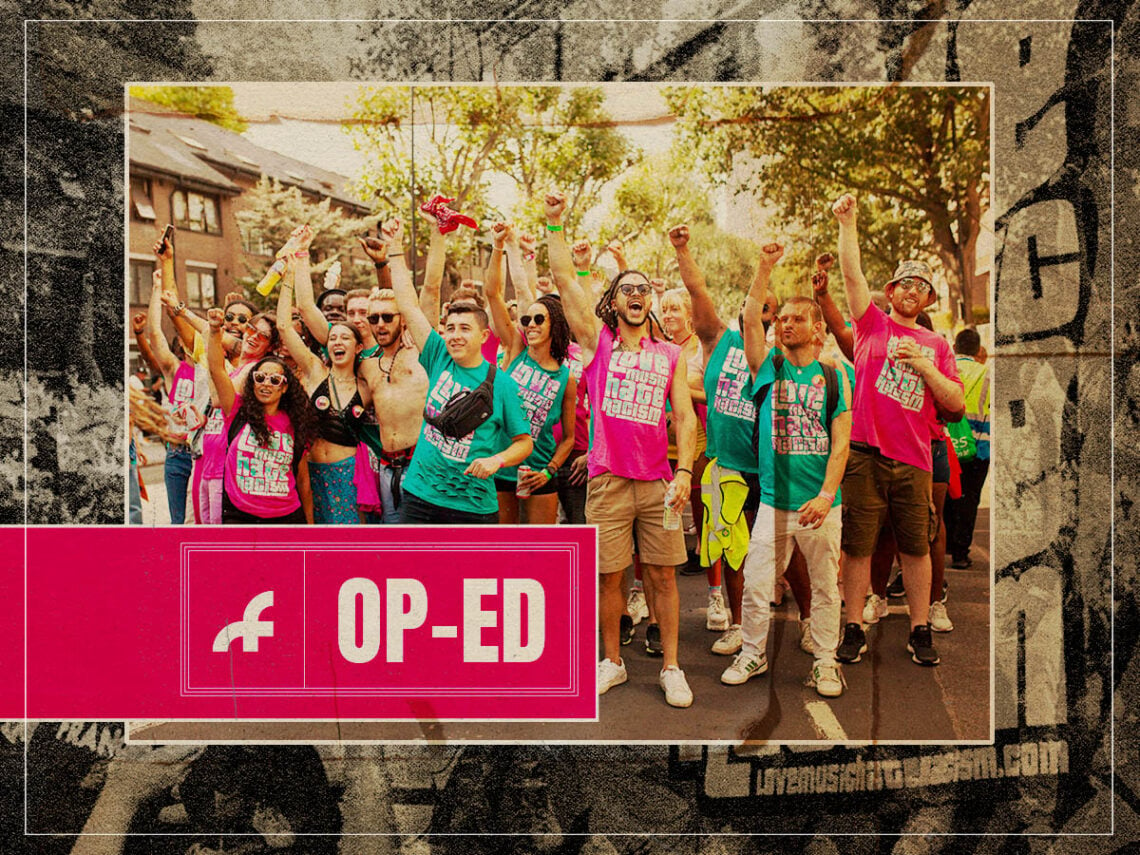
This weekend, I will be doing precisely that, partying with a purpose as part of the Love Music Hate Racism float in the Notting Hill Carnival parade—a parade that always has highlighted the communal power of cultural celebrations, something that is sadly more important than ever.
