


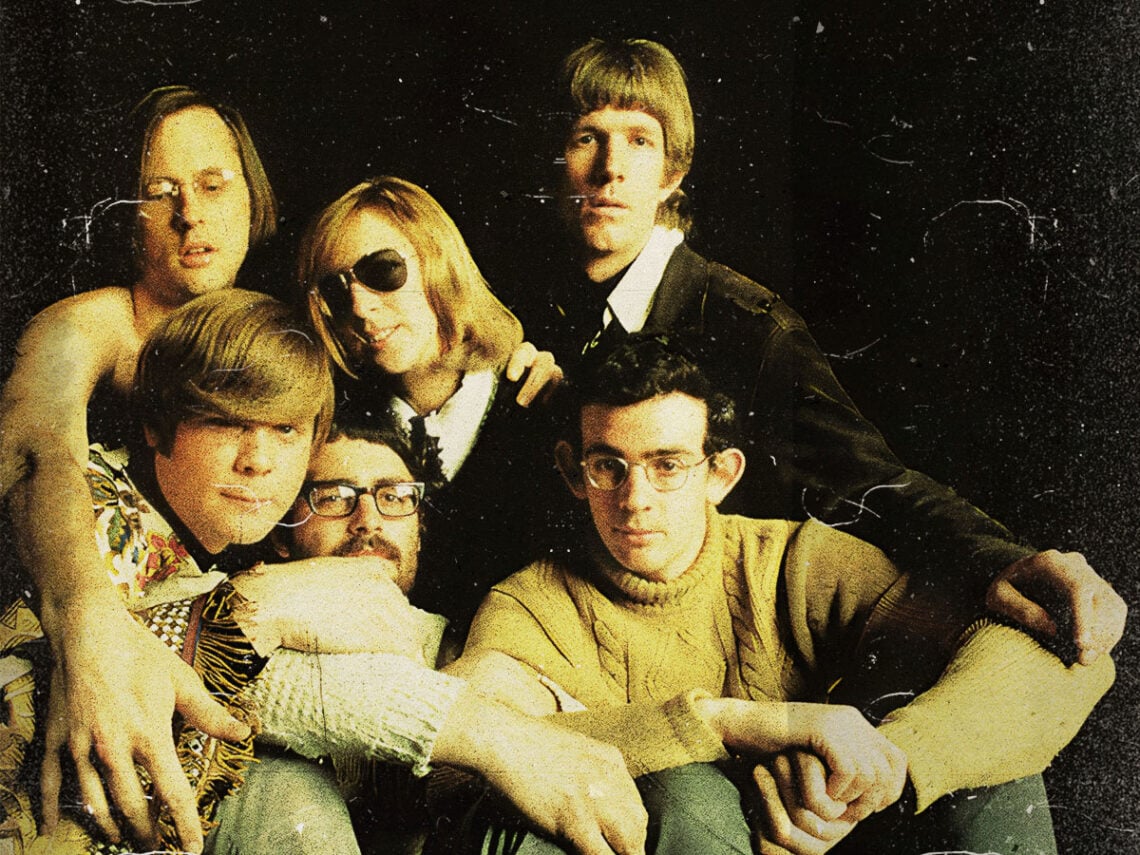
The United States of America – ‘The United States of America’

The in-state rivalry of the 1960s psychedelic scene was real. Although California became the beacon for hippies and free thinkers, there were two different places you could go. The first option was Los Angeles, the historical home base of the entertainment industry, or San Francisco, the looser and more far-removed setting. Some musicians went back and forth, but most bands stayed in one place: Los Angeles had Love, Buffalo Springfield, and The Beach Boys, while San Francisco had Santana, Jefferson Airplane, and the Grateful Dead.
The debate about which city harboured the ‘true’ psychedelic sound has never been fully resolved. Many parties briefly switched lines (the Dead moved to Los Angeles for a couple of weeks in 1966, while both Graham Nash and David Crosby made San Francisco their residency by 1970), and some important figures have been lost to history. The United States of America were on the front lines of the psychedelic explosion, complete with all the prerequisite experimental tendencies and left-wing politics. But with just one album to their name, the band slipped through the cracks of American pop culture.
Formed by New York avant-garde composer Joseph Byrd and folk vocalist Dorothy Moskowitz, The United States of America was a band that started by hanging around the same circles as Yoko Ono and Art Garfunkel, made industry connections, flew out to Los Angeles, made one giant push, crapped out, split up, and disappeared from the majority of people’s mind. There were thousands of groups throughout the 1960s who faced similar fates – garage rockers, psychedelic hippies, avant-garde boundary pushers, and pop stars-to-be. But The United States of America were so unusual that they were impossible to ignore.
Their story reads like a made-up version of a 1960s band: early members were so radical that they left the band once they signed to a major label. Linda Ronstadt might have briefly fronted an early version of the group. Byrd attended UCLA at the same time as Ray Manzarek and Jim Morrison. The overlap between them and the rest of the rock music world pulls in everyone from The Velvet Underground the Country Joe and the Fish. But The USA had exactly one lasting contribution to the psychedelic music canon: their debut, 1968’s The United States of America.
The band’s singular blend of electronic music and atypical genres is on display as soon as the needle hits the vinyl. ‘The American Metaphysical Circus’ springs to life with carnival organ and ragtime piano layered on top of each other. As the sounds blend and clash in a cacophonous overture, the music suddenly fades in on a gothic folk tune helmed by the detached voice of Moskowitz that reads like psychedelic sci-fi Frankenstein.
Like a demented mix of Lulu and Nico, Moskowitz is able to jump between hard-driving rock, rave-up soul, and robotic electronics at a moment’s notice. That’s what is asked of her, as Byrd and the rest of the band throw just about everything at the wall. ‘Hard Coming Love’ is a sharp-edged freakout rock with a Dusty Springfield-like single shoved in the middle. As bassist Rand Forbes and drummer Craig Woodson bash away, the cycle of sounds that float in and out of the arrangement is so elusive that it’s almost impossible to tell what they are.
In reality, a mix of keyboards, synthesised electronics, electric violin, and old-timey steam-powered keyboards take up the space that is usually reserved for guitar. Byrd leads the charge, but violinist/vocalist Gordon Marron and fellow radical composer Ed Bogas add to the experimental tones. Half a decade before Brian Eno was filtering Roxy Music through his own mad scientist workbench, Byrd was manipulating the elements of a rock band into something completely different.
‘Cloud Song’ shows off the folk origins that Byrd and Moskowitz certainly picked up during their beatnik years in New York. As varied and whiplash-inducing as any album of the 1960s, The United States of America burns through proto-Krautrock on ‘The Garden of Earthly Delights’, surrealistic Dixieland jazz on ‘I Won’t Leave My Wooden Wife for You’, monk chants on ‘Where Is Yesterday’, and acid-soaked garage rock on ‘Coming Down’. Just when you feel like you’ve gotten a grasp on what the band sounds like, a brand new style and approach turns you completely around.
The USA get points for ambition, although their dedication to cohesion was less successful. The band’s foundation was built upon being an anti-rock band, but that same volatility meant that they couldn’t stay together for any extended period of time. Members clashed over the band’s style and Byrd’s control, and as the psychedelic sound became more mainstream, it became increasingly clear that the group wouldn’t survive beyond their debut album.
“The idea was to create a radical experience,” Byrd told writer Richie Unterberger. “It didn’t succeed. For one thing, I had assembled too many personalities; every rehearsal became group therapy. A band that wants to succeed needs a single, mutually acceptable identity. I tried to do it democratically, and it was not successful.”
Evidently, a Los Angeles band signed to Capitol Records got flack for including a love song to then-recently deceased Marxist revolutionary Che Guevara. Go figure. As Byrd attempted to explore the denser corners of experimentation, Moskowitz began edging toward the singer-songwriter movement. The USA’s central core soon became fractured, and the band split up after disappointing sales, and a complete lack of stability led to everyone except Moskowitz leaving the band by the middle of 1968.
Unsurprisingly, The United States of America was virtually unknown in the immediate years after the band’s demise. There weren’t any features on compilations like Nuggets, no retrospectives on VH1 detailing their story, and no peers from the time singing their praises. The music that makes up their one and only studio album sounds more of its time than just about anything from the era, which is ironic considering how the group were consciously pushed toward the future of rock music.
However, hiding within the failure of The United States of America is a truly revolutionary band somewhere among the wreckage. Years before electronic music became a genre of its own, The USA were pioneering techniques that would blossom in the next eras of rock music. The only issue was the group themselves weren’t there to take advantage of it. They were only there to add a small contribution. Such is the fate of a band that has seemed to fill every space of the rock star bingo sheet.
