


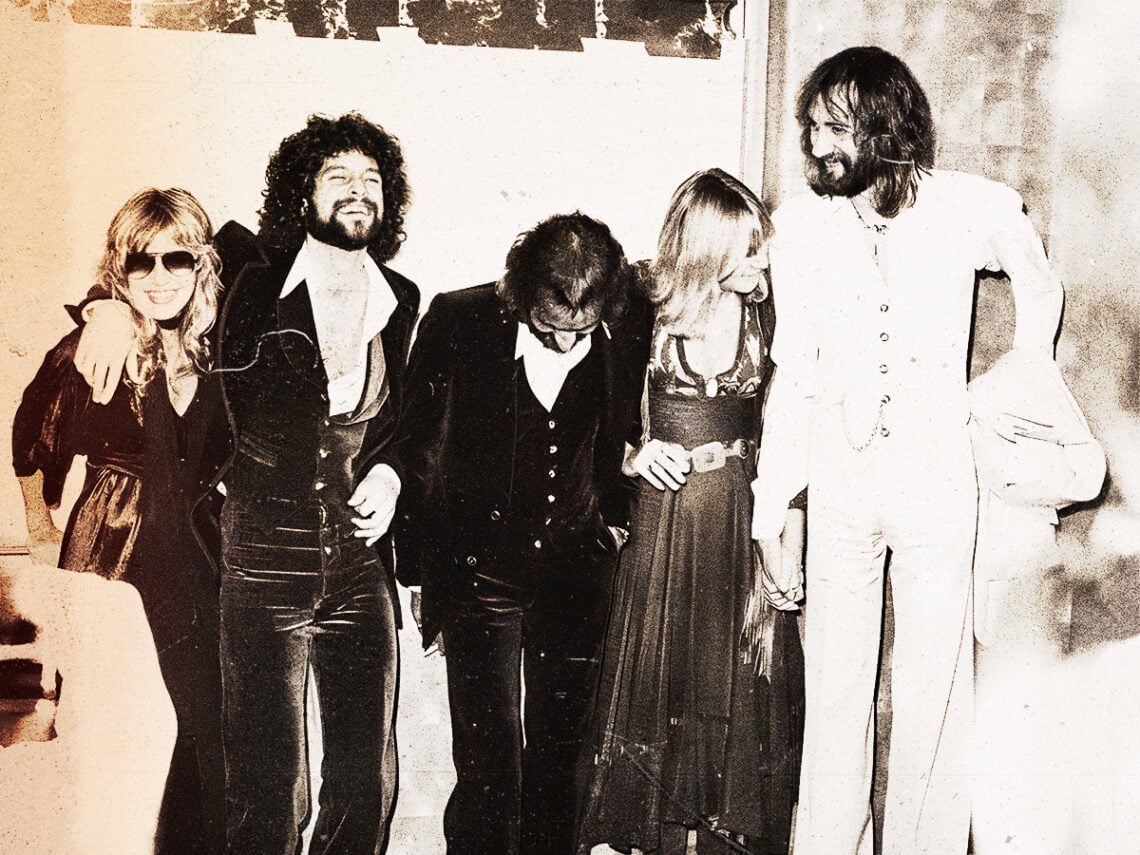
The ultimate beginner’s guide to Fleetwood Mac

Unlike many classic rock bands, over the years Fleetwood Mac’s popularity has only continued to grow. Their revered masterpiece, Rumours, now sits comfortably in the top ten best-selling albums of all time list, and with a new generation delving into the band, vinyl sales are flourishing. However, success only tells half the story when it comes to this group. In fact, there has been so little peace aboard the wild ride of Fleetwood Mac that even the crew of the curse Mary Celeste would look at them and say, ‘Hey, at least we didn’t have it that bad’.
This drama has inspired recent series like Daisy Jones & The Six. However, for the sake of believability, even that fictitious show had to tone things back. You see, Fleetwood Mac not only embody sex, drugs and rock ‘n’ roll, but they’ve also been caught up in cults, addictions, more break-ups than a sitcom couple made of Lego, legal disputes, on-stage fights, crushing flops, and monumental triumphs.
All of that going on in the background has led to some rather potent music. Whether it be their early blues period or the pop-rock that now defines them, the music that rises from this maelstrom of madness is always given an extra wallop. Thus, their sound might have changed a lot over the years, but Fleetwood Mac have always sustained a certain aura.
So, with that in mind, we thought we’d offer up a beginner’s guide to this unique band. From the defining albums and songs to see easy starting points, the history of the band, and why people love them. After all, they are an outfit that needs no introduction, but a hell of a lot of explaining.
The beginner’s guide to Fleetwood Mac:
The Key Facts
Where are Fleetwood Mac from?
The band are originally from the UK, with the first members meeting in London. Since then, however, they have become transatlantic with key members from both the UK and the US.
How many albums have Fleetwood Mac sold?
Over the course of 18 studio albums, nine live records, and 23 compilation efforts, Fleetwood Mac has sold a whopping 120million albums, making them one of the best-selling bands of all time.
Who is in Fleetwood Mac?
Well, the ever-revolving door of Fleetwood Mac needs some breaking down, so deep breath…
Dave Walker (1973), Stevie Nicks (1974-1990, 1997-present), Bekka Bramlett (1993-1995), Peter Green (1968-1970), Danny Kirwan (1968-1972), Bob Weston (1972-1974), Lindsey Buckingham (1974-1987, 1997-2018), Rick Vito (1987-1991), Dave Mason (1994-1995), Mike Campbell (2018-2019), Jeremy Spencer (1968-1971), Bob Welch (1971-1974), Billy Burnette (1987-1995), Neil Finn (2018-present), Christine McVie (1970-1990, 1998-1998, 2014-2022), Bob Brunning (1968-1968), John McVie (1968-present), Mick Fleetwood (1968-present).

History & Eras
Fittingly, for the tempestuous band, they were even born from the fires of a fallout in 1967. The door opened for a group to form when Peter Green left John Mayall & The Bluesbreakers and formed a new entity: Peter Green’s Fleetwood Mac. The band consisted of drummer Mick Fleetwood, bassist John McVie, and vocalists/guitarists Jeremy Spencer and Peter Green. Danny Kirwan would join as a third guitarist in 1968.
This early era was defined by a modified blues sound. In fact, the blues great B.B. King said that Green was the only guitarist who ever gave him “cold sweats”. However, a poppy appeal was also present, helping them to define a new niche thanks to a more prominent ‘band’ approach than most blues outfits.
This garnered some initial success for the group, especially in the UK and Europe. However, their first tragedy would soon curtail their rise. In 1970, while on tour in Germany, the band were lured away to a forest in the woods where a cult-like party was underway, and several members took part in the taking of homemade LSD.
“Peter Green and Danny Kirwan both went together to that house in Munich,” their one-time manager Clifford Davis recalls, “both of them took acid, as I understand. Both of them, as of that day, became seriously mentally ill. It would be too much of a coincidence for it to be anything other than taking drugs, as of that day.” Both left the band shortly after, with Kirwen sadly dying destitute and homeless.
When, over the next two years, Jeremy Spencer left the band to join a cult and Danny Kirwan’s replacement, Bob Weston, had an affair with Mick Fleetwood’s wife, it seemed like Fleetwood Mac were set to be a thing of the past. Then in 1974, when a legal dispute called leaning back on royalties into question, the band needed to focus on reviving themselves and earning some cash.
They went in the market for a guitarist; Lindsey Buckingham was the man they had in mind. They auditioned him, he passed, but an impasse soon arrived: he informed the band that he strictly comes as a pair with Stevie Nicks. Fleetwood Mac were not interested in hiring a singer, so they stepped back before ultimately agreeing.Wild success soon followed, and on this occasion, I mean wild in ever sense.
The band had been veering away from their blues origins to more typical rock anyway, but now with Nicks and Buckingham exercising an influence, they became more poppy than ever before. They were an intant hit with their first record as the now-eponymous line-up and that brought about an extended spell on the road and this stress caused cracks to appear. John and Christine McVie began divorce proceedings, Buckingham and Nicks also broke up, and Fleetwood was divorcing Jenny. Furthermore, they were all addicted to cocaine, alcohol or both.
Alas, their sound and stardom were solidified with their masterful 1977 album Rumours, which arose from this trainwreck and they have continued in that style ever since. While Tango In The Night saw them reach their poppiest, the powerful riff-driven spirit of the band has sustained. As has the madness behind the scenes with love triangles and chaos approaching and then surpassing parody levels, making them the band we all now love… or in a few cases, love to hate.

Defining Albums
Then Play On
If there is one thing that Fleetwood Mac has always been associated with, it’s polished musicianship. This, in part, is because they had one of the greatest guitarists ever in their ranks with Peter Green, but because Mick Fleetwood and John McVie form such a tight and distinct rhythm section that every single person they play with can be assured that the backbone of the team is solid and they can offer the flair.
It is this caustic combination that makes their 1969 record, Then Play On, soar. The album waxes and wanes, exploring everything that blues rock can possibly be. Along the way, it veers from sparse, heartfelt hymns like ‘Closing My Eyes’ to manic jam-outs with ‘Oh Well (Pt 1 & 2)’. Nevertheless, it is all seamlessly tied together with an air of thundering energy.

Rumours
In defining Fleetwood Mac fashion, Rumours is the distilled cacophony of five people falling apart and yet at the very top of their game. Despite all the chaos and despair, it is the sound of a rarefied space between crazy, debauched love and its lonely, sombre counterpoint — people at their best and worst. Most importantly, though, none of this is imbued retrospectively through the lens of the story we now know, it is all so perfectly captured and present in the sound.
The record encapsulates everything that was happening — all the wrung-out heartache, the comic silver-lining of tragedy, the vying musicianship, opulent excesses and all the inherent jubilation that they were, in their own berserk way, getting through it together. In short, the record is somehow a total mad expression of love — everything coalesces to make not only one of the greatest rock ‘n’ roll records ever but one of the greatest records ever, period.

Defining Songs
‘Man of the World’
Mick Fleetwood has made it as clear, as hopefully, this piece has, that without Peter Green, there would be no Fleetwood Mac. The blues-rock guitar virtuoso is one of the most mythologised men in rock ‘n’ roll, but the short truth of the story is that he was one of the greatest guitarists of all time who struggled with the hedonism of the scene.
Green wrote this song about how he achieved everything he wanted to with a set of his good old pals, but despite loving his bandmates and all the good times he was having, he still felt incomplete.
By his usual blistering 12-bar standards, the song is tender and mellowed, and his rare spaced-out strumming lends it a heart-wrenching sincerity. Despite the melancholy overture, the track is still equal parts an ode to his friends and good times, making for gorgeous duality. However, the highest triumph of all is one of the greatest guitar tones ever put to record—a thing of sumptuous beauty that sinks into your ears the way that your teeth sink into cheddar.
‘Landslide’
Although ostensibly about a father and daughter, Nicks has often said in interviews that this song has overtones of her feelings toward Buckingham. Nicks had penned this track pre-Fleetwood Mac, a time when the couple had each other and very little else. Buckingham took a payday touring with Don Everly and prior to departing, he dropped Nicks off to spend three months on her own in the “snow-covered hills” of Aspen.
The resulting piece of music is a thing of introspective beauty that captures something deeply spiritual. The star tackles independence and the isolated feeling of those early mid-20 years with profound poetry and a poignant melody to boot.
“Well, I’ve been afraid of changing ’cause I’ve built my life around you / But time makes you bolder, even children get older, and I’m getting older too,” is a simply gorgeous lyric.
‘Dreams’
‘Dreams’ is the perfect tableau for Fleetwood Mac’s existence. Picture, if you will, the moment the three-part vocals had to be recorded: in a silent, darkened studio room stood Stevie, Christine and Lindsey huddled inches apart around the same microphone and pouring their heartaches into it, no doubt in that very moment the heartache was being added to – frankly, it’s hard to imagine a performance under any more emotional duress.
And yet, it is that very vulnerability combined with the cathartic so-screw-it liberation of great rock music that lends ‘Dreams’ its vibrant and emotive immediacy. ‘Dreams’ is perhaps too catchy and too easily sung along to be considered the peak of heart-breaking music; in fact, it is even played at weddings by less lyrically scrupulous DJs. However, the story behind it is one that doesn’t get much more tragic this side of Orpheus.
‘Gypsy (Acoustic)’
In the Coen brothers film The Man Who Wasn’t There, there is a scene whereby a pretentious French piano instructor dismissively explains, in roundabout terms, ‘I don’t know what it is, but she hasn’t got it’. On the surface, this mystic je ne sais quoi of artistry may well seem like the sort of elitist tripe that has allowed trashcans to sell for millions at the Museum of Modern Art, but I’ll be damned if there isn’t more than a grain of truth to it.
In this stunning acoustic rendition of ‘Gypsy’, Stevie Nicks transfigures a few simple, sparse chords and a hushed raspy vocal into a track-stopping performance, brimming with that a hatful of that certain je ne sais quoi we often call soul. And there was good reason for so much expression to be poured into the wispy piece of music too.
The song, written by Nicks, was originally intended to feature on her solo debut Bella Donna in 1980, however, given the limited space that records allowed back then, it fell shy of making the cut. A tragedy would later ensure that the song saw the light of day with Fleetwood Mac following the sad death of Nicks’ best friend Robin Anderson, as Nicks viewed the tale of a trailblazing woman baring her inner fearlessness as a fitting tribute. This sincerity always ensures that there is an assertiveness to the expression of the band, they don’t set out to reinvent any wheels, they’ve got too much to say to bother with experimentation and that shines through the grey clouds of bands forcing invention like hot train throough butter powered by simplified soul and honesty.
Why do people love Fleetwood Mac?
For the last few years, Fleetwood Mac have been the best-selling classic rock band in the world as Stevie Nicks’ exploits continue to bring the band to new generations. As detractors have pointed out, the band might not always induce a personal response or barnstorm new horizons (admittedly, they never did), but commercially viable alternative music is a realm that must be occupied by someone and thankfully, nobody has ever done that better than on the pop-rock perfection of Fleetwood Mac’s post-1974 years.
Laden with more opulent hooks than the Alnwick Fishing Tackle Museum and a rollicking rhythm section, the tracks bound along life’s long and winding road transfiguring the potholes on memory lane into triumphs so vitalised that you’re almost glad life is tragic for the sake of saving us from boredom. Ultimately, this is the true conquest of the band throughout the eras.
The message of finding dalliance amid chaos is fitting today, too, it is one of defiance. Despite the garbage fire of circumstance that the group have weaved through during their troubled history, albums like Rumours exude more fervent joie de vivre than an orgiastic melee of seagulls surrounding a dropped kebab with double garlic sauce in the Bigg Market on a Friday night. In part, this might be because the backstory is so potent; whether it be Green struggling to reconcile the world of fame and letting his guitar gently weep for him or the furore that followed.
If we were all in music for the maestros or the avant-garde groundbreakers, then the best-selling lists of the world would be occupied by a mix of Beethoven and scientific field recordings of the bees rendered orchestral by an ingenious producer with a lot of free time. However, pop culture tells us tales that make sense of life and the backstory madness wavering in the welter of Fleetwood Mac is palpable in their music, it dips and weaves through solemn ditties to thunderous f–k you’s and it has never lost that breath of humanised fresh air that it exhales like a hurricane.
In fact, over the years, it has done what the best commercial art achieves, it has timelessly transcended into our dismal daily lives adding so much colour that you can’t imagine the world without it and I, for one, am glad of that as are millions of fans.
