


The Cover Uncovered: Cream’s Cambodian-inspired ‘Disraeli Gears’

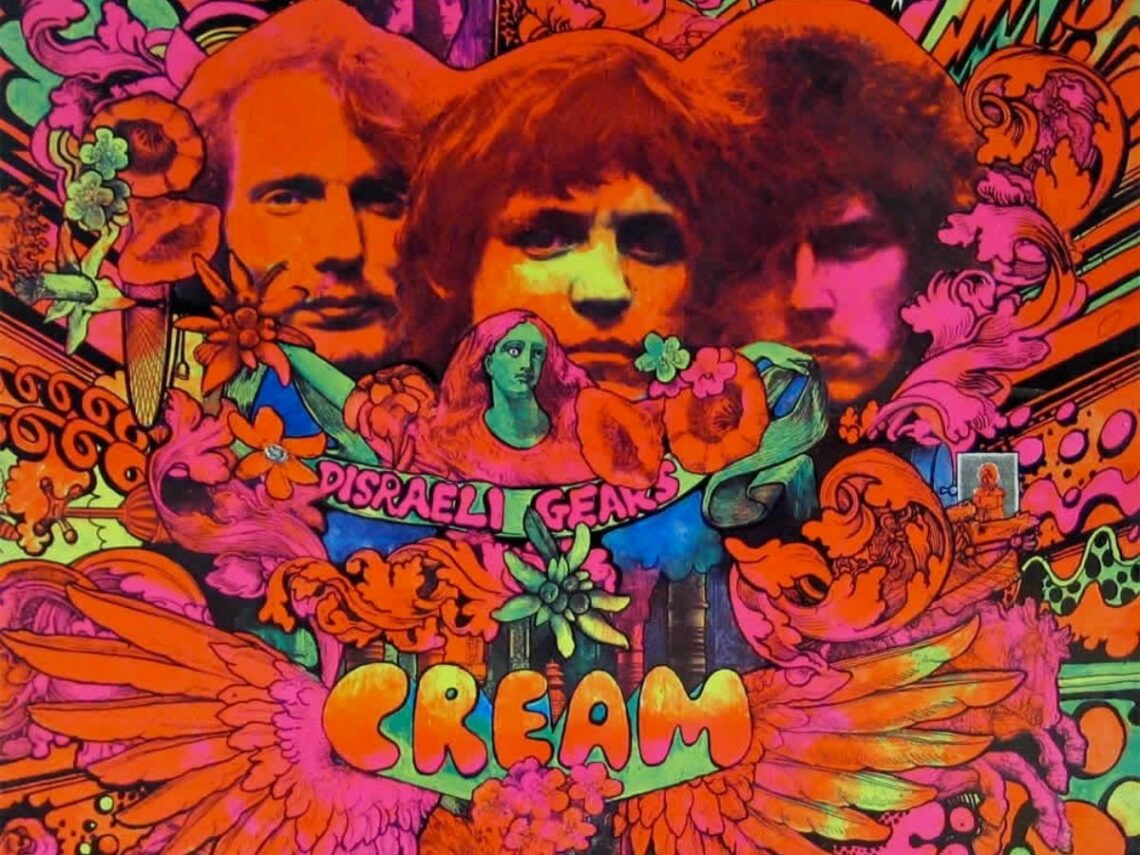
When Atlantic Records owner first heard Disraeli Gears‘ ‘Sunshine Of Your Love’, he called it “psychedelic hogwash”. The cover art conceived by Australian artist Martin Sharp was a fitting swirl of colours, a sea of pink and green flourishes adorning the heads of Cream’s Ginger Baker, Jack Bruce, and Eric Clapton.
Sharp had met Clapton in a chance encounter at the Speakeasy nightclub in 1967. He’d just written a poem inspired by the Greek tragedy Ulysses, its lyrics written loosely to the melody of Leonard Cohen’s ‘Suzanne’. Clapton was looking to make a song inspired by the Lovin’ Spoonful’s ‘Summer in the City’, so he got Sharp to scribble the words on a napkin. Two weeks later, ‘Tales of Brave Ulysses’ was completed.
Clapton promptly moved Sharp into a studio apartment in London and enlisted him to create the album artwork. “Originally, Robert Whitaker took some photos from one of their tours,” Sharp told Classic Rock. Whitaker had previously shot The Beatles, famously producing the vaguely horrifying butcher photo for ‘Paperback Writer‘, and his photos were used for the back cover instead.
Sharp got some of the publicity shots of the band and cut them up alongside collaged cut-outs from books, arranging them on a 12-inch square. “I did some drawing outlines, and then painted all over it with fluorescent inks and paints of the time,” he recalled. “I really wanted to capture that warm electric sound of their music in the colours and expression of the cover.”
The sound Sharp was capturing marked a quite pronounced pivot from Cream’s blues roots, which were far more evident on Fresh Cream. While it could still be felt in Bruce’s seismic bass, Clapton ramped up his use of wah-wah pedals, which combined with Sharp’s poetry, creating a glittering blend of blues rock with the lyrical lightness of psychedelia.
Sharp also unwittingly captured what was said to be their most democratically recorded albums, with Bruce’s vocals slightly less pronounced. While they went the way of most supergroups and broke up in 1968 after a battle of egos, this album featured a more equal share of vocals, with Clapton on lead for ‘Outside Woman Blues’ and ‘Strange Brew’, Baker on lead for ‘Blue Condition’. This sense of harmony is reflected on the album cover, them all side by side, equal in size as they float in a sea of fuchsia.
While that was a coincidental reflection of the band’s emotional world, Sharp had looked elsewhere for explicit inspiration for the cover art, the majority of which came to him on a trip to Cambodia. “On my way to England I’d gone there,” he explained, “and in one of the towns I visited there were these amazing sculptures with faces on each side, and huge trees growing out on top of these sculptures.”
He saw that over the years, roots had overtaken the sculptures, and thought that looked like a cartoon imagining of the band at work, “where you could see three of their faces, and the music coming out of their heads”. The artwork remains one of the most fitting covers to come out of the psychedelic era, capturing not only its usual flowery motifs and eclectic palette, but the wider cultural shift of music towards the hallucinogenic sounds of psych.
